
The Constitution is fairly clear about who holds the core powers that authorize war, and much less explicit about who gets to run a modern military campaign once force begins. That tension is why each new flare-up involving Iran triggers the same question: can a president keep using military force without a fresh vote from Congress?
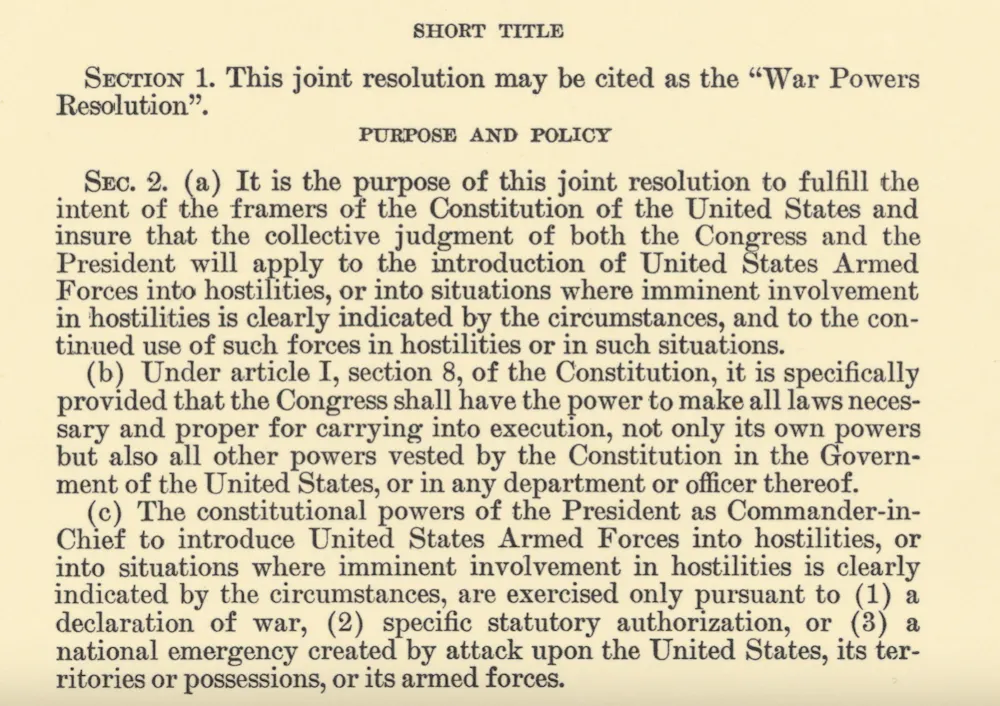
In the background is a 1973 law that tried to force clarity onto a system that often runs on ambiguity: the War Powers Resolution. It is the statute behind today’s headlines about Congress voting to rein in presidential action beyond a 60-day threshold.

Join the Discussion
The Constitution’s split: Congress authorizes, the president commands
Start with the text. Article I gives Congress the power to declare war, raise and support armies, provide and maintain a navy, and make rules for the armed forces. It also controls the purse, meaning it funds military operations and can refuse to fund them.
Article II names the president “Commander in Chief” of the armed forces. That makes the president the top operational commander, but it does not explicitly grant a power to begin a war whenever he chooses.
The framers designed this split on purpose. They wanted speed and unity in command once force was authorized, but they did not want one person to be able to commit the nation to war by personal will.
What the War Powers Resolution tries to do
The War Powers Resolution (often called the War Powers Act) was Congress’s attempt to put guardrails around unilateral presidential military action, especially after the long Vietnam era. It does three central things:
- Reporting: It requires the president to submit a written report to Congress within 48 hours after introducing U.S. forces into hostilities or situations where hostilities are imminent.
- Consultation: It says the president should consult with Congress “in every possible instance” before introducing forces into hostilities, and continue consulting afterward. In practice, what counts as meaningful “consultation” is frequently disputed.
- A clock: It creates the famous 60-day limit for using forces in hostilities without congressional authorization, with a narrow additional window tied to withdrawal.
Notice what the statute is not. It is not a constitutional amendment. It is a law passed by Congress, meant to bind the executive branch under Congress’s Article I authority. And that is exactly why it has been contested ever since by administrations of both parties.
The 60-day rule as a timeline
The War Powers Resolution’s core enforcement mechanism is time. Here is the simplified structure, with one key legal nuance noted:
- Day 0: U.S. forces are introduced into hostilities (or situations where hostilities are imminent).
- Within 48 hours: The president must submit a written report to Congress describing what is happening and the asserted legal authority.
- The trigger nuance: The termination clock is tied to a report that is submitted (or required to be submitted) under the Resolution’s reporting provision. The statute is designed to prevent the clock from being avoided simply by declining to file.
- By Day 60: The president must terminate the use of U.S. armed forces unless Congress has either (a) declared war, (b) passed a specific authorization, or (c) extended the period.
- Extra time: The statute also contemplates up to an additional 30 days if needed for the safe withdrawal of forces.
That is the headline version. The real fight is over the trigger phrase: “hostilities.” If an administration argues that a particular operation is not “hostilities” in the statutory sense, it argues the 60-day clock never started.
One often-cited example is the Obama administration’s position during the 2011 Libya operation, where it argued that certain U.S. activities did not rise to “hostilities” as the Resolution uses that term, even though U.S. forces were involved in a real conflict environment. Whether you agree or not, that dispute shows how much turns on the definition.
Can a president keep going past 60 days?
Legally, under the War Powers Resolution as written, the president is supposed to stop using force after the deadline unless Congress authorizes it. In practice, presidents of both parties have often treated the Resolution as something they can comply with procedurally while disputing its force.
There are a few recurring ways administrations justify continued action without a new vote:
- Arguing the operation is not “hostilities”: For example, the U.S. may be providing support, intelligence, refueling, air defense, or limited strikes, and the administration claims the level of risk and exchange of fire does not meet the statutory threshold.
- Relying on existing authorizations: Presidents sometimes point to older Authorizations for Use of Military Force (AUMFs) and argue the current mission fits within them, even if Congress did not have today’s specific conflict in mind when it passed them. A common example is the way post-9/11 authorizations have been cited for later operations against evolving groups and threats across multiple countries.
- Invoking inherent Article II power for limited uses of force: Administrations routinely argue the Commander in Chief can act to protect U.S. forces and U.S. persons, repel sudden attacks, or respond quickly to imminent threats, at least for short and limited engagements. The controversy begins when “limited” starts to look like an ongoing campaign.
The system then becomes less about one clean legal answer and more about an institutional contest: Congress asserts its Article I role, the president asserts operational necessity, and courts frequently decline to resolve the underlying separation-of-powers question.
What counts as Congress authorizing force?
Under the War Powers Resolution, the cleanest form of authorization is a statute that specifically approves the use of force against a particular country, group, or in a particular theater. That is what people usually mean by an AUMF.
A declaration of war also qualifies, though modern Congresses almost never use that formal label.
The harder question is whether other forms of congressional action count. Can funding the military generally be treated as permission? The War Powers Resolution tried to avoid that implication by stating that authorization should not be inferred from appropriations alone unless Congress makes the intent clear.
In real life, though, appropriations can become the strongest signal Congress sends. If Congress continues to fund an operation that everyone knows is ongoing, that can function politically like authorization even if Congress insists it is not.
What a war powers vote in Congress does
When you see headlines about the House or Senate passing a “war powers resolution,” it can mean a few different procedural vehicles. The general goal is to force a vote on whether U.S. forces should be removed from certain hostilities or to limit the scope or duration of involvement.
Two practical realities matter:
- A measure usually has to become law to bind the president in the usual way. That typically means both chambers pass it and the president signs it, or Congress overrides a veto.
- There is an important Chadha wrinkle. The 1973 War Powers Resolution originally included a “legislative veto” style mechanism (in effect, action by Congress without going through presentment to the president). After INS v. Chadha (1983), that kind of concurrent-resolution shortcut is widely considered constitutionally dubious, so modern war powers efforts are typically structured to work through ordinary legislation or through funding restrictions.
- Even when Congress passes a directive, enforcement is hard. Congress can litigate, but courts often treat these disputes as political questions or find that individual members lack standing. That pushes the fight back into politics: votes, public pressure, and funding.
So a war powers vote is not meaningless, but it is not self-executing either. Durable constraints usually come from sustained majorities, veto-proof legislation, or money.
Why courts rarely settle war powers fights
If this seems like the kind of dispute the Supreme Court should resolve, you are not wrong. But war powers cases frequently die before courts reach a final ruling on the merits of who has the better constitutional argument.
Common judicial off-ramps include:
- Standing: Who, exactly, is injured in a way that allows them to sue? Individual lawmakers often fail this test.
- Political question doctrine: Courts sometimes say the Constitution commits the dispute to the political branches rather than the judiciary.
- Mootness: By the time litigation moves, the operation has changed, ended, or been superseded by new facts.
There have been merits-adjacent rulings and pointed judicial observations along the way, but the overall pattern is that courts usually avoid becoming the primary referee. The result is that war powers law is shaped as much by practice between the branches as by definitive court opinions.

Iran makes the friction worse
Iran is a recurring stress test because it sits at the intersection of short-notice threats, regional proxy conflicts, and questions about what counts as self-defense versus escalation. A limited strike can quickly become a cycle of retaliation, and “limited” is a word that tends to shrink as events move fast.
That is precisely the scenario the framers worried about: momentum. Once forces are engaged, the political cost of withdrawal rises, and the president’s control of information and operational tempo can outpace Congress’s ability to deliberate.
What Congress can do if it wants to stop a conflict
If Congress wants to do more than signal disapproval, it has tools that bite:
- Pass a specific AUMF with limits: Congress can authorize force but restrict geography, targets, tactics, reporting, and sunset dates.
- Repeal or narrow older authorizations: If an administration is relying on prior AUMFs, Congress can revoke or clarify them.
- Use the power of the purse: Congress can cut off funding for particular operations, restrict funds to defensive actions, or require affirmative votes for continuation.
- Oversight: Hearings, subpoenas, and mandatory reporting can force the executive branch to justify its legal theory and disclose facts Congress needs to legislate.
Each of these requires sustained majorities. The separation of powers is not a single lever. It is a set of weights, and Congress has to keep its hand on the scale.
FAQ
Does the Constitution require Congress to approve any military action?
No clause says, in so many words, “the president may never use force without prior approval.” But Article I gives Congress the war-declaring and war-funding powers, and the overall structure assumes Congress decides when the nation commits to war as a sustained national project. The hard part is drawing the line between a short, limited use of force and a war in the constitutional sense.
Is the War Powers Resolution constitutional?
Congress says yes, grounded in its Article I powers. Presidents have often said parts of it intrude on Article II commander-in-chief authority. Because courts rarely reach the merits in a definitive way, the answer in practice remains contested, which is why enforcement tends to be political and financial rather than purely judicial.
What happens if the president ignores the 60-day limit?
Nothing automatically happens like a buzzer going off. Congress has to respond using legislation, funding restrictions, or sustained oversight. If Congress cannot unite to act, the president’s operation often continues.
Can Congress stop action in Iran with one House vote?
A single chamber vote can be an important signal, but binding limits generally require legislation that clears both chambers and either gets signed or survives a veto override. The most durable constraint tends to be appropriations language that restricts money for specific military actions.
The deeper civics lesson
The Constitution did not create a simple war powers on switch for Congress and an off switch for the president. It created a system where the nation’s decision to commit to war requires democratic buy-in, and the execution of military action requires speed, secrecy, and control.
The War Powers Resolution is Congress’s attempt to keep those two truths in the same room. The 60-day clock is not just a deadline. It is a constitutional argument in the form of a calendar: if this is real war, Congress must own it.