When a war powers vote hits the Senate floor during a live foreign policy standoff, the public question is predictable: can Congress actually make a President stop?
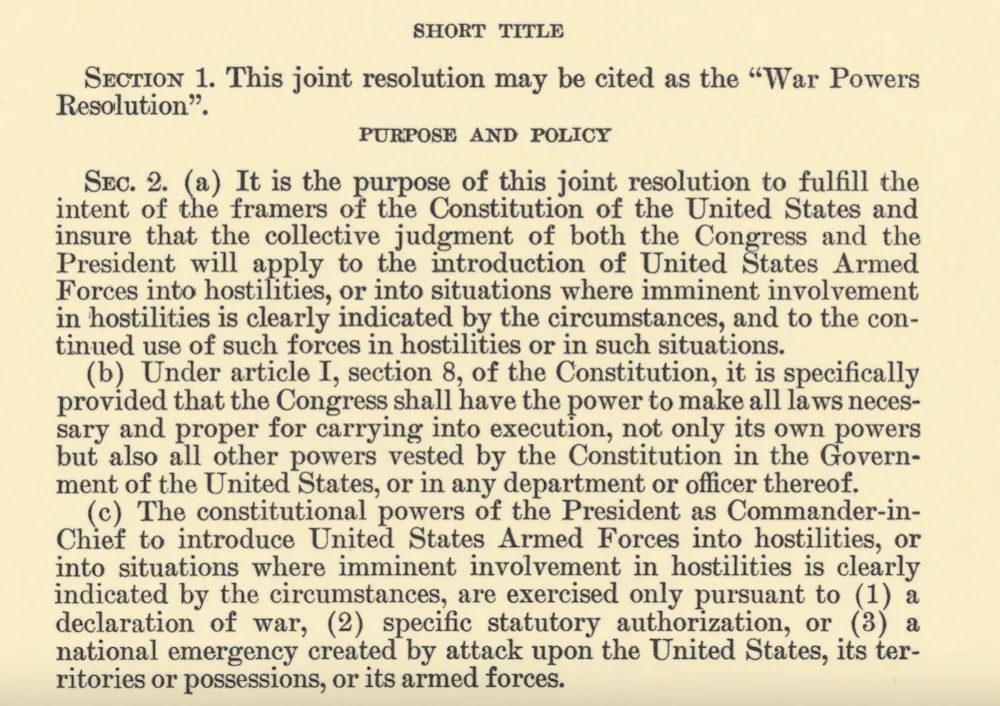
The legal answer is less satisfying, but more important. The Constitution splits war authority between two branches on purpose, and the War Powers Resolution of 1973 is Congress’s attempt to police that split after repeated episodes of Presidents initiating significant military operations without a formal declaration of war.
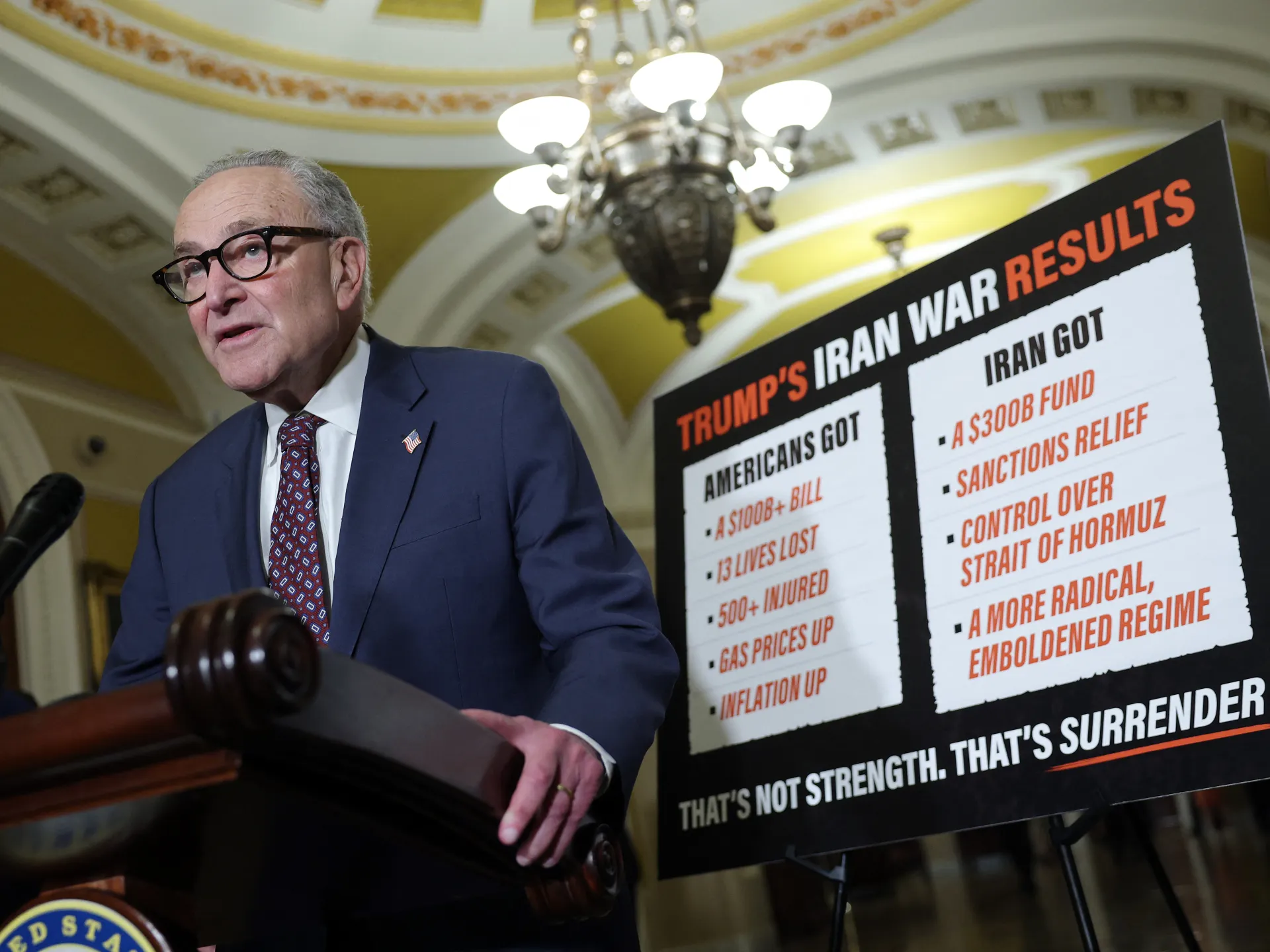
Today’s spike in searches follows a presidential post criticizing a Senate War Powers vote tied to Iran, and accusing lawmakers of giving “aid and comfort” to an enemy. That language is constitutional. It is also widely misunderstood.
Join the Discussion
War power: the Constitution’s split
The Constitution does not hand the “war power” to one branch. It divides it.
Congress’s powers (Article I)
- Declare War (Article I, Section 8)
- Raise and support armies and provide and maintain a navy
- Make rules for the armed forces
- Control funding through appropriations
- Regulate foreign commerce and related national security tools
The President’s powers (Article II)
- Commander in Chief of the armed forces (Article II, Section 2)
- Responsible for conducting military operations and responding to emergencies
- Leads diplomacy and, through the executive branch, implements national security policy
That division creates an unavoidable tension. Congress can authorize, structure, and fund war. The President can direct the military and respond rapidly.
The fight is usually over the gray zone in between: limited strikes, “advisers,” naval deployments, air campaigns, and retaliatory actions that do not come with the political label “war,” but carry many of the practical realities of one.
What the War Powers Resolution is
People often call it the “War Powers Act,” but the law is formally the War Powers Resolution of 1973. Congress passed it over President Nixon’s veto, with Vietnam as the backdrop and executive power as the target.
The Resolution is not a constitutional amendment. It is a statute. That matters because the core dispute is whether Congress can, by statute, constrain what the Commander in Chief can do as a matter of constitutional power.
Still, the Resolution has become the main framework Congress invokes when it wants to force a confrontation over military action.
The Resolution’s key requirements
1) Consultation
The Resolution says the President should consult with Congress “in every possible instance” before introducing U.S. forces into hostilities or situations where hostilities are imminent.
In practice, “consultation” is the most ambiguous part. Presidents often argue that classified briefings satisfy it. Many members of Congress argue that notification is not consultation.
2) The 48-hour report
When U.S. forces are introduced into hostilities, imminent hostilities, or certain foreign deployments, the President must submit a report to Congress within 48 hours explaining the circumstances, the constitutional and legal authority, and the expected scope and duration.
These reports often become public in some form, but significant details can be classified. Administrations have also sometimes filed reports “consistent with” the Resolution rather than “pursuant to” it, a phrasing fight that signals a broader disagreement about whether the law is being triggered.
3) The clock: 60 days, plus a 30-day withdrawal period
The most famous feature is the time limit. If U.S. forces are in hostilities (or imminent hostilities) without congressional authorization, the President must terminate the use of forces within 60 days, with a possible additional 30 days to withdraw safely.
Presidents frequently argue that particular operations do not qualify as “hostilities,” or that existing statutes already authorize the action. Those two arguments are how the clock is often avoided. The debate over Libya in 2011 is a frequently cited example of how narrowly “hostilities” can be interpreted in practice.
What a Senate war powers vote does
A “War Powers” vote can describe a few different things, and the labels can be misleading.
- One-chamber statements of position (for example, a simple Senate resolution) that are politically meaningful but not binding law.
- A joint resolution aimed at directing a withdrawal or limiting hostilities. To be legally binding, it generally must pass both chambers and be presented to the President for signature or veto.
- A separate statute that authorizes, limits, or prohibits certain military actions, again requiring passage by both chambers and presentment.
One technical but important detail: the War Powers Resolution originally contemplated a fast-track “concurrent resolution” mechanism to direct removal. After INS v. Chadha (1983), legislative veto style tools are widely understood to be unconstitutional because they bypass presentment. That is why modern War Powers efforts are typically structured as joint resolutions or as funding restrictions.
Here is the key civics point: a Senate vote by itself does not change the law. For Congress to legally compel a President, it generally must pass legislation that also passes the House and either is signed by the President or enacted over a veto.
That is why many war powers votes are described, fairly, as “symbolic.” Not because they are meaningless politically, but because the Constitution’s lawmaking process is designed to make unilateral congressional commands hard to issue in real time.
Can Congress stop military action?
Yes, but only through tools that survive the Constitution’s separation of powers.
What Congress can do
- Refuse to authorize a new use of force.
- Cut off or limit funding for a specific operation. This is Congress’s most direct leverage, though it is politically difficult because it can be framed as abandoning troops already engaged.
- Pass a binding statute restricting or ending a military operation, and override a veto if it has the votes.
- Conduct oversight through hearings, subpoenas, classified briefings, and reporting requirements.
- Impeach and remove in extreme cases, though that is a political process, not a fast operational one.
What Congress cannot do easily
- Command the military directly. Congress cannot pick targets, plan operations, or issue battlefield orders. Those are Commander in Chief functions.
- End an operation with one chamber acting alone. A single-house resolution is generally not binding law.
- Count on courts to settle it quickly. War powers cases often fail on standing, ripeness, or political question grounds. Courts tend to avoid becoming referees of live military disputes.
The practical reality is that Congress’s most effective war powers tool is not a resolution. It is an appropriation with conditions.
How force is authorized in practice
In modern practice, Congress most often authorizes or sustains military action through:
- Specific authorizations (AUMFs), such as the 2001 and 2002 AUMFs, which have been cited well beyond their original contexts.
- Defense and appropriations laws that fund operations and can include limits, reporting rules, and conditions.
That is also why debates over repealing, narrowing, or replacing older AUMFs matter. Old authorizations can become the legal bridge that turns a new crisis into an extension of a prior conflict.
What Presidents argue in response
Modern Presidents of both parties have typically taken some version of these positions:
- Article II permits limited uses of force to protect U.S. personnel, repel attacks, rescue Americans abroad, and serve national interests without waiting for Congress.
- Some operations are not “war” in the constitutional sense, and may not even be “hostilities” under the Resolution.
- Existing authorizations cover new actions. The most prominent are the 2001 and 2002 AUMFs.
This is why war powers debates often feel like two sides arguing past each other. Congress talks about authorization. The executive talks about operational necessity and existing authority.
Does the Resolution “work”?
It depends on what you mean by “work.”
- As a reporting and transparency tool, it has some effect. The 48-hour report requirement can create a paper trail and force legal justifications into the record, even when key facts remain classified.
- As a hard stop, it is weaker. Presidents can dispute whether the law applies, argue that a statute already authorizes the action, or run out the clock while Congress lacks veto-proof majorities.
- As a political forcing mechanism, it is real. A War Powers vote can change incentives, shape negotiation narratives, and signal where Congress may go next on funding or authorization.
One more complication belongs upfront: the Resolution’s constitutionality and enforceability are contested, and courts rarely reach the merits of live war powers fights. In practice, the Resolution often matters most as a political lever and an organizing framework for Congress, not as a clean, court-enforced command.
The Resolution was designed to pull Congress back into the decision to sustain hostilities. It has not reliably prevented the initial use of force, which is often the moment Congress most wants leverage.
“Aid and comfort”: what it means
The phrase “aid and comfort” comes from the Constitution’s definition of treason, not from general political rhetoric.
Article III, Section 3 says: “Treason against the United States, shall consist only in levying War against them, or in adhering to their Enemies, giving them Aid and Comfort.”
Three guardrails the Constitution builds in
- Treason is narrowly defined. The Framers feared treason accusations being used as a political weapon, as they had been in England.
- High proof is required. Conviction requires two witnesses to the same overt act or a confession in open court.
- “Enemies” is a wartime concept. In constitutional law, the term is generally tied to entities the United States is in a declared war with or otherwise in a legally recognized state of war or armed conflict with, not simply adversaries in diplomacy.
That does not mean speech cannot be reckless or damaging. It means that calling a congressional vote “treason” is almost always a rhetorical move, not a description that matches the Constitution’s legal elements.
Members of Congress also have broad speech protections under the Speech or Debate Clause (Article I, Section 6) for legislative acts. That clause exists for the same basic reason treason is narrowly defined: the system is designed to allow sharp disagreement inside government without treating it as criminal disloyalty.
Why a war powers vote still matters
Even when a War Powers measure does not become binding law, it can have real downstream effects:
- It clarifies congressional consent or dissent. That matters for future authorizations and for funding fights.
- It shapes the record. A clear record of congressional opposition can matter for oversight, internal executive branch lawyering, and related litigation.
- It shapes alliances and negotiations. Foreign governments track U.S. domestic constraints, including whether a President can sustain military action politically and financially.
- It sets up the next step. A failed or partial vote today can become a funding restriction or authorization rewrite tomorrow.
The takeaway
If you are looking for a single sentence summary, here it is: the President can often start military action quickly, but Congress holds the strongest tools to sustain, expand, or end it.
The War Powers Resolution is Congress’s attempt to force that second part of the sentence to be true in practice, not just on paper. Whether it succeeds in any given moment depends less on constitutional theory and more on political alignment, veto-proof majorities, and whether Congress is willing to use the power it always has, the power of the purse.
And as for “aid and comfort,” the Constitution treats treason as a tightly fenced category, not a catch-all insult for hard votes at hard moments. That fence is there because the republic is supposed to survive disagreement, including disagreement about war.