
When a presidential administration threatens to withhold federal funding from a public school district over transgender student policies, it hits a raw nerve in American government: public schools are mostly local, but federal dollars are real leverage. The question is not only political. It is constitutional.
This article uses a recent, widely reported funding-threat scenario involving a Kansas City area school district as the example. Because there are multiple districts with “Kansas City” in the name and federal actions can range from an OCR inquiry to a formal termination proceeding, the first thing to do in any real case is identify the specifics: which district (Kansas or Missouri), what federal office is acting (typically the Department of Education’s Office for Civil Rights), and what document is on the table (a complaint, a notice of investigation, a proposed finding, or a termination notice).
The underlying issue is familiar: can the federal government use Title IX to pressure districts on policies involving transgender students, including bathrooms, pronouns, or athletics? And if it can, what does the Constitution require before federal money can actually be cut off?
The short civic answer is this: yes, Congress can attach conditions to federal education funds, and agencies can enforce those conditions. But the power is not unlimited. It runs through Title IX’s text, the Spending Clause, and a set of Supreme Court guardrails designed to prevent “funding conditions” from becoming federal commands in practice.

Join the Discussion
The hook: the Spending Clause
The federal government does not run your local public school system. States and school districts do. That is why most education law, funding formulas, curriculum fights, and staffing decisions are state and local battles.
But Congress has one extremely practical tool: money. Article I, Section 8 gives Congress power to tax and spend for the “general Welfare.” That Spending Clause authority is the foundation for the modern system where Washington sends funds to states and districts and conditions that money on compliance with federal requirements.
This is not a magic workaround for every federal goal. It is a constitutionally recognized form of leverage, constrained by the same Supreme Court doctrines that limit federal coercion and protect state choice.
The catch: conditions have limits
The Supreme Court has repeatedly said that spending conditions must operate like a genuine bargain, not a trap. The key limits, drawn from cases like South Dakota v. Dole (1987) and sharpened in NFIB v. Sebelius (2012), are usually summarized like this:
- Clear notice: Recipients must be able to understand the conditions up front. If the government wants to attach a major requirement to money, it must say so clearly.
- Relatedness: The condition should relate to the federal interest in the program being funded. In practice, courts have often been fairly deferential on this factor.
- No independent constitutional violations: The condition cannot require states or districts to do something unconstitutional.
- No coercion: At some point, the “offer” becomes a financial gun to the head. When a threatened loss is so large that the recipient has no real choice, the Court may treat it as unconstitutional coercion.
Those limits matter because “we will cut your funding” is not a single action; it triggers a legal pathway that has to fit these rules.
Where Title IX fits
Title IX of the Education Amendments of 1972 is a spending-condition statute. Its core promise is simple: if an educational institution receives federal financial assistance, it cannot discriminate “on the basis of sex.”
That structure is why Title IX shows up in funding threats. If a district takes federal money, it accepts Title IX’s nondiscrimination condition. The hard part is what “on the basis of sex” means in modern disputes involving transgender students, and what remedies the federal government can pursue when it believes a district is out of compliance.
To make the stakes concrete, “federal education money” often means large, familiar streams such as Title I aid for low-income students, IDEA special education funds, and federally supported school meals and related programs. Not every dispute puts every dollar at risk, and that distinction can be outcome-determinative.
Sex, gender identity, and the courts
In recent years, the legal meaning of sex discrimination has been heavily influenced by Bostock v. Clayton County (2020), a Title VII employment case holding that firing someone for being transgender (or gay) is discrimination “because of sex.”
Bostock is not itself a Title IX decision, but it has been used by litigants and lower courts to argue that Title IX’s sex discrimination language should be read similarly in the education context. Other courts have distinguished the two statutes or treated certain school contexts, especially athletics and privacy concerns, as materially different.
So when an administration says it will enforce Title IX against a district’s transgender policies, the legal fight often becomes a two-layer question:
- Statutory meaning: Does Title IX, properly read, cover the policy at issue as sex discrimination?
- Agency authority: Even if Title IX can reach the issue, did the Department of Education implement its view through valid regulations and lawful procedures?
A third, practical layer often follows: even if the agency’s interpretation ultimately prevails, did the district have clear notice at the time it accepted funds, especially when regulatory approaches change from one administration to the next?
Can funding be cut quickly?
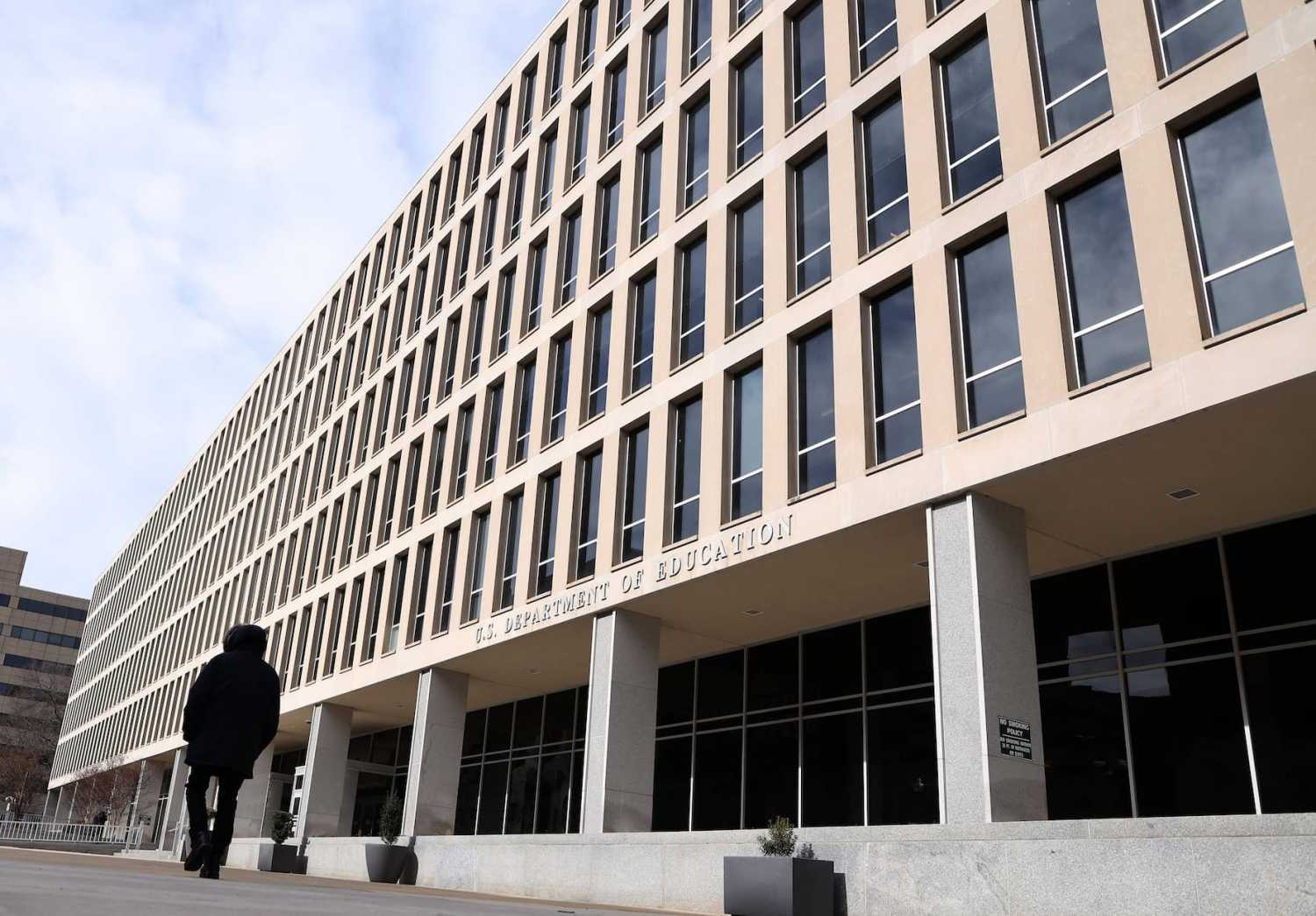
Headline threats often sound immediate. In practice, cutting off education funds is procedurally and politically difficult, and outright termination is rare compared with investigations, negotiated resolution agreements, or targeted compliance remedies.
1) Title IX enforcement has formal steps
Title IX enforcement typically runs through the Department of Education’s Office for Civil Rights (OCR). OCR can investigate complaints, request information, attempt voluntary compliance, and negotiate resolution agreements.
Terminating federal financial assistance is treated as a last resort. Under Title IX’s enforcement structure and implementing regulations, a cutoff generally requires notice and an opportunity for a hearing before funds can be terminated. In addition, fund termination decisions are typically routed through formal agency processes and may require reporting to Congress, mirroring the broader civil-rights funding-termination architecture used across federal assistance programs.
Agencies that shortcut procedure invite lawsuits that can pause enforcement through injunctions.
2) Program-specific versus institution-wide cutoffs
Another practical and legal distinction is what money is threatened. A narrow, program-specific consequence is usually easier to defend than an institution-wide cutoff that effectively risks large portions of a district’s operating budget.
This matters not only as policy, but as constitutional posture. The larger and more essential the threatened loss, the more plausible a Spending Clause coercion argument becomes.
3) Big penalties can raise Spending Clause coercion claims
Even if an agency has a valid Title IX theory, the size of the threatened penalty matters. The more money at stake, the more a district can argue the threat is coercive under the logic the Court used in NFIB v. Sebelius, where the justices rejected a structure that would have put a very large portion of state budgets at risk if states refused to expand Medicaid.
Education funding is not identical to Medicaid, but the constitutional intuition is similar: at some point, a condition stops being meaningfully voluntary.
4) Courts can freeze enforcement while meaning is litigated
Because the core dispute often turns on how Title IX should be interpreted, funding threats can trigger immediate litigation in federal court. Districts and states often seek temporary restraining orders or preliminary injunctions to prevent funding consequences while courts decide whether the agency’s legal theory is likely correct.
Bathrooms, pronouns, and sports differ
One reason these conflicts generate so much confusion is that “transgender policy” is a bucket label. Courts treat different school settings differently because the interests and statutory hooks differ.
Bathrooms and locker rooms
Bathroom and locker room disputes often turn on how courts balance nondiscrimination principles against privacy and sex-separation traditions in schools. Some courts have read Title IX and the Equal Protection Clause to protect transgender students from exclusion; others have emphasized statutory and regulatory allowances for sex-separated facilities.
Names and pronouns
Pronoun policies can raise Title IX questions, but they also sometimes trigger First Amendment claims by staff members who argue compelled speech or religious burdens. Even when a policy is framed as nondiscrimination, courts may analyze it through multiple constitutional lenses at once.
Athletics
Sports are currently the hottest and most legally unsettled zone because Title IX has long been understood to permit sex-separated teams in many contexts, and because competitive fairness and physical differences are central to how many athletic programs are structured.
That means an administration’s attempt to tie funding to transgender athletic eligibility rules can run into a uniquely dense thicket: Title IX’s statutory text, long-standing regulations, newer rulemaking efforts, and a rapidly evolving body of litigation.
Federal versus local control
There is a persistent misconception that the federal government has a general constitutional authority over education. It does not. Education is not an enumerated federal power, and the Supreme Court has also said education is not a fundamental right under the federal Constitution. Those facts push education governance toward states.
But the same constitutional framework also allows Congress to spend and to attach conditions to spending. That is how Washington influences local schools without running them.
This is why funding threats feel like federal control even when they are formally “voluntary.” If a district cannot realistically refuse the money, the constitutional debate shifts from “local control” as a slogan to coercion as a legal standard.
Equal Protection behind the statute
Title IX is a statute. The Equal Protection Clause of the Fourteenth Amendment is constitutional law. They often travel together, but they are not interchangeable.
Equal protection claims arise when state actors, including public school districts, classify or treat students differently. The Supreme Court applies heightened scrutiny to sex-based classifications (often described as intermediate scrutiny). The unresolved question in many transgender student cases is whether and how that framework applies to gender identity classifications, and what level of scrutiny should be used.
For maximum real-world precision, many lower courts have applied heightened scrutiny in transgender classification cases, but the approach is not uniform nationwide, and the Supreme Court has not issued a single definitive rule that resolves every context.
What to watch in a real dispute
If you are trying to understand whether a funding threat is legally durable or mostly rhetorical, these are the questions that usually determine the outcome:
- Which district and which document? Look for a dated OCR notice of investigation, a letter of findings, a proposed resolution agreement, or a formal notice proposing fund termination.
- What funds are actually at stake? A narrow program-specific consequence is easier to defend than a sweeping cutoff.
- What is the precise policy being challenged? “Transgender policy” is not one thing, and different policies trigger different legal doctrines.
- Is the agency relying on a regulation, guidance, or a new rule? Courts treat binding rules differently than informal guidance, and regulatory volatility can complicate the “clear notice” analysis.
- Was the district given clear notice? The clearer the statutory and regulatory warning, the stronger the Spending Clause case for enforcement.
- Will a court grant an injunction? Many of these disputes turn on early emergency rulings that freeze the status quo while the merits are litigated.
The most important point is also the least satisfying: the federal government’s ability to pressure schools is real, but the legality of any specific threat depends on the statutory theory, the procedures followed, and the size and structure of the penalty.
The civics takeaway
Funding fights like this are not just cultural flashpoints. They are stress tests for a quiet constitutional bargain that runs through modern American life: Washington writes checks, and the checks come with conditions.
The Spending Clause makes that possible. Title IX is one of the conditions. And the courts serve as the referee when “conditions” start to look like commands, when agencies stretch statutory language beyond what recipients could reasonably anticipate, or when the threatened penalty becomes too big to be meaningfully voluntary.
That is why these disputes keep returning, administration after administration. They sit at the intersection of money, civil rights statutes, and a Constitution that never mentions public education at all, but still shapes who gets to set the rules.