
The federal government writes rules that touch everyday life: what counts as “overtime,” what a “clean” tailpipe means, which medicines can be marketed, and how student loans can be collected. Most of those rules are not written by Congress line-by-line. They are written by agencies.
The Administrative Procedure Act of 1946, usually called the APA, is the basic statute that tells agencies how to do that lawmaking-like work, and it tells courts how to police it. If you have ever heard that a regulation was “struck down as arbitrary and capricious,” or that an agency “failed to follow notice-and-comment,” you are hearing the APA in action.
Join the Discussion
What the APA is
The APA is Congress’s default instruction manual for federal agencies. It sets baseline procedures for rulemaking and adjudication, requires agencies to explain themselves, and provides a framework for court review of whether an agency stayed within the law and engaged in reasoned decisionmaking.
It is not the only manual. Many agencies also operate under “organic” statutes that add extra steps or special standards. But when those statutes are silent, the APA is the floor.
Why the APA exists
By the early twentieth century, Congress had created a growing “administrative state” of specialized agencies. The problem was not specialization. It was legitimacy.
Agencies write binding rules that look like legislation.
Agencies enforce those rules like an executive branch.
Agencies sometimes judge disputes like courts.
The APA was a mid-century compromise: agencies could keep doing those things, but they had to do them through published procedures, and they had to be answerable in court.
Two buckets: rules and cases
The APA divides much of agency action into two procedural worlds.
Rulemaking
Rulemaking is forward-looking and generally applicable. It is how an agency creates a regulation that will govern a category of people or conduct.
Adjudication
Adjudication is case-specific. It is how an agency decides that this person violated that rule, or whether this applicant qualifies for that benefit, license, or status.
In real life, the line blurs. Agencies make policy through both. The APA matters because it sets different procedural expectations for each.
With that map in mind, the most familiar APA feature is what happens when agencies make rules for everyone at once: notice-and-comment.
Notice and comment, step by step
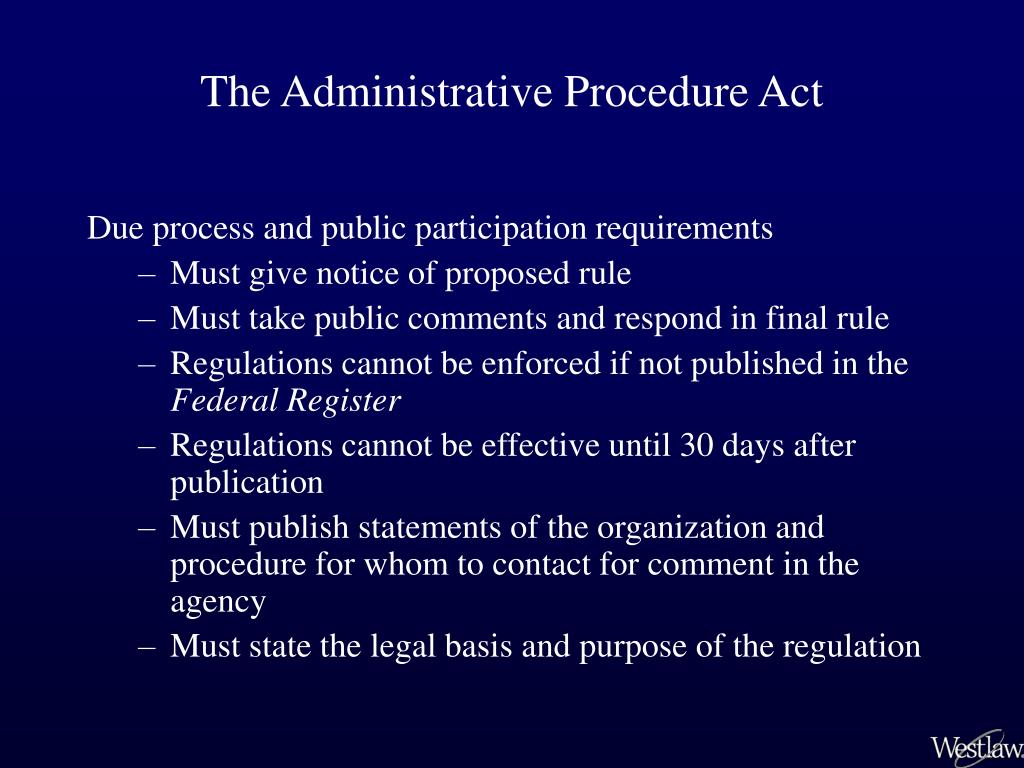
When people say “the public gets to comment on regulations,” they mean the APA’s notice-and-comment process for informal rulemaking, codified primarily in 5 U.S.C. § 553.
At a high level, it works like this.
1) Notice: the agency publishes a proposal
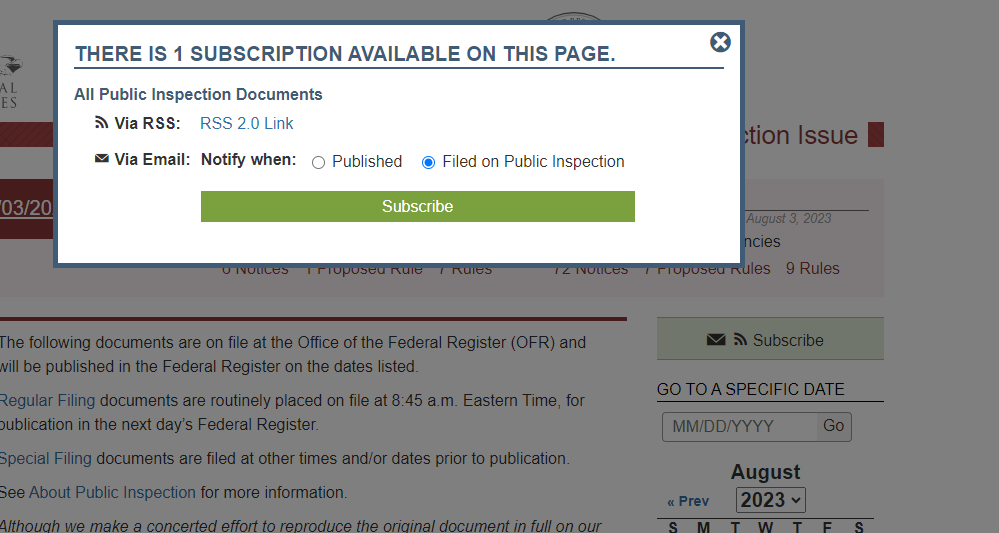
The agency issues a Notice of Proposed Rulemaking, typically in the Federal Register. The notice explains:
What the agency proposes to do
The legal authority it claims
The reasoning and evidence it relies on
How and when the public can comment
Think of the notice as the government saying: here is our draft, here is why we think we can do it, and here is the record you should respond to.
2) Comment: the public responds in writing
The APA does not require a town hall or a televised debate. It requires an opportunity to submit written comments. Those comments can come from:
Individual citizens
State and local governments
Regulated businesses and industry groups
Labor unions and nonprofits
Scientists, economists, and other experts
This is not a poll. A million identical comments may be politically meaningful, but what matters legally is whether commenters raise substantive issues that the agency must grapple with.
3) Response and final rule: the agency explains its choices
After reviewing the comments, the agency publishes a final rule and a “concise general statement of basis and purpose.” In practice, that statement often becomes a long preamble.
The key constraint is not that the agency must satisfy everyone. It is that the agency must respond to significant comments and show a rational connection between:
The evidence in the record
The policy choice it made
The statute it is implementing
When notice and comment is skipped
Notice-and-comment is the centerpiece, but the APA contains carveouts and shortcuts that often drive litigation.
Interpretive rules and policy statements
Agencies often issue guidance that claims to interpret existing law rather than create new obligations. These documents can influence behavior without being “legislative rules.” The line is contested, and courts sometimes treat “guidance” as an end-run around § 553.
Good cause exceptions
The APA allows an agency to skip notice-and-comment if it finds “good cause” that notice is impracticable, unnecessary, or contrary to the public interest. Courts interpret this narrowly because otherwise the exception could swallow the rule.
Other statutes add steps
Some regulatory areas require extra layers: cost-benefit analysis mandates, small business review panels, or specific deadlines and consultation requirements. The APA supplies the baseline, then other laws stack on top.
Adjudication under the APA
Many agency disputes look like courtroom proceedings: witnesses, evidence, cross-examination, and written decisions. The APA distinguishes between two broad forms.
Formal adjudication
When a statute requires a decision “on the record after opportunity for an agency hearing,” the APA’s formal adjudication provisions kick in. These cases are typically overseen by an administrative law judge (ALJ), with separation between prosecutors and decisionmakers inside the agency.
Informal adjudication
Much agency decisionmaking is less trial-like: benefit determinations, licensing decisions, immigration decisions in certain contexts, and enforcement settlements. The APA still imposes important guardrails, but the procedures can be thinner depending on the statute and due process requirements.
The constitutional backdrop matters here. Even when the APA sets a minimum, the Fifth Amendment’s due process clause can require more process when the government is depriving a person of life, liberty, or property.
The transparency spine: the record
Notice-and-comment and adjudication both generate a central object: the administrative record.
The record is what the agency considered and relied on. In court, that record is usually the agency’s universe. It is also a frequent battleground: parties may dispute whether the record is complete, whether material is privileged, and when a court may look beyond it in narrow circumstances.
When you hear that a court “looked to the record,” that is the APA model at work: agencies must justify decisions based on what was before them, not on post-hoc explanations invented after a lawsuit is filed.
Judicial review: how courts say no
The APA is not just about process. It also supplies a cause of action and the standards for judicial review, subject to important limits. Courts generally review only “final agency action,” and the APA itself recognizes that some matters are unreviewable when a statute precludes review or when action is committed to agency discretion by law. Practical doctrines like ripeness and exhaustion can also matter in real cases.
The most cited language is in 5 U.S.C. § 706, which tells courts to “hold unlawful and set aside” agency action that fails certain tests.
Arbitrary-and-capricious review
This is the standard people quote because it is both powerful and misunderstood.
“Arbitrary and capricious” does not mean the court dislikes the policy. It means the agency failed at reasoned decisionmaking. Courts typically ask whether the agency:
Relied on factors Congress did not intend it to consider
Failed to consider an important aspect of the problem
Offered an explanation that runs counter to the evidence
Made a decision so implausible that it cannot be ascribed to expertise
In plain terms: explain your reasoning, show your work, and stay within the lane Congress gave you. Courts may give agencies leeway on technical and evidentiary judgments under this standard, while still requiring a coherent explanation grounded in the record.
Contrary to law and beyond authority
Courts also set aside agency action that violates the Constitution, violates a statute, or exceeds the agency’s delegated power. This is where fights about “major questions” and the limits of agency authority tend to land.
Procedural failure
If the agency was required to use notice-and-comment and did not, that alone can be enough to invalidate the rule. Even then, remedies can vary. Courts may vacate the rule, remand it to the agency, or in some jurisdictions remand without vacatur when equities and practical disruption weigh against immediate nullification.
How this fits with Rulemaking 101
“Federal Rulemaking 101” explains the lifecycle of a regulation: proposal, comments, final rule, enforcement, and challenges. The APA is the statute-level skeleton underneath that story.
Rulemaking 101 is the process as a narrative. The APA is the legal requirement that the narrative follow certain chapters.
Rulemaking 101 explains what agencies do. The APA explains what agencies must do, and what can happen in court if they do not.
Rulemaking 101 highlights public participation. The APA makes that participation meaningful by forcing agencies to respond to significant comments in the final rule.
If you are trying to understand why a rule is vulnerable, you usually start with two questions the APA makes unavoidable: Did the agency follow the right procedure, and did it offer a reasoned explanation tied to the statute and the record?
What the APA does not do
The APA is often treated like a general “fairness” law. It is not. It has limits.
It does not guarantee that the public will win. It guarantees a chance to participate and a requirement that the agency respond rationally.
It does not eliminate politics. Agencies are led by political appointees. The APA channels that reality into a public record and legal constraints.
It does not make courts the policymakers. Courts do not choose the best policy option. They enforce statutory limits and the discipline of reasoned decisionmaking.
Why the APA matters
The Constitution says Congress makes laws, the President executes laws, and courts interpret laws. Administrative agencies complicate that clean separation because they do a bit of all three. The APA is one of the main ways the modern system stays tethered to constitutional values: public notice, accountable reasoning, and judicial review.
When the APA is working, it does something quietly radical. It forces power to leave fingerprints. The agency must publish, explain, and defend what it is doing. And when it cannot, a court can send it back to try again, this time on the record, in the open.
That is not red tape. It is a constitutional pressure valve for a government that has to govern at scale.