
When the Justice Department announces voting-related charges, the public reaction tends to jump straight to the biggest question: Does this mean the election system is broken?
That question is understandable, but it is usually the wrong starting point. The better place to begin is more basic and more constitutional: Who is legally allowed to vote, what exactly is being alleged, and why federal prosecutors, not just state election officials, have a role here.
Note: This explainer is written to be evergreen. If you are reading it in response to a particular DOJ press release, the most useful first step is to look for three concrete details in the source document: the announcement date, which U.S. Attorney’s Office brought the case (Eastern, Middle, or Western District of Pennsylvania), and the statutes listed in the criminal complaint or indictment. Those basics tell you what kind of conduct is being alleged and what the government has to prove.
The specifics will matter in court, and they can matter for immigration consequences. But the larger civic lesson is structural: election integrity is not one single rule enforced by one single government. It is a layered system of state-run elections, federal guardrails, and overlapping criminal laws.
Join the Discussion
What we know, and what not to assume
At this stage, what matters is the posture: charges are allegations, and the government must prove each element of each offense beyond a reasonable doubt.
Two things can be true at once in cases like this.
- Even a small number of improper ballots is still unlawful, and the law treats it seriously because elections are how power changes hands without force.
- One prosecution does not, by itself, tell you the scale of a problem. Criminal cases show what can be proven about specific defendants, not the overall prevalence of a practice.
The constitutional stakes are less about headlines and more about jurisdiction: which government can set voter qualifications, which government can prosecute, and what happens when citizenship and immigration status are part of the fact pattern.
Can noncitizens vote in Pennsylvania?
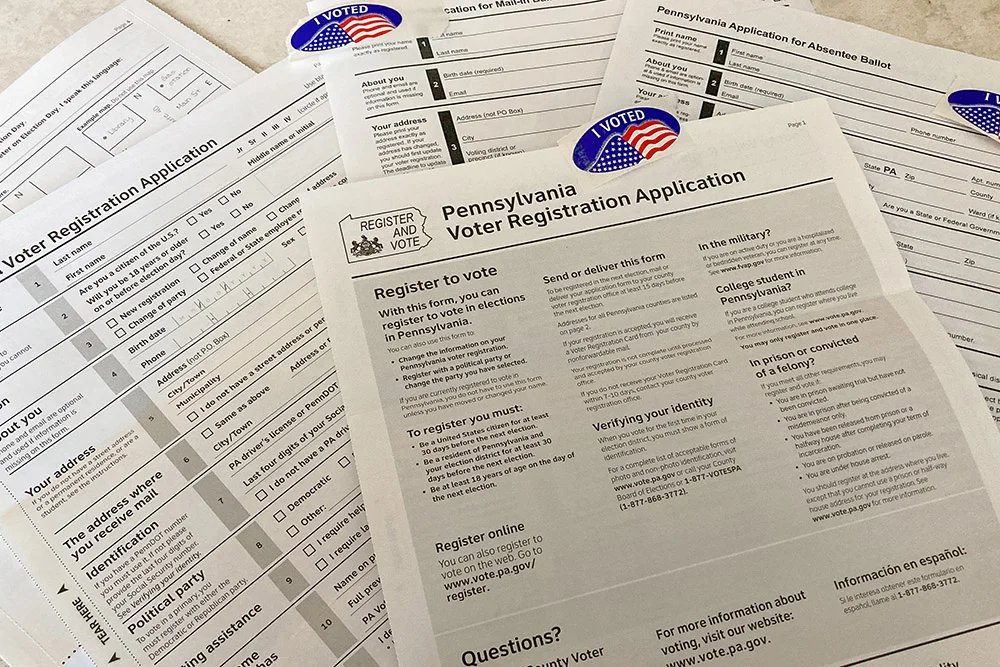
For federal elections (President, U.S. House, U.S. Senate), the answer is simple: noncitizens cannot lawfully vote. Federal law makes it a crime for a noncitizen to vote in a federal election, with limited statutory exceptions in narrow circumstances. One commonly cited statute is 18 U.S.C. § 611 (unlawful voting by aliens).
For state and local elections, the Constitution leaves voter qualifications largely to the states. Pennsylvania requires U.S. citizenship as part of voter registration eligibility, and the state’s registration application includes a citizenship eligibility statement signed under penalty of perjury. For reader verification, see the Pennsylvania Department of State’s voter registration eligibility requirements and the Pennsylvania voter registration application itself.
That is an important constitutional nuance. The U.S. Constitution does not contain a single sentence that says “only citizens may vote in every election.” Instead, it is a patchwork: states set qualifications in the first instance, and the Constitution and federal statutes limit how those qualifications can be administered and enforced.
Who sets election rules?

The Constitution’s default rule is that states run elections. Article I, Section 4 (the Elections Clause) gives state legislatures the power to set the “Times, Places and Manner” of congressional elections, while also giving Congress authority to “make or alter” those regulations.
For presidential elections, the Constitution gives states power to appoint presidential electors “in such Manner as the Legislature thereof may direct” (Article II). That is one reason election law is so often state law first, federal law second.
But state control does not mean federal absence. Federal power enters in three recurring ways:
- Federal elections are a national interest, so Congress can criminalize certain misconduct connected to them.
- Federal constitutional rights apply, including equal protection and due process rules that constrain how states administer elections.
- Federal courts enforce federal law, which is why the Justice Department can bring criminal cases when the alleged conduct fits federal statutes.
What “election fraud” can mean
“Election fraud” is not one crime. It is a public label that can cover many different offenses, depending on what a person allegedly did.
Voting-related prosecutions often turn on distinctions that sound technical but matter enormously in court:
- Registration vs. voting: Some crimes focus on the registration step, including making a false statement on a registration form, even if no ballot is later cast or counted.
- False statement vs. ineligible act: Some cases focus on a misrepresentation (for example, claiming citizenship). Others focus on the act of voting while ineligible.
- Federal vs. state contest: If the ballot included federal races, federal statutes may apply more directly. If it involved only local races, state law may be the primary tool, though federal charges can still arise in certain circumstances.
This is why the details in an indictment matter more than the headline. The government has to prove specific elements: knowledge, intent, materiality, and jurisdiction. Fraud is not a label. It is a set of elements prosecutors must prove, one by one.
Common federal statutes in these cases
Without the indictment in hand, it is not responsible to guess what was charged in any particular case. But as general background, voting-related cases involving noncitizens often involve one or more of these federal provisions, depending on the facts:
- 18 U.S.C. § 611: unlawful voting by aliens in federal elections (with narrow statutory exceptions).
- 18 U.S.C. § 1015: a set of false statement offenses in citizenship, naturalization, and related contexts; specific subsections may be implicated where a case involves a false claim of citizenship connected to registration or voting.
- 18 U.S.C. § 1001: false statements to the federal government, sometimes relevant when federal forms, federal agencies, or federal jurisdiction are involved.
- 52 U.S.C. § 20511: certain fraud and false statement offenses connected to federal election administration.
State charges, when present, often track parallel concepts such as perjury, false swearing, unlawful voting, or election code violations. The specific statute list, and the elements that go with it, are the point.
Why DOJ gets involved
Election administration is mostly state and local. Prosecution is more complicated. Federal prosecutors can bring cases when Congress has made the conduct a federal crime or when the conduct affects federal elections.
Think of it this way: Pennsylvania decides who may register under Pennsylvania rules, but the federal government can still criminalize certain conduct that interferes with federal election integrity, and it can criminalize false statements or identity-related offenses used to accomplish it.
Courts have recognized in various contexts that the federal government has legitimate interests in protecting federal election processes and enforcing federal criminal law, even when the underlying election machinery is state-run. (If you want to evaluate a specific case, the best evidence is still the charging document and the cited statutes.)
How cases can happen in practice
It is tempting to treat every voting-eligibility case as a single, simple story. In reality, these fact patterns vary widely.
- Eligibility confusion: A person may misunderstand the rule, especially if they have lived in the U.S. for years or have a complex immigration status.
- Registration workflow mistakes: Registration is often offered during PennDOT driver’s license and ID transactions under federal “motor voter” rules, and errors can occur in how forms are completed, interpreted, or processed.
- Intentional misrepresentation: Some cases allege a knowing false claim of citizenship or a deliberate attempt to vote despite clear ineligibility.
The legal system treats those differences as central. Knowledge and intent often determine what can be charged, what can be proven, and what consequences follow.
How immigration status changes the stakes
For a U.S. citizen, a voting-related criminal case is already serious. For a noncitizen, it can be life-altering.
That is because immigration consequences often operate on a second track:
- Criminal penalties: fines, probation, or prison depending on the charge and facts.
- Immigration consequences: potential removal proceedings, inadmissibility barriers, and future citizenship problems that can flow from certain convictions. In some situations, consequences can also be triggered by formal admissions in immigration proceedings or other legally cognizable admissions, depending on the specific ground and the person’s status.
This is not an argument about sympathy or severity. It is simply a description of how the legal system is built: criminal court answers “did you commit the offense,” while immigration proceedings may answer “can you remain in the country,” sometimes using different standards, timelines, and legal categories.
Safeguards and process
The phrase “layered system” can sound abstract until you name the layers. In Pennsylvania, as in most states, basic safeguards typically include:
- Eligibility attestation on registration forms, generally under penalty of perjury, including an explicit citizenship eligibility statement on the Pennsylvania application.
- Recordkeeping and verification steps tied to identity and residency requirements.
- List maintenance and audits, which can surface anomalies after registration or after an election.
- Referral pathways when local or state officials identify potential violations that appear to fit state or federal criminal statutes.
None of this guarantees perfection. But it helps explain why isolated cases can be detected and prosecuted without implying that the whole system is collapsing.
What this means for Pennsylvania
Cases like this tend to be used as symbols. The constitutional reality is more mundane and more important: enforcement exists, and it exists at multiple levels.
If the allegations are proven, it underscores a few practical points about election integrity that do not require partisan assumptions:
- Eligibility rules are only as strong as the verification and deterrence behind them.
- Recordkeeping matters, because prosecutions generally depend on documents, signatures, and traceable acts.
- Coordination matters, because state election officials, local prosecutors, and federal agencies each see different pieces of the same system.
Voting and membership
American elections sit at the intersection of two ideas we often treat separately.
- Democracy: legitimate power comes from the consent of the governed.
- Citizenship: the governed community has boundaries, and those boundaries define who gets to consent.
The Constitution does not write a philosophical essay about those boundaries. Instead, it delegates, prohibits, and patches. States run elections. The federal Constitution prohibits certain forms of exclusion (race, sex, age for citizens 18+). Congress and federal agencies enforce federal statutes. Courts police constitutional violations.
When noncitizens are charged for voting-related conduct, the story is not just about ballots. It is about how the United States defines political membership, and how aggressively the legal system enforces the line between living here and governing here.
Quick answers
Can a noncitizen be charged for voting?
Yes. If a noncitizen votes in a federal election (see, for example, 18 U.S.C. § 611, with limited exceptions) or violates applicable state laws or other federal statutes (including false statement laws connected to registration), prosecutors can bring charges.
Is noncitizen voting ever legal in the United States?
Federal law bars noncitizens from voting in federal elections. Some jurisdictions outside Pennsylvania have permitted noncitizen voting in limited municipal contexts where state and local law authorize it. Pennsylvania requires U.S. citizenship for registration and voting under state law.
Who runs elections, the state or the federal government?
States primarily administer elections, but the federal government can regulate aspects of federal elections and prosecute federal crimes connected to elections.
Do charges like these prove widespread fraud?
No. Charges show what prosecutors allege in specific cases. Measuring prevalence is a different question that requires broader evidence.