
When a ceasefire is real, civilians can feel it. Planes take off. Markets unclench. Families stop checking their phones every few minutes.
When a ceasefire is mostly words, it looks like this: Iran launches a missile and drone attack targeting U.S. military bases in Kuwait, the incoming weapons are intercepted, and debris still rains down on Kuwait International Airport, killing one person and injuring dozens, while the President of the United States insists negotiations are still alive and “going on continuously.”
Join the Discussion
What happened at the airport
Kuwait said an Iranian missile and drone attack struck Kuwait International Airport early Wednesday, killing one person and wounding dozens more. Kuwait said the missiles and drones were intercepted, but debris from the Iranian weapons fell to the ground and caused major damage, including serious destruction at Terminal 1.
Kuwait’s Directorate General of Civil Aviation said emergency plans were implemented and all flights were suspended after Building (T1) was targeted. Later Wednesday, it said operations resumed at two terminals: Kuwait Airways flights out of Terminal 4 and Jazeera Airways flights to and from Terminal 5, after teams completed damage assessments and implemented safety measures.
- Casualties: Kuwait reported one person killed and 63 wounded.
- Damage: Terminal 1 sustained serious damage, with additional airport facilities affected by falling debris.
- Operations: Some flights resumed from Terminals 4 and 5 after safety reviews.
Iran: retaliation claim
Iran portrayed the attack as retaliation after another set of overnight U.S. airstrikes on an Iranian island and an Iranian vessel. U.S. Central Command described the American actions as “self-defense strikes” on Iranian military positions. Iran said it was targeting U.S. military bases in Kuwait and cast its actions as self-defense.
Iran’s foreign minister, Seyed Abbas Araghchi, said the country’s military was “conducting self-defense strikes on sites the U.S. is permitted to use to attack civilian shipping and violate the ceasefire,” adding that “any hostile act will be met with an immediate, decisive response.”
“What sanctions and war failed to achieve won't be won with more war,” Araghchi added.
Iran’s chief negotiator, Mohammad Bagher Ghalibaf, issued an even blunter warning, saying: “any aggression will be met with a decisive, regrettable, and proportionate response.”
Kuwait: expulsions and a no
Kuwait did not treat Iran’s claim as a technical dispute about targets. It treated it as an attack on Kuwaiti sovereignty and on civilian and vital facilities.
Kuwait’s Foreign Ministry said it summoned Iran’s top envoy to lodge a formal protest and declared two members of Iran’s diplomatic staff persona non grata, ordering them to leave within 24 hours. Kuwait also said it would reduce the size of Iran’s diplomatic mission.
Just as important, Kuwait rejected the premise that its territory was fair game. The ministry reiterated Kuwait’s “categorical rejection of the use of its territory or airspace for hostile actions against any country” and said Iran’s allegations were “baseless,” unsupported by evidence, and incapable of justifying attacks on Kuwaiti territory or its civilian and strategic facilities.
Trump: talks are still on
Here is the central tension Americans should not ignore: the President is arguing that diplomacy is ongoing at the same time debris from intercepted missiles and drones is falling onto an international airport.
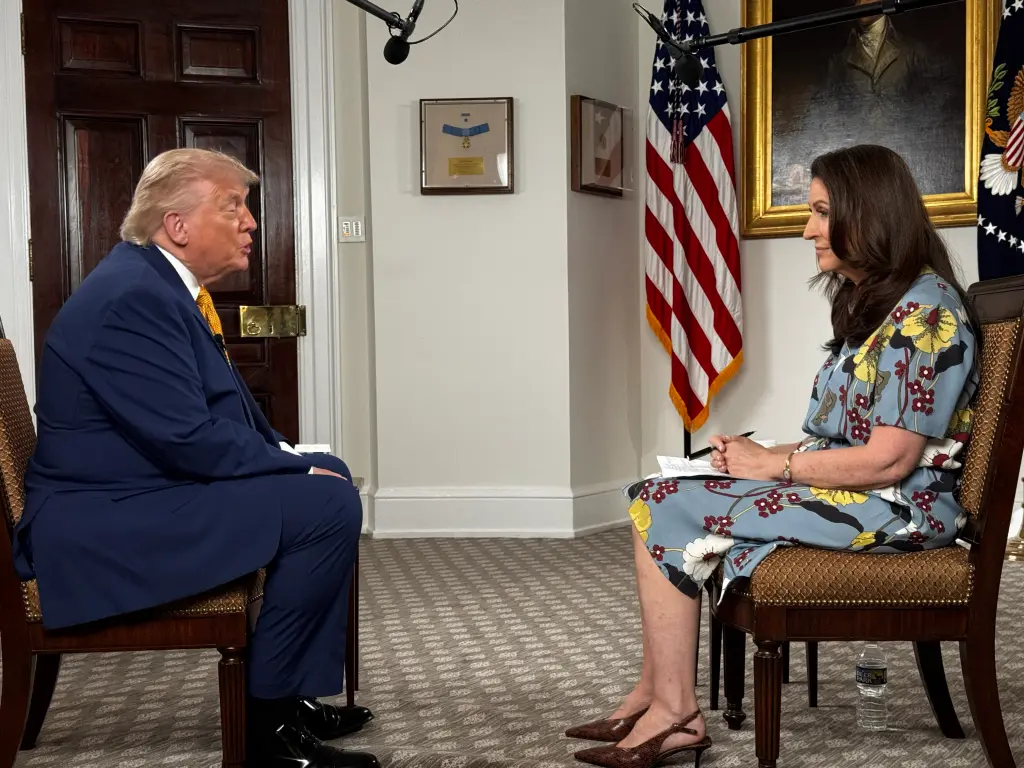
President Trump denied claims that Tehran suspended indirect negotiations and said talks were “going on continuously.” He also said Iran’s supreme leader, Mojtaba Khamenei, is “involved” in the peace talks. Trump said he hopes one day to meet Khamenei and “we probably will meet at some point, depending on how it all works out.”
Trump added that the U.S. had “gone through two ‘sets’ of Iranian negotiators who were now gone,” and that “some of the third set” were also gone.
Rubio: uranium and Hormuz
Secretary of State Marco Rubio put concrete stakes on the table: the fate of Iran’s highly enriched uranium stockpiles.
Rubio said Iran’s near weapons grade enriched uranium is a central issue and that Tehran has not agreed to a peace deal. He told the House Foreign Affairs Committee that draft papers have addressed the issue, but the United States still lacked “final sign off” from Iran’s system.
Rubio also described the U.S. position for any lasting agreement: Iran must turn over the near weapons grade enriched uranium, accept limits on nuclear activity, and reopen the Strait of Hormuz.
At the same hearing, Rubio argued the U.S. has already achieved its military aims and said sustained U.S. strikes had ended. “We’re no longer conducting sustained strikes inside of Iran to degrade their military, because Epic Fury is over,” he said.
The constitutional question
As a civics teacher, I always asked students the question they wanted to avoid: Who decides what counts as “self-defense” when it starts to resemble war?
Administrations love the phrase “self-defense” because it implies necessity, urgency, and a defined scope. Under our constitutional design, that scope is not a feeling. It is a boundary.
Congress has the power to declare war. Presidents have real authority as Commander in Chief. The friction between those two ideas is not a bug. It is the safety feature.
So when the executive branch describes new strikes as “self-defense,” and the next step is retaliation that kills civilians after debris falls at an international airport, the question becomes less about talking points and more about architecture:
- What is the legal theory for the continued use of force, and what limits does it claim?
- What information is Congress receiving, and what oversight is actually being exercised?
- If negotiations are “continuous,” what are the conditions, and who can verify them?
The Constitution is a mirror. In moments like this, it reflects our national habit of wanting the President to be both peacemaker and war manager, while pretending those roles never collide.
Why this matters
War is not only a military event. It is an economic event, a legal event, and a moral event. Even a partial breakdown in stability across the Persian Gulf can travel quickly into everyday American life through energy prices and global markets.
A new report from the Organization for Economic Cooperation and Development warned that a prolonged disruption of Middle East energy supplies would slow global growth sharply, spread inflation, and increase unemployment, with the hardest hits falling on Asian economies dependent on Persian Gulf energy and on poorer countries where household budgets are more fuel and food sensitive.
Markets were already reacting. Brent crude rose 1.6% to $97.51 per barrel as traders digested the latest flare-up.
What to watch next
- Airport operations: whether Kuwait can keep terminals operating without further attacks or disruptions.
- Negotiation substance: whether Iran agrees to terms tied to uranium stockpiles, nuclear limits, and reopening the Strait of Hormuz.
- Escalation risk: whether “self-defense strikes” becomes a rolling justification on both sides.
- Congressional posture: whether lawmakers demand clearer authorization, clearer objectives, or clearer constraints.
The hard truth is that diplomacy does not fail all at once. It frays. It thins. And then one morning you wake up to an airport on fire and a government still insisting everything is under control.