
When the Senate votes on whether to “rein in” presidential authority over a potential Iran conflict, the headline is not just about one president or one country. It is about a structural choice the Framers made on purpose: the power to use military force is split, so no single branch is supposed to take the nation into a major, sustained war without the other branch being able to check it.
That sounds clean in civics class. In real life, it produces constant friction, and history shows the drift. Presidents have initiated or expanded significant hostilities without a formal declaration of war, while Congress has often acted after the fact through authorizations, appropriations, or oversight. Presidents claim speed and secrecy. Congress claims democratic legitimacy and the power of the purse. The War Powers Resolution of 1973 tries to referee. The courts mostly stay out.
Join the Discussion
The Constitution splits war powers
The Constitution does not give “the war power” to any one branch. It divides it, and it does so in a way that is meant to force debate before a short-term response becomes a long-term commitment.
- Congress has the power to declare war, raise and support armies, provide and maintain a navy, regulate the armed forces, regulate foreign commerce, and fund military activity. The declarations and the money matter because they are levers that can expand or choke off a conflict.
- The president is “Commander in Chief” of the armed forces. That makes the president the top operational decision-maker once U.S. forces are in motion.
In theory, that design was meant to force deliberation: a president could respond to threats, and Congress would decide whether the response should become something larger, longer, and more expensive. In practice, the modern pattern is messier, with major conflicts often proceeding under broad or older authorizations, and sometimes under contested claims of inherent Article II authority.
The modern world also produces an endless stream of events that sit in the gray area between “repelling attacks” and “starting a war.” Iran has lived in that gray area for decades: proxy conflicts, strikes and counterstrikes, shipping threats, militia attacks, cyber operations, and the ever-present question of escalation.
What the War Powers Resolution says
The War Powers Resolution (often called the War Powers Act) was passed in 1973 over President Nixon’s veto, after Vietnam convinced Congress that presidents could steadily widen a conflict without a clear vote of approval.
It does three big things.
1) It demands reporting
When U.S. forces are introduced into (1) “hostilities,” (2) situations where imminent involvement in hostilities is clearly indicated, or (3) foreign territory, airspace, or waters while equipped for combat, the president must notify Congress “within forty-eight hours” (50 U.S.C. § 1543). The report is supposed to explain why forces were introduced, the constitutional and legal authority claimed, and the scope and duration expected.
2) It creates a clock
Absent congressional authorization, the statute says the president must terminate the use of U.S. forces within 60 days, with a possible 30-day extension for safe withdrawal (50 U.S.C. § 1544(b)).
In practice, this “clock” is contested and often non-self-enforcing. Administrations regularly argue the clock never starts because an operation does not qualify as “hostilities” under the statute, and courts have not supplied a definitive enforcement mechanism.
3) It sketches how Congress can end the action
The statute is written to push the branches toward a simple end state: either Congress authorizes the action, or the action ends on a timetable.
Two complications matter. First, two words do enormous work here: “hostilities.” The Resolution never defines it with precision. That ambiguity is the whole fight in many modern cases: do airstrikes count, or only sustained combat? What about advising, intelligence support, drone operations, or operations where U.S. personnel face limited risk?
One concrete example is Libya in 2011, when the Obama administration argued in its communications to Congress that U.S. operations did not amount to “hostilities” in the War Powers sense, in part because U.S. forces were playing a supporting role and the risk to U.S. personnel was limited. Many members of Congress disagreed, and the argument became a template for the broader debate.
Second, the War Powers Resolution originally included a fast way for Congress to force an end through a concurrent resolution. After INS v. Chadha (1983), that kind of legislative veto mechanism, legislation without presentment, is widely viewed as unconstitutional. The practical result is that ending an operation usually requires a law that can survive a presidential veto, or funding constraints that the executive branch cannot ignore.
Why senators vote on war powers
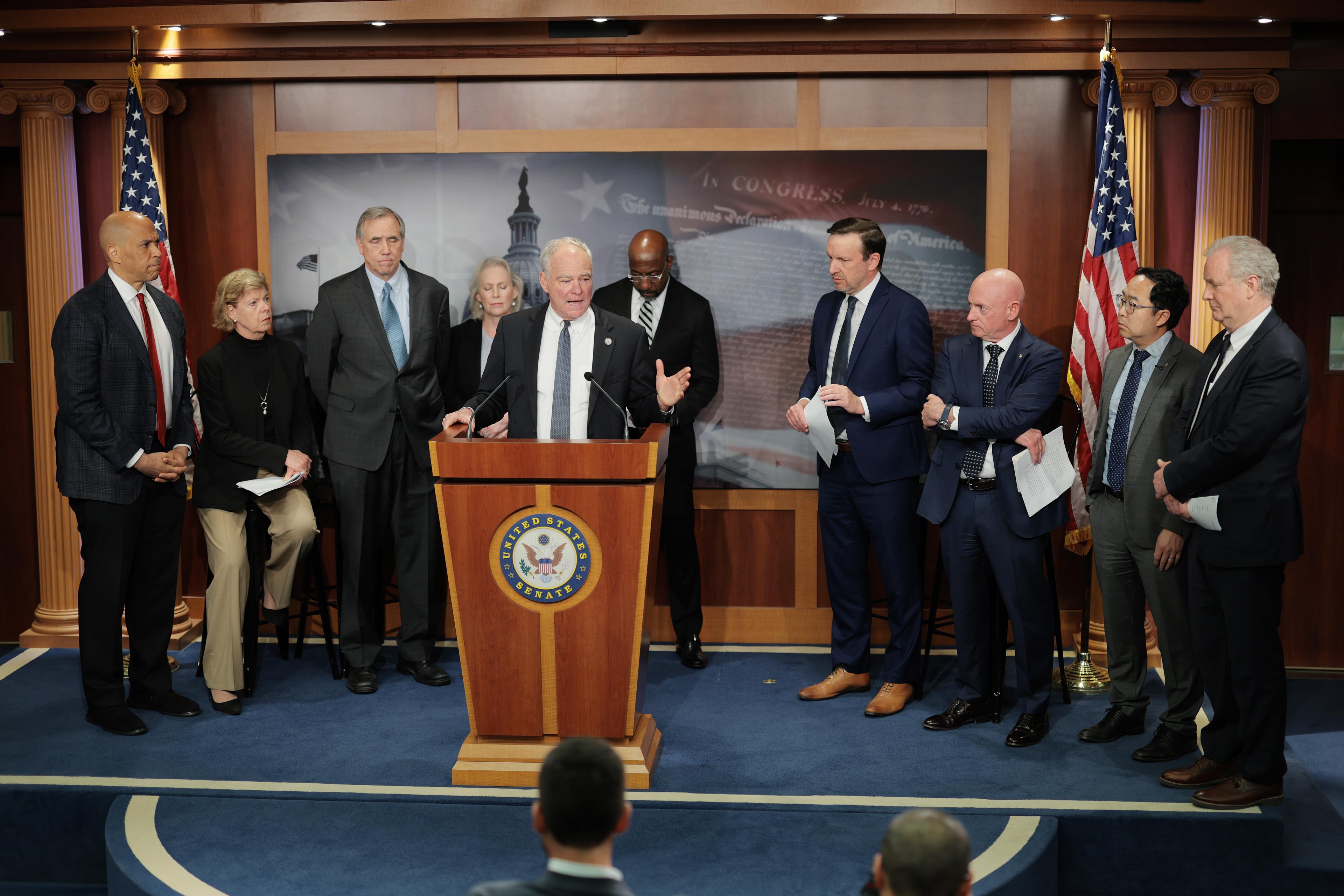
A Senate war powers vote is rarely a literal declaration of war. More often it is a privileged War Powers Resolution measure, a standalone bill, or an amendment aimed at a narrower question: Is the president using force, or about to use force, without Congress’s buy-in?
“Privileged” matters procedurally. It generally means the measure can get expedited consideration and cannot be buried as easily. But it still does not become binding law unless it passes both chambers and is signed by the president, or enacted over a veto.
That is what makes these votes important even when they fail. They are a public test of constitutional boundaries. They force senators to state, on the record, whether they think a particular situation counts as “hostilities” and whether existing authorizations cover it.
They also signal to the executive branch how much political risk comes with escalation. War powers fights are not only legal fights. They are separation of powers fights, which means leverage, coalition-building, and credible threats matter.
What counts as authorization
In war powers disputes, “authorized by Congress” can mean different things, and the differences drive real-world arguments.
- Declarations of war are the clearest form, but they have become rare.
- Authorizations for Use of Military Force (AUMFs) are the modern workhorse: Congress approves force, but often with less formality and with contested limits.
- Appropriations can look like authorization because they fund ongoing operations, but whether money alone counts as legal approval is debated. Congress can fund to protect troops while still insisting it has not authorized a broader war.
This is where Iran debates often get tangled. Modern operations sometimes lean on older AUMFs, especially the 2001 AUMF (post-9/11) and the 2002 Iraq AUMF. Whether those statutes stretch to cover a particular Iran-related operation can become the central legal dispute.
Can Congress stop a president
In theory, yes. In practice, it depends on what you mean by “stop,” and how united Congress is.
Money is usually the strongest tool
Congress can refuse to appropriate funds for a military action, or it can appropriate money with conditions attached. It is not glamorous, but it is often the most effective lever. Sustained military operations require fuel, munitions, maintenance, intelligence support, and personnel resources that are funded through statutes Congress controls.
Even here, timing matters. A president can sometimes rely on existing appropriations and statutory authorities in the short term, which is why Congress’s leverage grows when it can credibly cut off or condition future funding.
Congress can narrow or forbid force by statute
Congress can pass a new AUMF, or it can repeal or sunset an old one. It can also set limits: geographic boundaries, mission constraints, reporting requirements, or time limits.
Withdrawal orders run into veto politics
If Congress passes a law ordering termination or withdrawal, the president can veto it. Overriding a veto takes two-thirds of both chambers. That is a high bar in a polarized era.
This is why war powers votes can look symbolic from the outside. A simple majority can “send a message.” Forcing a legal change often requires either a veto-proof majority or bargaining that the White House will accept.
What the president can do alone
The president’s strongest argument begins with a widely asserted executive-branch position: the president can respond quickly to protect U.S. forces, deter imminent attacks, and conduct limited operations that do not rise to the level of a full-scale war.
Presidents of both parties have also claimed broader inherent authority under Article II to use force when important national interests are at stake, particularly for actions presented as limited in duration or scope, or to protect Americans and U.S. assets abroad.
But there is a difference between initiating force and sustaining it. The longer an operation lasts, the more it resembles the kind of commitment the Constitution expected Congress to own. That is where the War Powers Resolution’s timeline is supposed to matter, at least when the branches agree the statute applies.
Why courts rarely settle it
If this sounds like a problem begging for a Supreme Court ruling, you are not wrong. But federal courts often treat war powers disputes as political questions better handled by the elected branches, or they dismiss cases for lack of standing because it is hard to identify a plaintiff who is legally entitled to sue.
One modern example is Campbell v. Clinton (D.C. Cir. 2000), in which members of Congress challenged President Clinton’s Kosovo operation under the War Powers Resolution and related theories. The court did not produce a clean, enforceable rule on the merits that would govern future conflicts.
Another frequently cited example is Crockett v. Reagan (D.C. Cir. 1982), involving challenges related to U.S. involvement in El Salvador. It similarly illustrates the judiciary’s reluctance to referee interbranch war powers fights in real time.
The result is that many war powers conflicts are “resolved” by practice, politics, and precedent-by-habit rather than clear judicial doctrine. That vacuum is part of why congressional votes matter. When courts stay out, the branches fight it out themselves, and the paper trail becomes the next conflict’s ammunition.

What the Iran fight means
It means the country is watching the separation of powers do what it was designed to do, even if it does it messily.
- For Congress, a war powers vote is an attempt to reclaim the constitutional role of deciding whether military force should expand beyond immediate defense or narrow strikes. It is also an effort to prevent drift, where repeated limited actions become a sustained conflict without a clear authorization.
- For the president, resisting those limits preserves flexibility and speed, and it protects the modern presidency’s long-claimed interpretation of Article II authority.
The deepest question underneath the headlines is not “Who is tougher?” It is this: At what point does a pattern of limited military actions become the kind of war the Constitution expected Congress to authorize?
The Constitution does not answer that with a number of missiles or a particular calendar date. It answers it with a structure. Congress controls authorizations and funding over time. The president commands forces. The friction between those roles is not an accident. It is the safeguard.
Quick FAQ
Is the War Powers Resolution constitutional?
It has never been definitively struck down by the Supreme Court. Presidents have often said parts of it intrude on the Commander in Chief power, but many administrations still file reports “consistent with” the Resolution, even while disputing its application.
Does a Senate vote alone change anything?
Not by itself. Under the Constitution, legislation must pass both chambers and be signed by the president or enacted over a veto. Senate-only actions can still influence policy and shape negotiations, but they are not the end of the legal story.
What is the most effective way to limit a conflict?
Appropriations and conditions on funding are usually Congress’s strongest levers, because sustained military operations require sustained money.