
Every election cycle has its shiny objects. This week’s primaries have one that is stranger than most: a Trump-backed, reality TV famous, online influencer turned candidate trying to crack open Los Angeles City Hall, a place Republicans have not won in roughly three decades.
But the deeper story is not celebrity politics. It is power. Specifically, the kind of power that is not written into the Constitution but shapes our system anyway: the ability of a president to reach beyond the White House and shape party contests with an endorsement.
California and Iowa are about to test whether President Donald Trump’s endorsement remains a uniquely potent force in Republican politics, or whether it is starting to behave more like any other political tool: useful in some locks, less so in others.
Join the Discussion
The power of endorsements
The Constitution does not mention political parties. It certainly does not mention endorsements. Yet endorsements have become a kind of informal pre-primary, a way for modern presidents to project influence far past their formal duties.
That raises a question I used to press my civics students with: what matters more in American government, the official powers on paper or the informal powers that become normal over time?
Trump’s endorsement power sits right in that tension. It is not law. It is leverage. It is persuasion backed by fundraising lists, media gravity, and the fear of becoming the next target.
Los Angeles: nonpartisan, still political
Los Angeles uses a nonpartisan mayoral election. If no candidate clears 50% in the primary, the top two finishers advance to November. That structure is supposed to reward coalition-building, not party tribalism.
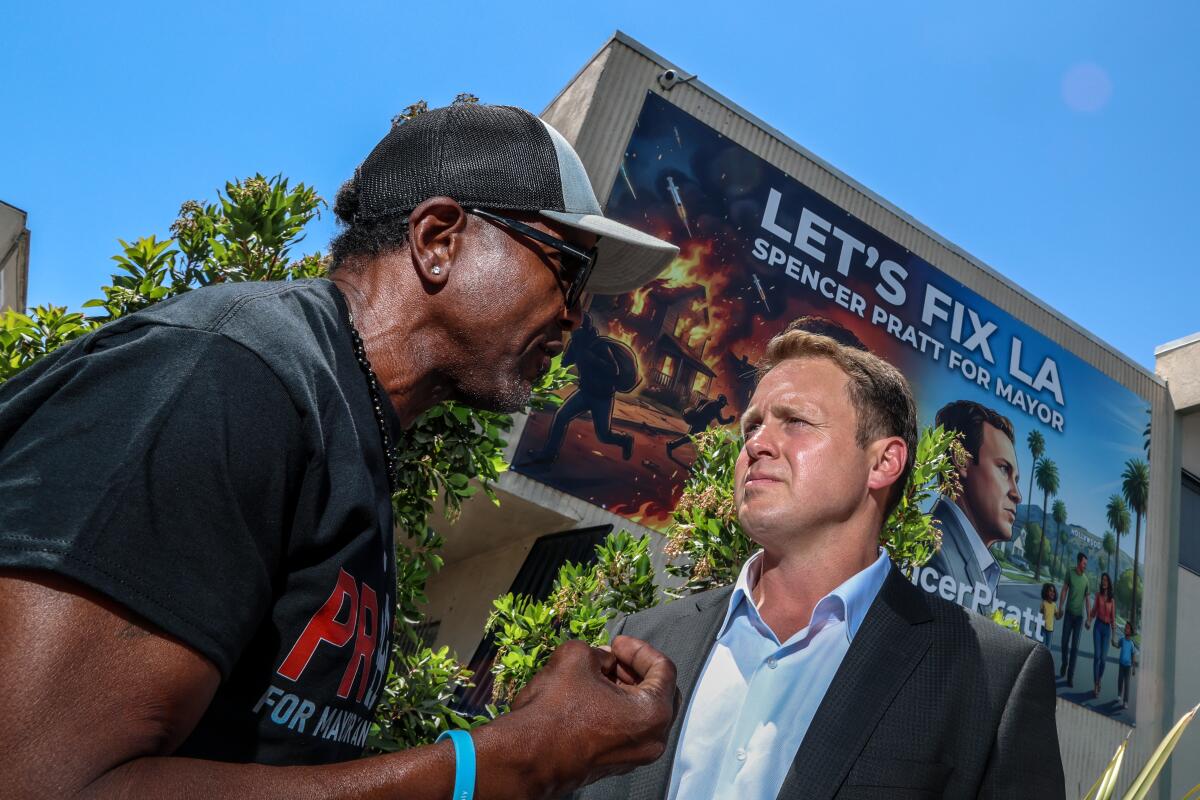
And yet, Trump stepped into the race anyway by backing Spencer Pratt, a Republican running as an independent in the left-leaning city. That alone tells you something about how endorsements work in 2026: party lines are flexible, but political branding is not.
Pratt has gained traction with a populist style built for viral video, and he has positioned himself as a disruption candidate on issues that dominate daily life in Los Angeles: homelessness, crime, and government accountability. His personal story is also part of the pitch. He is among those who lost a home in last year’s wildfires, when more than 17,000 homes in Los Angeles County were destroyed.
Pratt has also framed his support as coming from ordinary families, especially mothers. In a recent interview, he put it in blunt, provocative terms: I keep saying I become the mayor because of moms. Moms are getting me elected. Moms do not feel safe in Los Angeles. Not just feel safe, they are not safe. Nobody's safe really in LA unless you're the drug dealer. The drug dealers and the people giving them the needles, the city, our taxpayer money, the needle givers, they're safe, the meth pipe givers. They're safe. Everyone else is not safe in LA.
He is aiming that message directly at Mayor Karen Bass, a former Democratic member of Congress seeking a second four-year term. Bass has accumulated heavyweight Democratic support, including endorsements from former Vice President Kamala Harris, California’s two Democratic U.S. senators Adam Schiff and Alex Padilla, and Gov. Gavin Newsom.
She is also being challenged from her left by City Council member Nithya Raman. So the Los Angeles primary is not simply right versus left. It is a test of whether a Trump endorsement can help a right-leaning candidate squeeze into the top two in one of the country’s most Democratic major cities.
California governor: top-two math
California’s governor’s race is even more chaotic. A staggering 61 candidates are running to succeed Gov. Gavin Newsom.
California’s jungle primary puts everyone on the same ballot regardless of party, with the top two advancing. That format changes the strategic value of endorsements. The goal is not just to win the primary. It is to survive the crowd and make the runoff.
Trump has backed Republican Steve Hilton, a conservative commentator and one-time British political strategist. Another prominent Republican in the field is Riverside County Sheriff Chad Bianco, who has argued he is the most conservative candidate. But the endorsement has functioned like a thumb on the scale: Bianco’s momentum was blunted after Trump backed Hilton in early April.
Democrats with serious name recognition in the mix include Javier Becerra and Tom Steyer, along with Katie Porter, San Jose Mayor Matt Mahan, former Los Angeles Mayor Antonio Villaraigosa, and state schools chief Tony Thurmond. Becerra, a former congressman and California attorney general who later served in President Joe Biden’s Cabinet, could become the first Latino California governor in modern history. Steyer, a billionaire hedge fund founder turned environmental activist, has poured extraordinary money into the race, spending more than $200 million of his own funds on ads.
There is also a political vacuum shaping this contest. Kamala Harris and Alex Padilla both considered running and declined, leaving Democrats without the kind of pre-ordained frontrunner California often produces.
In that kind of environment, an endorsement can have more marginal value than usual, especially in a top-two system where the entire race can turn into a sorting exercise. But the jungle primary has its own logic. If too many Republicans split votes, the top two could be all Democrats. That would turn Trump’s endorsement from a simple boost into something closer to a strategic bet about who can survive the rules of the ballot.
Iowa: a test of clout
If California is where endorsements meet their toughest structural obstacles, Iowa is where they can still operate as a blunt instrument inside a party.
With Gov. Kim Reynolds retiring and Sen. Joni Ernst retiring, Iowa has become a state-sized opening in the 2026 map. Trump carried Iowa by 13 points in 2024, and he has now inserted himself into the GOP governor’s primary by endorsing Rep. Randy Feenstra.
Feenstra’s opponents include entrepreneur and private school co-founder Zach Lahn, who is backed by Turning Point USA, along with state Rep. Eddie Andrews, former state Rep. Brad Sherman, and former state administrative services director Adam Steen.
The winner will face Democratic state Auditor Rob Sand, who is unopposed in his primary and is the only Democrat currently elected statewide in Iowa.
That last fact matters. It means the general election will likely be about persuasion and turnout, not party novelty. Republicans are picking who they think can hold a state that has trended red over the last decade but still remembers what swing-state politics feels like.
Trump’s endorsement in this context is not just a preference signal. It is also a way to steer the field. Over the past month, Trump-backed candidates have been strong enough in GOP primaries to oust incumbents he targeted in states including Indiana, Louisiana, Kentucky, and Texas. Iowa now tests whether that effect still applies when the field is crowded and outside groups are also spending and organizing.
The Senate subplot
Iowa’s open Senate seat adds another layer. Rep. Ashley Hinson is the heavy favorite for the Republican nomination to succeed Ernst. She is backed by Trump, Senate Majority Leader John Thune, and the National Republican Senatorial Committee.
Hinson faces a long-shot challenge from former state senator Jim Carlin. The general election, though, is where the fireworks are expected. Democrats have an expensive and contentious primary between state Rep. Josh Turek, a Paralympian, and state Sen. Zach Wahls.
Wahls has the backing of Sen. Elizabeth Warren. Turek, positioned more toward the party’s center, is backed by former Transportation Secretary Pete Buttigieg. He also has the tacit support of Sen. Chuck Schumer and Sen. Kirsten Gillibrand, and an outside group, VoteVets, has spent heavily to help him.
Notice what is happening here: Trump’s endorsement is powerful, but it is not the only kind of party power. Senate leadership, committees, aligned outside groups, and ideological stars are all trying to shape the ballot too. This is what modern party looks like. It is not smoke-filled rooms. It is competing networks of influence, each trying to define what counts as legitimate.
What we are watching
On paper, primaries are about voters choosing nominees. In practice, primaries are also a referendum on who controls the gate.
California tests whether Trump can push Republican candidates through systems designed to dilute party control: nonpartisan city ballots and jungle primaries. Iowa tests whether Trump can still function as a dominant center of gravity, even when conservative organizations and party institutions have their own favorites.
The constitutional mirror here is not flattering or ugly. It is simply honest. The Founders designed offices and elections. They did not design parties. But parties became the machinery that makes the system run. Endorsements are the levers on that machinery.
And now voters in Los Angeles and Iowa are about to answer a hard question with a simple act: do they follow where Trump points, or do they remind everyone that the only endorsement that truly matters is the one cast in a ballot booth?