
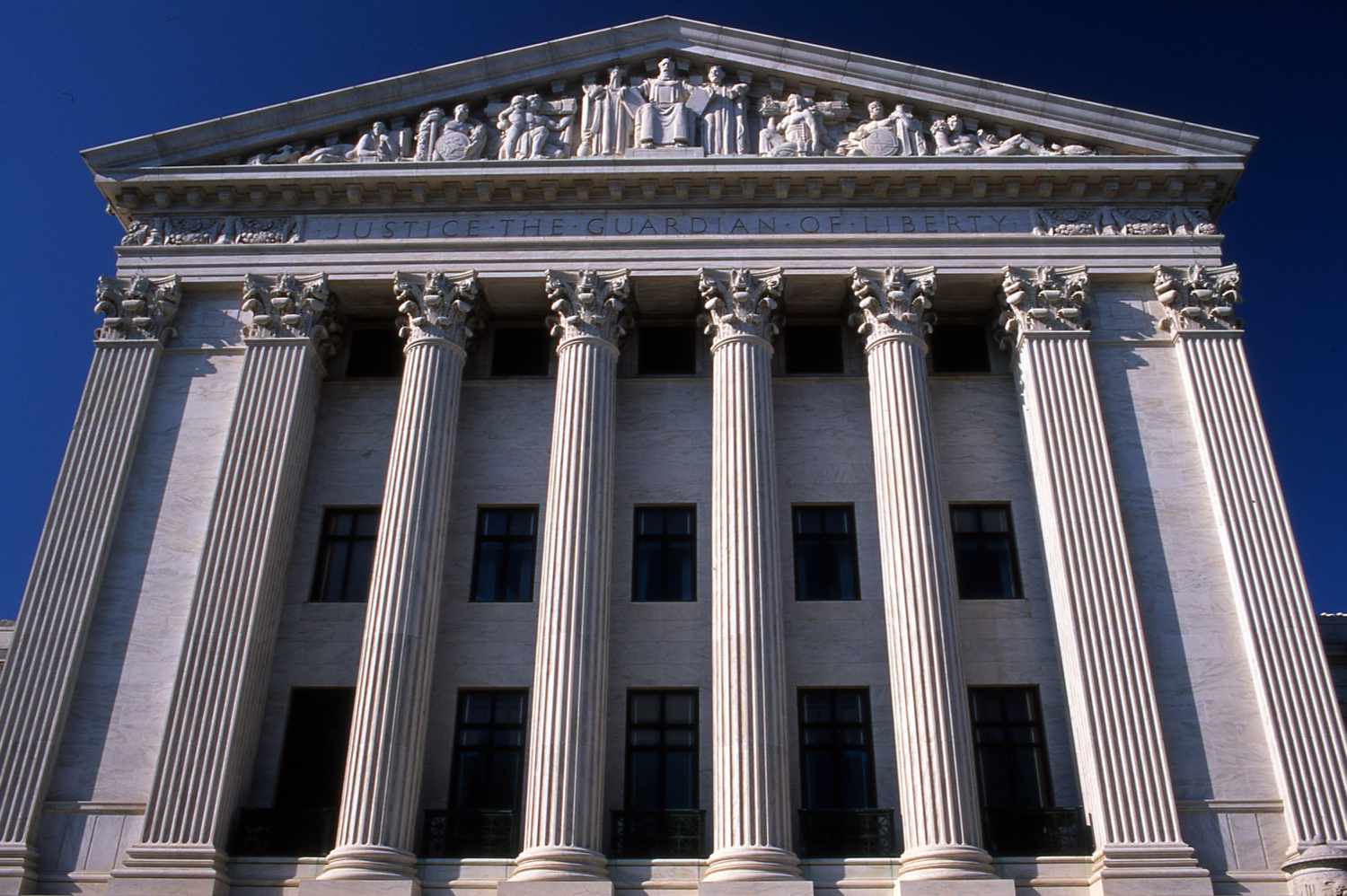
There are Supreme Court decisions that arrive like weather. You see the clouds gathering, you hear the distant thunder of oral argument, you brace for impact, and then the storm still manages to flatten the house.
That is what it felt like in Springfield, Ohio, after the Court ruled Mullin v. Doe by a 6-3 vote and allowed the Department of Homeland Security to carry out the termination of Temporary Protected Status for Haitian and Syrian recipients.
In Springfield, where roughly 15,000 residents have been living under TPS, the decision did not land as an abstract separation-of-powers debate. It landed as a question with immediate, intimate consequences: What happens to families where some people are citizens and others are not? What happens to parents with American-born children? What happens to a community that has already been asked to defend its humanity against rumors and political scapegoating?
Join the Discussion
TPS is a pause
Temporary Protected Status is exactly what it sounds like. It is not asylum. It is not permanent residency. It is not citizenship. It is a statutory decision by the executive branch to temporarily shield people from removal when their home countries face extraordinary conditions like natural disasters or political violence.
That distinction matters because it reveals the fragility of the promise. TPS can function like stability, especially when it is renewed again and again. But legally, it is built to be revoked. When it ends for a given country designation, a person who was working legally yesterday can become undocumented today.
That is what the Court’s ruling effectively triggered. In mere moments, hundreds of thousands of immigrants across the country became undocumented, and fears about what would happen to them and their mixed-citizenship families mounted.
How this got to the Court
The ruling did not drop out of a clear sky. Organizations representing Haitian TPS holders sued the Department of Homeland Security in March 2025, after then-Homeland Security Secretary Kristi Noem first attempted to terminate TPS.
Over the last year, federal courts undid Noem’s partial vacation of the legal status, which sought to revoke the Biden administration’s February 2026 extension and force recipients to return to Haiti in August 2025, and courts blocked the government from ending the program.
The Trump administration appealed to the Supreme Court in March, asking the justices to decide whether the TPS statute prevents courts from reviewing the department secretary’s designation of status. Last week, counsel for the Haitian respondents asked the Court to dismiss the case due to newly discovered evidence they believed would support their equal protection claim. The ruling still arrived, sweeping and final in the way procedural decisions can be, even when the human stakes are not procedural at all.
What the Court said
The case turned on a deceptively technical question: whether courts can review the Homeland Security secretary’s decision to terminate a TPS designation.
Justice Samuel Alito, writing for the majority, pointed to the text of the TPS statute and concluded that it blocks judicial review of these termination decisions. In the Court’s words, the statute “plainly bars consideration of respondents’ non-constitutional claims,” and “allows ‘no judicial review of any determination … with respect to the … termination of a TPS designation.’”
The Court also held that Syrian and Haitian TPS holders are not entitled to orders postponing the termination of their designations during litigation. And it held that the Haitian respondents did not provide sufficient evidence that the contentious statements President Donald Trump and Kristi Noem made demonstrate that racial animus motivated the termination of Haitians’ TPS.
Then came the deeper constitutional tremor. In a concurrence, Justice Clarence Thomas claimed that “aliens” did not have federal protections under the Fourteenth Amendment’s Equal Protection Clause. That statement is not just about TPS. It is about whether equal protection is a person-based guarantee or a membership perk. The answer to that question reshapes what “equal” even means in the United States.
Springfield gathers
The day of the decision, the emotional center of Springfield’s response was not a law office or a campus auditorium. It was a church sanctuary and then the courtyard of City Hall.
Vilès Dorsainvil, executive director of the Haitian Community Support Center in Springfield, described the decision in terms that sounded less like policy disappointment and more like civic heartbreak. “Today was the saddest day since I’ve been here because, as a foreigner in this land, I expected what I knew about the U.S.,” he said. “I used to know a USA, where human dignity was valued — justice was valued — but it’s no longer this.”
He also put it plainly: “Coming from a country where it is not safe, and there will be some family separation, I expected the Supreme Court to take those into consideration and do a better ruling, but unfortunately, this is not the case,” Dorsainvil said.
Pastor Carl Ruby, a leader of the local advocacy coalition Springfield G92, framed the community’s response through scripture and the old American habit of moral witness. “We’ve had to think about the issue of providing sanctuary,” he said. “When there’s a conflict between man’s laws and God’s laws, we have an obligation to side with God’s laws.”
The vigil in the public square
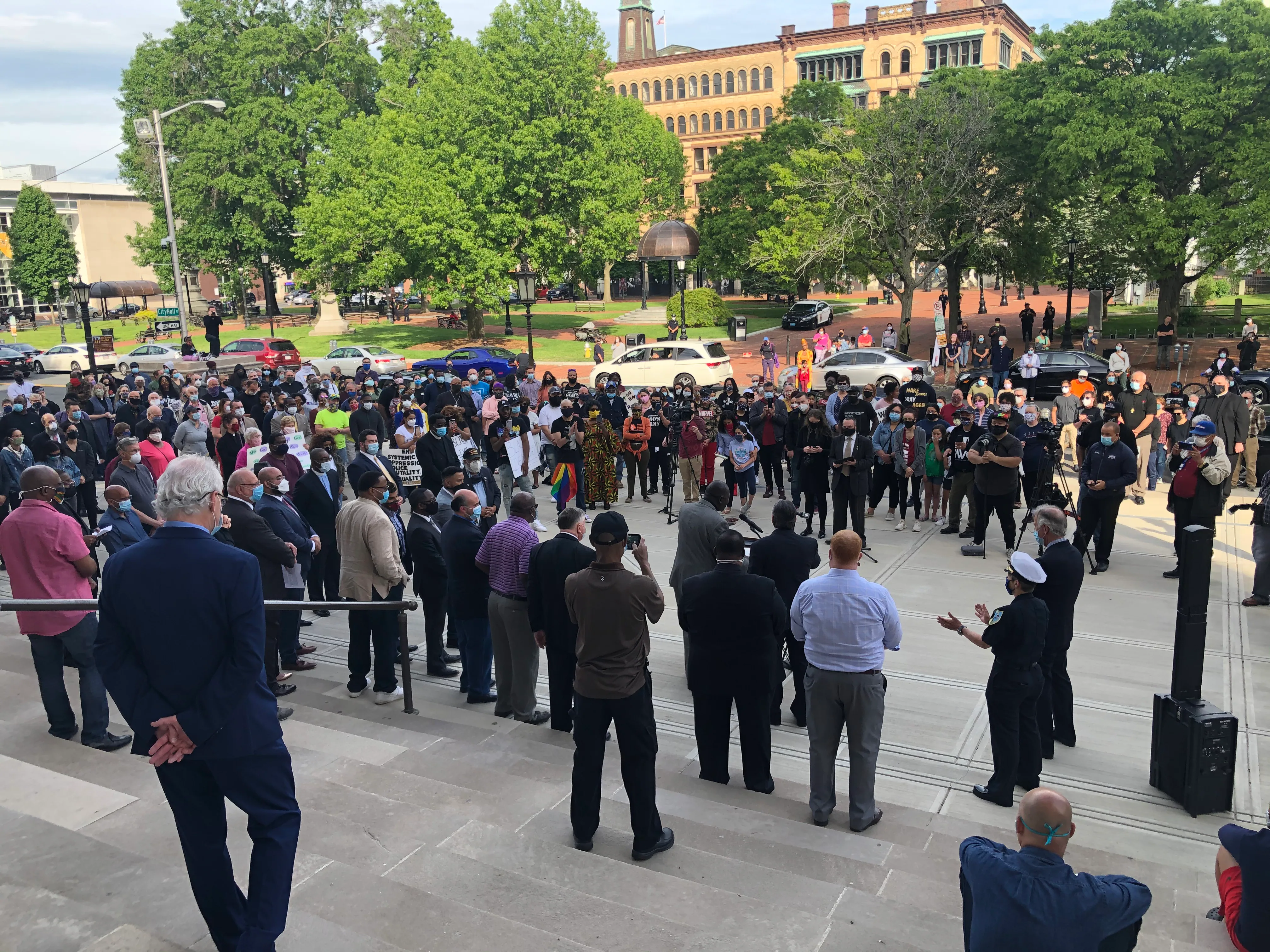
As evening settled over Springfield, hundreds gathered in the stone courtyard of City Hall around 6 p.m. Some held signs with messages like “Love your neighbor as yourself.” People cheered as local clergy-turned-activists spoke out against the ruling and joined the World House Choir in protest song. “Everyone of these people are ours” rang out in harmony against a light summer breeze.
Organizers passed around cards urging Ohio’s two Republican senators, Bernie Moreno and Jon Husted, to support S.B. 4814, a bill that would designate TPS for Haitians through the end of President Trump’s term.
Several speakers emphasized that many Haitian residents could not attend publicly because visibility itself can become a risk when a legal category turns from protected to precarious. The vigil was also a practical act of accompaniment: neighbors showing up, signing cards, and singing out loud for the people who could not afford to be seen.
“Where are we going to send 300,000 Haitians?”
At the vigil, the fear was not theoretical. Haiti’s instability was not treated as a talking point but as lived memory.
Marc Joseph, who provides immigration and legal services through Catholic Charities Southwestern Ohio and is a U.S. citizen, spoke about the violence his family experienced in Haiti, including the killing of close relatives. He questioned the practicality and morality of mass removals: “I don’t really understand why this decision come up because where are we going to send 300,000 Haitians?”
That number, 300,000, is more than a statistic. It is an ethical scale. It forces the country to confront what “return” means when home is not safe, and when the United States has become the place where children were born, schooling began, and community ties were formed.
Fear goes quiet
Some of the most revealing accounts came from interpreters and organizers who described what happened as news of the decision spread through the community.
A Haitian Creole interpreter named Laura, who asked that only her first name be used, described witnessing panic and disbelief as families learned what the ruling meant for their status and their children.
Another interpreter, Margery Koveleski, recalled one mother’s terror as she clutched her newborn and worried about separation. Koveleski described the woman as saying, “I just had this baby. I’m still bleeding from my cesarean, and to say they will start deportation, will they rip my child away?” She also recalled the woman’s words: “I literally would commit suicide if they take me into detention and they take my child away.”
When people talk about immigration law as if it is only about border control or paperwork, they miss this dimension. The law reaches into hospital rooms, classrooms, and cribs.
The schoolhouse impact
A Springfield City teacher who declined to be named out of concern for potential repercussions described attending because they work with Haitian students and had been seeing the strain in real time. Their sign read “Protect Our Haitian Neighbors.”
“I work with a lot of Haitian students, and their safety and well-being is very important to me, as well as the safety and well-being of the people in this community,” the teacher said.
“It just is very disheartening seeing the distress on my students’ faces when they come into school, and knowing what they are dealing with at home, which is then reflected in the school day,” they added.
Rights and discretion
One of the hardest truths to explain in civics is that the Constitution does not give everyone the same relationship to the federal government.
Many constitutional protections apply to “persons,” not only to “citizens.” Due process, for example, has long been understood as a constraint on government power when it acts against human beings under U.S. jurisdiction. But immigration law also lives in a space where Congress and the executive branch have historically been granted sweeping discretion. That discretion expands further when courts interpret statutes to limit judicial review.
So the Springfield moment becomes a civics lesson in real time: a community can live, work, worship, pay taxes, raise children, and still discover that its legal footing is contingent, revocable, and politically vulnerable.
What sanctuary means
In American history, “sanctuary” has always been a contested word because it sits at the border between two loyalties: loyalty to law as written and loyalty to moral conscience.
But the Constitution does not require citizens to be quiet. The First Amendment does not protect speech only when the government is comfortable. It protects speech precisely when it is not. When a city gathers on courthouse steps or in a public courtyard to insist that families belong, that is constitutional culture you can actually see: bodies in public, names on cards to senators, and songs aimed outward as a warning that isolation is part of the policy design.
Dorsainvil, addressing supporters and immigrants who were anxious that night, offered gratitude that also doubled as a civic argument about solidarity: “Your compassion has reminded us of the very best of America,” he said. “You have welcomed your neighbors, spoken out against injustice, defended vulnerable families and refused to let hate and division have the final word.”
“To every immigrant family who is anxious tonight, there are people across this nation who believe in you, who stayed with you, and who will continue advocating for your rights and your dignity,” he added.
After the gavel
Geoff Pipoly, lead attorney for the Haitian respondents, criticized the ruling’s effect on court oversight. “The new rule from the Supreme Court is that when it comes to TPS decisions, the administration, any executive branch agency, can break the law flagrantly, openly and make no secret of it, and the federal courts can’t stop it,” he said.
Pipoly said his team was still reviewing the opinion and planned to evaluate what claims remain viable. But his warning was stark: “The Supreme Court’s decision means that many, many people are going to die violent, needless deaths. That’s the bottom line.”
Even if you set aside the rhetoric, the legal point is urgent. When judicial review is limited, accountability shifts. People are forced to seek relief through politics, legislation, and local community defense rather than through courts.
What Springfield shows
Springfield has been treated as a symbol before, often without its consent. In 2024, national politicians dragged this city into the spotlight and fueled false claims about Haitian residents. Now Springfield is again a symbol, but this time on different terms: a test of whether a community can respond to legal whiplash with something sturdier than panic.
After the vigil ended, when the crowd had cleared and the lingering equipment was packed away, Dorsainvil was asked what was next. “I don’t know. I don’t know,” he said softly. He was worried about how the termination of his TPS would affect his pursuit of a master’s degree.
The Constitution does not mention Temporary Protected Status. It does not promise that a life built here will be allowed to remain here. But it does set the terms of our political morality, because it structures how power is exercised and who can challenge it.
When a Supreme Court decision makes thousands of people newly deportable, the question for the rest of the country is not only what the law permits. The question is what we, as citizens, will insist the law should become.