
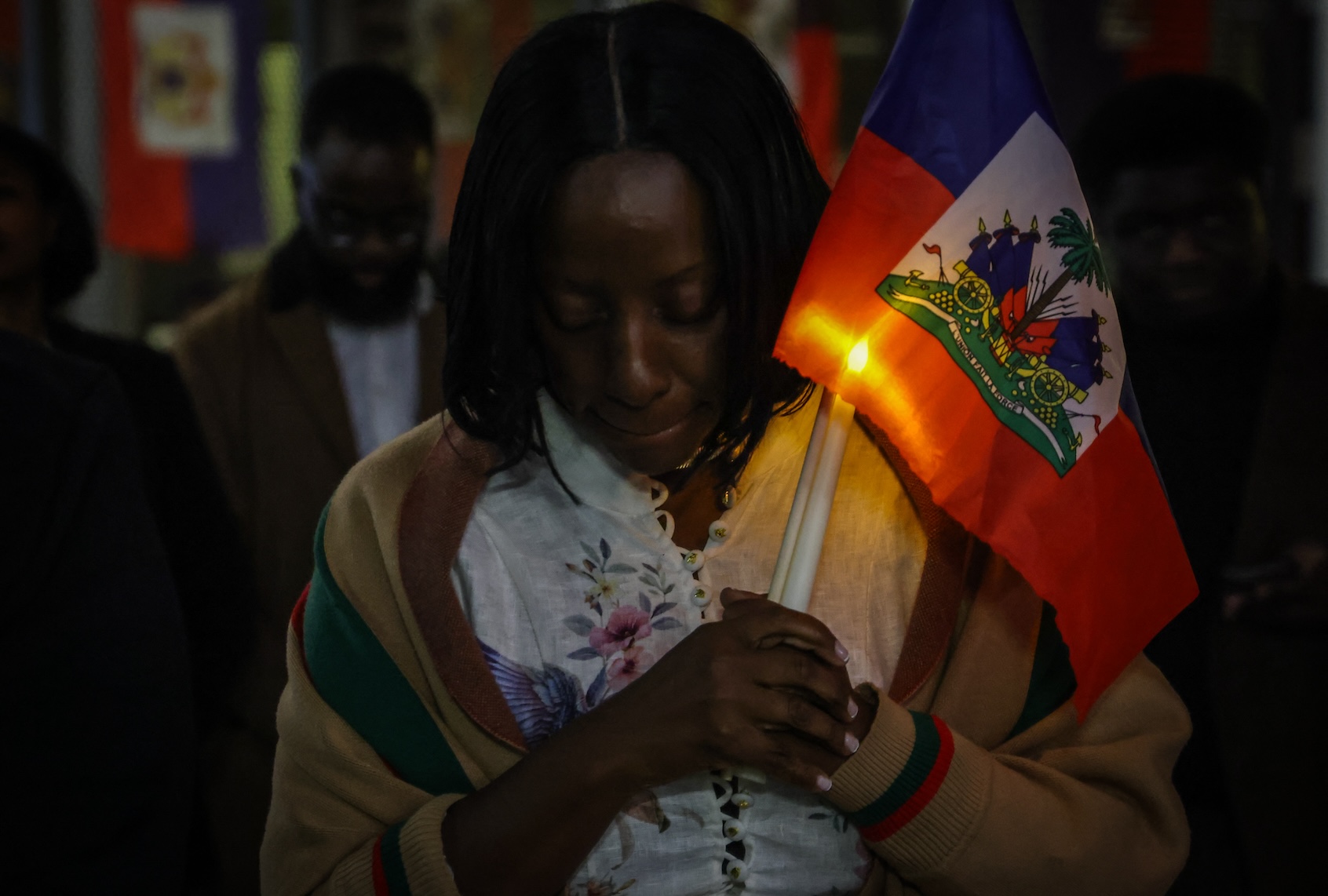
You can live for years inside a legal category and still wake up one morning to discover it was never a wall. It was a curtain.
That is the quiet terror Temporary Protected Status has always carried: it is protection, but not permanence. It is lawful presence, but not belonging in the way most Americans mean that word. And after the Supreme Court’s June decision in Mullin v. Doe, many Haitian TPS recipients learned just how fast a federal label can change the shape of a life.
Join the Discussion
The ruling that turned paperwork into peril
The Court ruled 6-3 for the Department of Homeland Security, allowing the cancellation of TPS for Haitian and Syrian recipients to take effect. The practical result was immediate: hundreds of thousands of people nationwide lost that temporary shield against deportation and, with it, the stability that allows a family to work, rent, plan, and breathe.
Justice Samuel Alito, writing for the majority, framed the decision as a question of statutory limits on the courts. “The TPS statute plainly bars consideration of respondents’ non-constitutional claims,” he wrote, emphasizing language that permits “no judicial review of any determination … with respect to the … termination of a TPS designation.”
In other words: Congress wrote a law that gives the executive branch a lever, and the judiciary fewer hands to grab it when people say the lever is being pulled unlawfully.
Springfield, Ohio: where national law meets local consequences
Springfield is not a theoretical place. It is a working city about 40 miles west of Columbus, with schools, churches, jobs, rent payments due on the first, and children who bring home permission slips on Fridays. It is also home to roughly 15,000 TPS holders, many of them Haitian.
When TPS is revoked in a community that size, the shock is not contained to immigration attorneys and government forms. It spreads to employers who wonder whether they are about to lose trained workers, to teachers watching stress show up as distraction, to hospitals and landlords and pastors who suddenly find themselves asked a question that has nothing to do with theology and everything to do with power: What happens next?
A vigil at City Hall, and a different kind of constitutional language
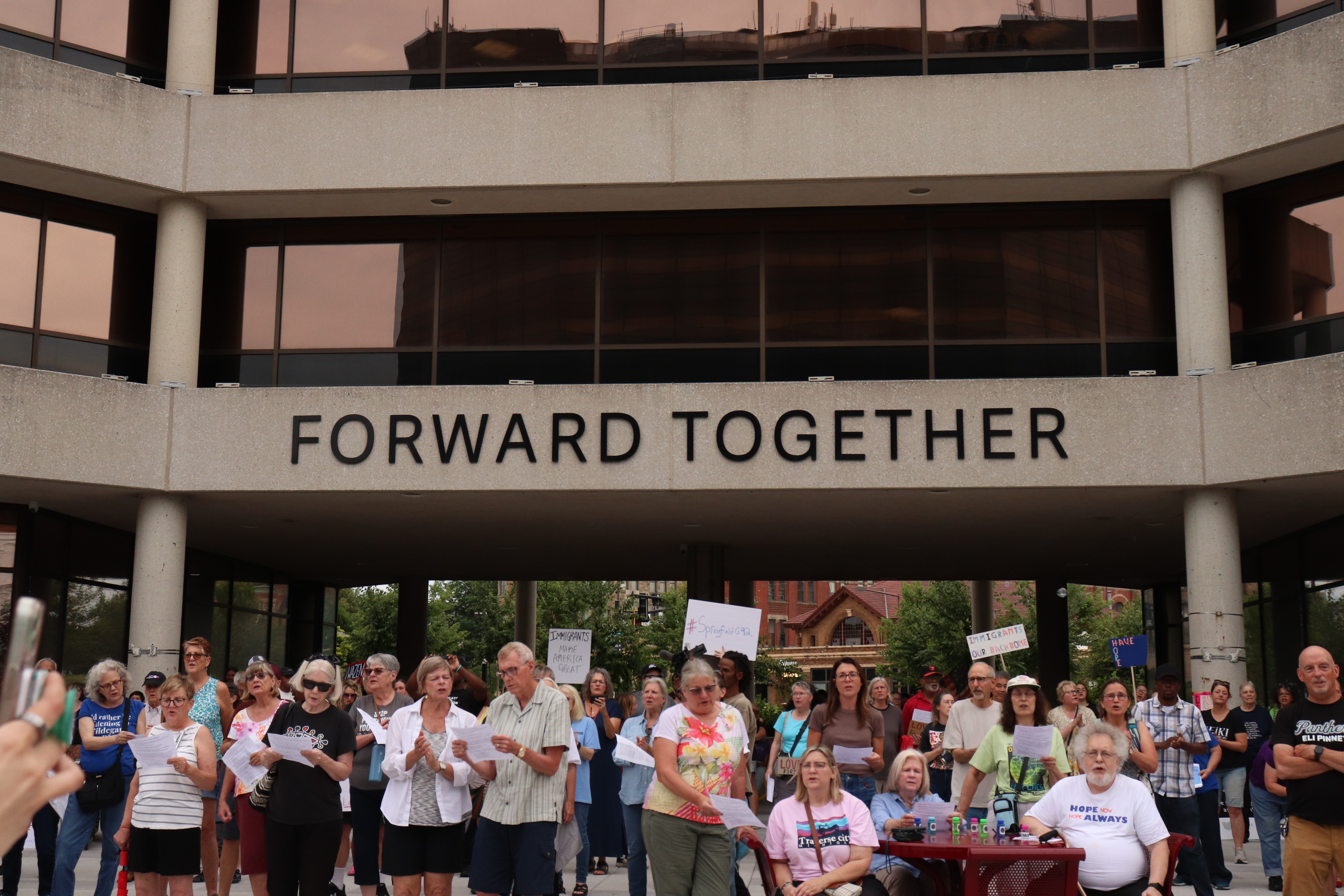
On June 25, as the sun dropped behind Springfield’s downtown, residents and organizers gathered in the stone courtyard of City Hall for an impromptu vigil. They held signs. They sang. They listened to clergy and advocates who treated the loss of TPS not as a partisan skirmish, but as a moral emergency playing out in real time.
Pastor Carl Ruby, a leader in the local coalition Springfield G92, told supporters there was “a strong commitment in Springfield for the faith community to stand with Haitians who are at risk of deportation.” He explained that the coalition’s name comes from the 92 times the Hebrew word “ger,” meaning foreigner, appears in the Old Testament. “We’ve had to think about the issue of providing sanctuary,” Ruby said. “When there’s a conflict between man’s laws and God’s laws, we have an obligation to side with God’s laws.”
This is not how constitutional law is usually discussed. But it is how constitutional pressure is often felt: people reach for a higher language when the ordinary channels seem closed.
What the Constitution does and does not promise noncitizens
Here is the hard civics lesson hiding underneath the grief: immigration law sits at one of the Constitution’s most lopsided intersections. The political branches, especially the executive, traditionally receive broad latitude. Courts can intervene, but only when Congress has given them room or when a constitutional claim is both available and provable.
In Mullin v. Doe, the majority treated the TPS statute as a kind of “no trespassing” sign for judges. That matters because it narrows the path to relief for people arguing that the government acted arbitrarily or unlawfully under the statute itself.
The decision also arrives alongside a familiar, troubling theme in modern constitutional debate: who gets to claim constitutional protection when status is contested. In a concurrence, Justice Clarence Thomas asserted that “aliens” did not have federal protections under the Fourteenth Amendment’s Equal Protection Clause. That view is not universally accepted, and it collides with a long history of courts recognizing at least some constitutional safeguards for noncitizens. But even the existence of the argument tells you something about the current moment.
The Constitution is not just a text. It is a set of boundaries enforced by institutions. When an institution says, “We cannot review this,” the boundary shifts, even if the words on the page have not.
“I used to know a USA”: the emotional cost of legal uncertainty
At a virtual press conference the morning of the ruling, Vilès Dorsainvil, executive director of the Haitian Community Support Center in Springfield, described the decision in a register that was not legal but deeply American. “Today was the saddest day since I’ve been here because, as a foreigner in this land, I expected what I knew about the U.S.,” he said. “I used to know a USA, where human dignity was valued justice was valued but it’s no longer this.”
You can debate statutes and jurisdiction all day, but that line lands because it captures what TPS recipients often buy with their compliance: the belief that following the rules will eventually produce safety. TPS can feel like a bridge. When the bridge is pulled back, the sense of betrayal is not abstract.
When “temporary” meets Haiti’s reality
Supporters at the vigil kept returning to the same blunt question: What does it mean to terminate TPS when the underlying danger has not disappeared?
Marc Joseph, who provides immigration and legal services through Catholic Charities Southwestern Ohio and is a U.S. citizen, described a family history shaped by violence in Haiti. “I don’t really understand why this decision come up because where are we going to send 300,000 Haitians?” he said. “This situation in Haiti is still a reality.”
That number, 300,000, is not just a statistic. It is the scale of disruption implied by the Court’s permission slip to end protections. It is also a reminder that immigration policy is, at its core, policy about bodies: where people will live, whether they will be safe, whether children will grow up with their parents in the same home.
Fear has a specific sound when children are involved
Interpreters and community members described a day filled with frantic calls and whispered questions. A Haitian Creole interpreter who asked to be identified only as Laura spoke of delivering the news to families and seeing panic take hold.
Another interpreter, Margery Koveleski, recalled a mother’s terror as she clung to her newborn. “This woman clung to her baby, and said, ‘I just had this baby. I’m still bleeding from my cesarean, and to say they will start deportation, will they rip my child away?’” Koveleski said. “She said, ‘I literally would commit suicide if they take me into detention and they take my child away.’”
We often treat deportation as a distant administrative act. Families experience it as a threat of forced separation. And the Constitution, notably, does not include a neat clause guaranteeing that mixed-status families will be kept intact. What exists instead is a patchwork of due process rules, agency discretion, and political will.
The legal fight is not over, but it is narrower
The path to the Supreme Court began when organizations representing Haitian TPS holders sued DHS in March 2025 after then-Homeland Security Secretary Kristi Noem attempted to terminate TPS. Lower courts blocked the termination and unraveled efforts to undo prior extensions.
The Trump administration brought the dispute to the Supreme Court in March, pressing the question of whether courts can review the secretary’s termination decision under the TPS statute. The Court’s majority said they largely cannot.
Geoff Pipoly, lead attorney for the Haitian respondents, summarized the stakes with unusual bluntness: “The new rule from the Supreme Court is that when it comes to TPS decisions, the administration any executive branch agency can break the law flagrantly, openly and make no secret of it, and the federal courts can’t stop it,” he said. Pipoly added that the team was still assessing what claims remain. “The Supreme Court’s decision means that many, many people are going to die violent, needless deaths,” he said. “That’s the bottom line.”
Even if you disagree with that forecast, it is a window into what the ruling does to accountability. When judicial review is limited, politics becomes the primary check. That is not inherently unconstitutional. But it is a reminder of how much immigration stability depends on elections and appointments rather than durable rights.
Community as a backstop
In Springfield, people responded the way communities often respond when the formal system feels indifferent: they started organizing.
At the City Hall vigil, attendees filled out cards urging Ohio’s two Republican senators, Bernie Moreno and Jon Husted, to support SB 4814, a bill that would designate TPS for Haitians through the end of President Trump’s term.
A Springfield teacher, worried about repercussions, spoke about Haitian students and the strain that legal uncertainty imposes on a school day. “I work with a lot of Haitian students, and their safety and well-being is very important to me, as well as the safety and well-being of the people in this community,” the teacher said, holding a handmade sign reading “Protect Our Haitian Neighbors.”
Aspen Forest, a 26-year-old community organizer, described looking for donation links and brainstorming local food drives and support through a Dayton soup kitchen. “Humanity as a whole, we are one big community,” Forest said. “We have so many greater powers that want to turn us against each other, so that we lose sight of what power we do have, and that is to take care of each other on the very ground-level of community.”
The constitutional question underneath the human one
TPS was created by statute. That fact matters. Statutory programs can be expanded, narrowed, extended, or terminated depending on who controls the executive branch and how Congress writes (or rewrites) the rules.
Many Americans instinctively assume that if a family has lived here for years, worked here, paid taxes, built a church community, and sent kids to school, the Constitution will step in as a kind of ultimate guarantee.
But the Constitution is not a general-purpose fairness machine. It contains powerful protections, especially for citizens, and it sets limits on government action. Yet it also leaves large areas to political control, particularly in immigration. When the Supreme Court interprets a statute to limit judicial review, it is not just deciding a case. It is deciding who gets a courtroom door, and who has to plead their case only in the political arena.
What dignity looks like when the law hardens
At the vigil, Dorsainvil thanked Springfield residents for refusing to let fear be the final word. “Your compassion has reminded us of the very best of America,” he told the crowd. “You have welcomed your neighbors, spoken out against injustice, defended vulnerable families and refused to let hate and division have the final word.”
He ended with a message to immigrants watching the news with dread: “To every immigrant family who is anxious tonight, there are people across this nation who believe in you, who stayed with you, and who will continue advocating for your rights and your dignity.”
This is the part that is easy to miss if you only read court opinions: constitutional democracy is not just courts and clauses. It is neighbors deciding whether “We the People” is a closed club or a living commitment. Springfield’s answer, at least for one long evening on the City Hall stones, was clear.