When a federal district judge becomes the main character in an election fight, it is usually because something bigger is happening behind the scenes. But before any personalities take over the story, one grounding point matters more than the headlines.
Clarification: This piece is an explainer that uses a hypothetical dispute, a president attempting to restrict mail-in voting by executive order and a federal judge blocking it, to make a concrete constitutional point about who can control election mechanics.
So the real question is the one that would exist in any version of this controversy.
Who actually has constitutional authority over the mechanics of voting by mail: the president, Congress, the states, or the courts?
Join the Discussion
What an order tries to control
Executive orders sound decisive because they read like commands. But constitutionally, they are closer to management memos. A president can direct executive branch agencies on how to execute laws that already exist, and how to use discretion Congress has already delegated. A president cannot create new election law simply by declaring it.
In a scenario where an executive order aims to restrict the availability or ease of voting by mail, the first practical question is what, exactly, the order tries to change. The most common targets are not abstract principles. They are concrete rules voters and administrators feel immediately, such as:
- Eligibility limits: narrowing who may request an absentee ballot.
- Deadlines: shifting request deadlines, mailing deadlines, or receipt versus postmark rules.
- Ballot handling rules: adding witness or ID requirements, or changing cure procedures.
- Postage and processing: mandating postage payment rules, delivery standards, or USPS handling directives.
The key constitutional friction point is not whether mail-in voting is wise policy. The issue is whether the president can impose nationwide rules that function like election legislation, particularly when elections are administered primarily by states and when Congress has its own enumerated powers to regulate federal elections.
In other words, the fight is not just about ballots. It is about the separation of powers.
Why a judge might block it
If a federal judge repeatedly concludes that a mail-in voting executive order exceeds presidential authority, that theme matters because it draws a bright line between two kinds of presidential action:
- Permissible: directing agencies on how to carry out statutes passed by Congress, including choices Congress has left to agency discretion.
- Not permissible: using an executive order to effectively rewrite election rules that Congress and the states ordinarily control.
Procedurally, these fights often arrive as emergency requests for a temporary restraining order or a preliminary injunction. Judges typically ask familiar questions: is the challenge likely to succeed on the merits, will voters or states suffer irreparable harm without relief, and do the equities and public interest favor freezing the policy while the case proceeds.
Federal judges do not get a roving commission to run elections. But they do have a core job that becomes unavoidable in election season: enforcing constitutional boundaries when a branch of government attempts to operate outside its lane.
The constitutional map
If you want the Constitution’s basic blueprint for elections, you start with Article I, Section 4, often called the Elections Clause. It gives states the initial responsibility to set the “Times, Places and Manner” of congressional elections, but it also gives Congress the power to “make or alter” those rules.
That structure is not accidental. It is a two-level design: states administer, Congress can standardize or override when it chooses. The presidency is not absent from this picture, but its role is indirect and largely channeled through legislation. The president executes federal law through executive agencies, enforces federal election statutes through the Department of Justice, and participates in lawmaking through signing or vetoing bills. The president does not get a separate, free-standing constitutional power to set voting rules nationwide.
It also helps to keep presidential elections distinct from congressional elections. For the presidential contest, Article II’s Electors Clause gives states authority over the “Manner” of appointing electors, subject to constitutional constraints and to federal statutes Congress validly enacts. Different clause, similar theme: state-run machinery, with federal guardrails that come primarily from Congress and the Constitution, not unilateral presidential rulemaking.
That is why lawsuits attacking election-related executive orders tend to sound repetitive. The plaintiffs keep returning to the same core claim: you cannot use Article II to do what Article I assigns elsewhere, and you cannot treat an executive order as a substitute for legislation.

Where USPS fits
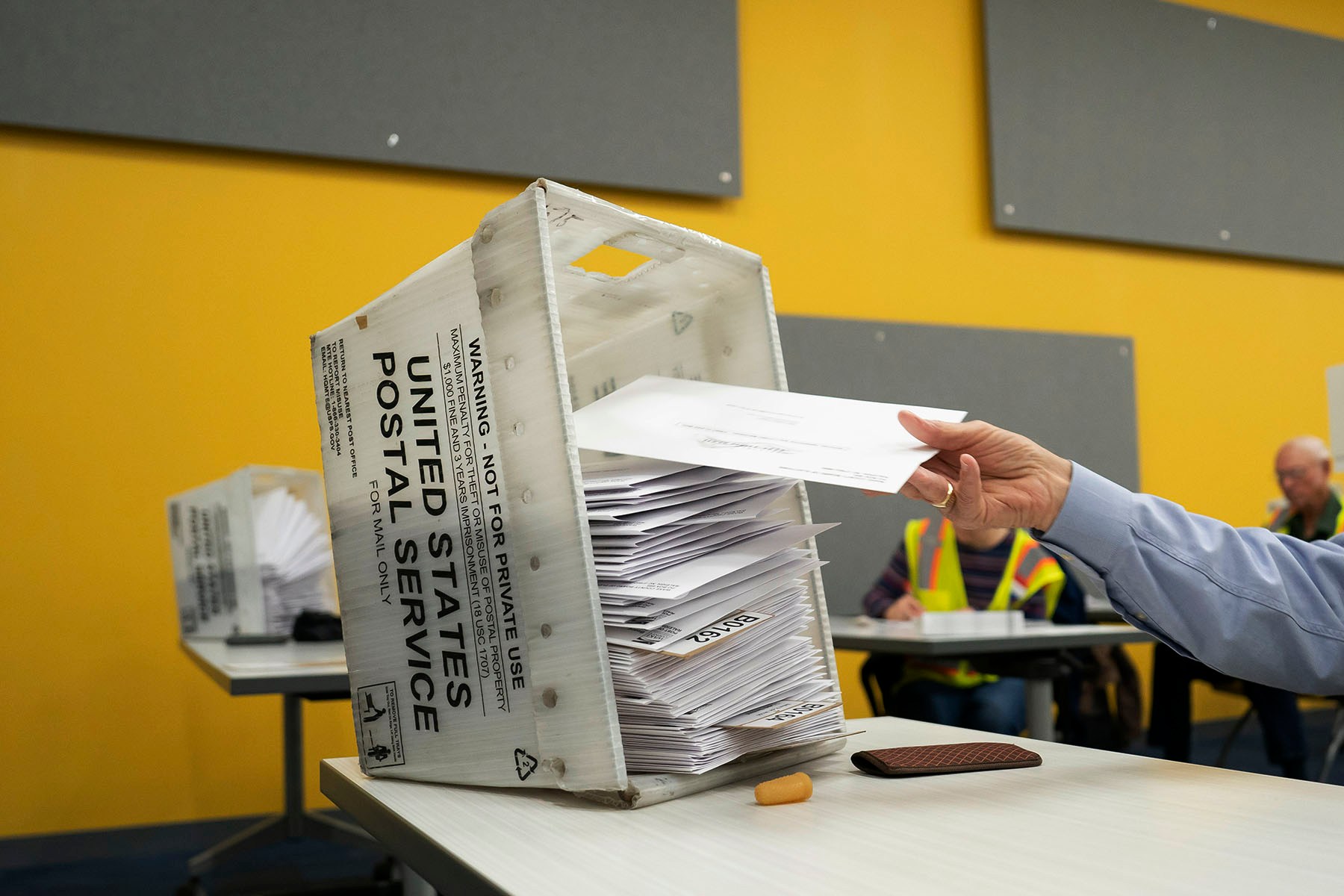
Mail-in voting is not only a legal design problem. It is also a logistics problem. If the Postal Service changes procedures, procurement, staffing, routing, or delivery standards in ways that affect ballot delivery, those choices can become the real-world battleground even while the merits are being litigated.
This is where implementation disputes can matter more than the theory. Court orders are not suggestions. If a federal court has enjoined an executive branch policy, an agency cannot treat that injunction as optional, or comply in public while implementing in practice through internal guidance or operational changes.
Even if the underlying legal fight is eventually resolved, premature implementation can change conditions during the very period when judicial review is supposed to preserve the status quo. And in election cases, “real-world conditions” can mean whether ballots arrive, whether voters trust the system, and whether local election officials are forced to retool their procedures right before a major election.
These disputes also collide with the fact that Congress has enacted election-related statutes that can intersect with mail voting administration in specific contexts, including UOCAVA protections for military and overseas voters, and laws like the Voting Rights Act, the ADA, and HAVA that can shape how access and administration disputes get litigated.
When the clock decides
Election litigation has a built-in vulnerability that other constitutional disputes do not: deadlines. Ballots get printed. Mailing windows close. Voter education campaigns begin. Once an election administration timeline starts moving, courts grow cautious about late changes.
That caution has a name in legal shorthand: the Purcell principle, referring to Purcell v. Gonzalez (2006) and later cases. It is not a constitutional amendment. It is a prudential doctrine that often shows up through stays and emergency orders, and it is applied unevenly across courts and circumstances. But in practice it can operate like a veto button, especially on emergency dockets, because timing alone can determine whether a challenged rule governs an election.
This is where critics and defenders of aggressive lower-court intervention talk past each other. One side argues that courts should avoid disruption. The other side argues that early enforcement of constitutional limits is the only way to prevent a last-minute scramble later. Either way, the strategic reality is the same: in election cases, procedure can swallow substance.
What defying means
There is a difference between defying the Supreme Court and disagreeing about how to apply Supreme Court guidance in a fast-moving case.
A district judge must follow Supreme Court holdings. But many election disputes live in the space between holdings: emergency orders with limited reasoning, stays with minimal explanation, and broad cautions about timing rather than clear rules about power.
So when you hear that a judge is “defying” the Court, the practical question is usually one of these:
- Scope: Did the Supreme Court actually decide this exact legal question, or did it issue a narrow procedural ruling?
- Timing: Is the lower court acting early enough to avoid last-minute changes, or late enough to trigger the Court’s concerns?
- Remedy: Is the judge blocking an order entirely, or tailoring relief to specific plaintiffs, jurisdictions, or actions?
In election disputes, Supreme Court timing doctrines can determine what rules govern an election before the Court ever reaches the merits.
The durable question
Strip away the personalities and the partisan framing, and what remains is a constitutional stress test.
If a president can restrict mail-in voting nationwide through an executive order, the Elections Clause begins to look optional. Congress’s role becomes easier to bypass. State authority becomes easier to preempt without legislation. And the executive branch becomes the primary architect of ballot access, even though the Constitution never designed it that way.
If, on the other hand, courts block such orders consistently, the Constitution’s structure holds: states administer elections, Congress can regulate federal elections, and the president executes the laws that result. The debate then moves where it arguably belongs: to legislatures and voters, not to agency directives issued under presidential signature.
FAQ
Does the Constitution protect a right to vote by mail?
The Constitution does not explicitly guarantee mail-in voting as a method. Voting rules are largely created by states, constrained by constitutional protections against discrimination and by federal statutes Congress validly enacts. Mail voting is typically a statutory and administrative choice, not an enumerated constitutional right.
Can a president control how states run elections?
Not directly. The president can enforce federal election laws and oversee federal agencies, but the Constitution assigns election administration primarily to states, with Congress holding the power to alter rules for federal elections. Presidential power generally has to hook into an existing statute, a delegated authority, or a valid constitutional role such as law enforcement and administration. An executive order cannot manufacture that hook.
Why does Supreme Court timing matter so much?
Because courts try to avoid changing election rules close to an election. That impulse can preserve stability, but it also creates incentives to delay. If a contested rule stays in place long enough, it can govern the election even if it is later held unlawful.
What happens if an agency implements a plan a court has blocked?
If a court has issued an injunction covering that conduct, implementation can trigger contempt proceedings, emergency motions, and further court supervision. In practical terms, it can also create confusion and friction for election officials and voters, which is exactly what courts try to prevent in the first place.
Why rulings matter
District court orders are often the only legal decisions that arrive in time to shape events on the ground. That is especially true in election cases, where the question is not only who is right, but when anyone with authority will say so clearly enough for election administrators to act.
The Constitution has many silences. It does not specify mail-in voting. It does not outline a modern postal system’s relationship to ballot access. But it is not silent about power. In any real-world dispute that tries to use executive action to reshape election mechanics, the central issue stays the same: whether the branches will keep to the boundaries the document actually draws, even when an election makes every incentive run in the opposite direction.