
When headlines say the Justice Department is suing a state over “sanctuary” limits, the constitutional question is usually simpler than the politics: Can a state refuse to help ICE, and if it can, how far can it go before it starts interfering with federal law?
To be clear on the factual setup: Virginia is generally not a sanctuary state, and recent high-profile DOJ litigation involving Virginia has centered on other issues, not immigration noncooperation. The legal questions discussed here arise most often in lawsuits over state or local limits on immigration enforcement cooperation in jurisdictions that adopt noncooperation policies (and, in a different posture, in lawsuits against states accused of over-enforcing immigration on their own). The constitutional framework is the same either way.
Those disputes put three core ideas back on the table: the Supremacy Clause, federal preemption, and the Tenth Amendment. Together they create a boundary that feels counterintuitive at first: states generally cannot obstruct federal immigration enforcement, but they often can decline to participate in it.
Join the Discussion
What “sanctuary” means in law
“Sanctuary state” and “sanctuary city” are not terms defined in the U.S. Constitution. They are political labels that tend to cover a range of policies, including:
- Limits on local police cooperation with federal immigration detainers or requests to hold someone longer than they otherwise would be held.
- Restrictions on sharing information with federal immigration authorities, depending on what information and what statute applies.
- Rules about when officers may ask about immigration status during routine policing.
- Limits on using state resources such as money, personnel, databases, or jail time to assist civil immigration enforcement.
Constitutionally, these policies live in the space between two principles that coexist uneasily: the federal government’s primary power over immigration and the states’ control over their own employees and budgets.
Immigration power is mainly federal
The Constitution does not contain a neat “Immigration Clause.” Instead, federal authority over immigration comes from a combination of enumerated powers and long-standing Supreme Court doctrine, including:
- The Naturalization Clause (Article I, Section 8), giving Congress power over rules for becoming a citizen.
- The foreign affairs and national sovereignty framework, recognizing that controlling entry and removal is tied to national power.
- The Supremacy Clause (Article VI), which makes valid federal law the “supreme Law of the Land.”
This matters because if Congress validly regulates immigration, states cannot simply pass a contradictory system and call it “state sovereignty.” That is where preemption enters.
Supremacy and preemption
The Supremacy Clause is the Constitution’s tie-breaker: when federal law and state law conflict, federal law wins, assuming the federal law is constitutional.
Courts describe several kinds of preemption that often come up in immigration disputes:
- Express preemption: Congress explicitly says states may not regulate in a particular area.
- Conflict preemption: a state law is invalid because complying with both state and federal law is impossible, or because the state law “stands as an obstacle” to federal objectives.
- Field preemption: federal regulation is so comprehensive that courts treat the field as occupied by federal law.
A key case is Arizona v. United States (2012), where the Supreme Court struck down major parts of Arizona’s immigration enforcement law because they intruded into a domain where federal control is dominant. The Court’s message was not that states have no role at all, but that they cannot create their own immigration enforcement scheme that competes with the federal one.
Anti-commandeering and the Tenth
Here is the constitutional twist: even though federal immigration law is supreme, the federal government generally cannot force states to use state personnel to enforce it.
This principle is known as the anti-commandeering doctrine, grounded in the structure of federalism and associated with the Tenth Amendment. The Supreme Court has articulated it in cases such as:
- New York v. United States (1992), limiting federal power to compel states to implement federal regulatory programs.
- Printz v. United States (1997), holding Congress cannot require state officers to carry out federal background checks.
- Murphy v. NCAA (2018), reinforcing that Congress cannot issue direct orders to state legislatures about what laws they must maintain.
Translated into the sanctuary context, anti-commandeering supports the idea that a state may choose not to:
- honor certain federal requests that are voluntary rather than mandatory,
- spend state funds to assist civil immigration enforcement,
- assign state officers to federal immigration tasks.
That is why many sanctuary policies are written as noncooperation rules. They attempt to stay on the “we are not helping” side of the line, rather than crossing into “we are stopping you.”
The line: noncooperation vs. obstruction
In practice, the hardest cases are not about whether federal law is supreme. They are about what counts as interference.
What states usually can do
- Decline to provide affirmative assistance to federal immigration enforcement, such as declining to allocate officers or funds.
- Set policy for state employees about the scope of their duties, as long as the policy does not directly conflict with federal mandates.
- Choose how to run state and local jails within constitutional limits, including not holding people beyond their lawful release time solely to facilitate civil immigration pickup, unless required by valid law.
What states generally cannot do
- Block federal agents from enforcing federal law where they are authorized to act.
- Impose penalties on private parties for cooperating with federal immigration authorities when federal law protects or authorizes that cooperation.
- Create state rules designed to frustrate federal objectives in a way courts treat as an “obstacle” under conflict preemption.
When the DOJ sues over a sanctuary-style policy, the case often turns on how the challenged rules are characterized: as permissible resource and employment policy choices, or as impermissible legal barriers that obstruct federal enforcement.
Detainers and the Fourth Amendment
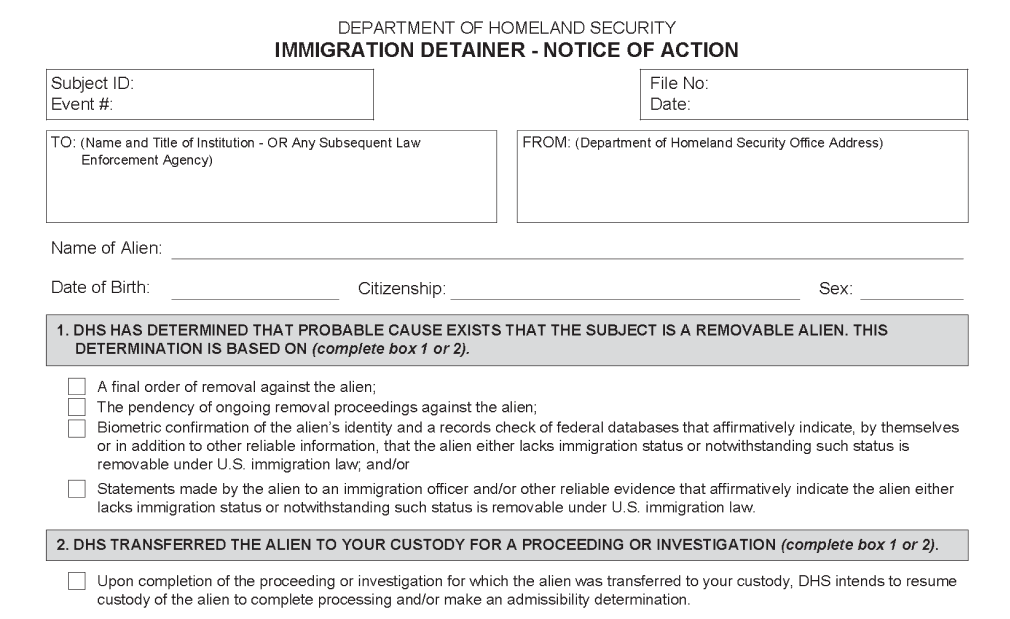
One reason sanctuary fights often focus on jails is that immigration “detainers” are frequently requests rather than warrants. Local officials worry about liability if they hold someone without proper legal authority.
That concern is not theoretical. Holding a person past their release time can raise Fourth Amendment issues if the continued detention lacks sufficient legal basis. As a result, some jurisdictions adopt policies that require a judicial warrant or clear statutory authority before honoring certain ICE requests.
This Fourth Amendment dimension can shape what courts think a state is doing. A policy framed as “we will not make potentially unlawful extra holds” looks different from a policy framed as “we will prevent ICE from taking custody.” The constitutional analysis often pivots on that framing and on the details.
Can the federal government punish noncooperation?
The federal government has tools, but they have limits.
Direct orders to state legislatures or state officers are where anti-commandeering is strongest. If a federal statute is interpreted as forcing states to administer or enforce a federal program, that statute can face serious constitutional resistance.
Conditional funding is another route: Congress can attach conditions to federal grants, but only within constitutional constraints. The conditions generally must be clear, related to the federal program, and not so coercive that they effectively leave states no real choice. The Supreme Court’s modern warning shot on coercion is NFIB v. Sebelius (2012), in the Medicaid expansion context.
Preemption lawsuits are often the cleanest approach: the federal government argues that a state policy conflicts with federal law and must be invalidated under the Supremacy Clause.
What to watch in these lawsuits
Without needing to choose a political team, you can usually predict the legal battleground by looking for a few factual questions:
- Does the state rule merely limit state participation, or does it impose barriers on federal officers or private cooperation?
- Is there a specific federal statute the DOJ says the state law conflicts with, and is that statute a valid exercise of federal power?
- Is the alleged conflict direct (impossible to comply with both) or more abstract (an “obstacle” to federal objectives)?
- Is the state invoking anti-commandeering as a defense, arguing the federal government is effectively trying to conscript state resources?
The most durable takeaway is that this area is not governed by a single on/off switch. It is governed by a constitutional boundary: federal supremacy over federal enforcement, and state autonomy over state resources. The litigation is about where, exactly, that boundary sits in the real world.
Bottom line
Can a state limit ICE? A state generally cannot stop ICE from enforcing federal law where ICE has lawful authority. But a state often can decide that its own officers, budgets, databases, and jail policies will not be used to assist, especially when federal requests are voluntary and raise independent constitutional concerns.
Sanctuary policies survive when they are built as noncooperation. They fail when courts view them as obstruction or as laws that conflict with federal statutes under the Supremacy Clause.
If you take anything from the sanctuary litigation cycle, let it be this: the Constitution does not require states to become an extension cord for federal power. But it also does not let states cut the federal power line.