
The news hook is procedural, but the stakes are substantive: House conservatives used rules votes as leverage to demand floor time for the SAVE Act. In a closely divided House, threatening to vote down the rule for unrelated legislation can stall the chamber, because most major bills cannot reach the floor until the House adopts a rule setting debate and amendments.
Why it matters: the SAVE Act would change the federal voter registration baseline for federal elections by requiring documentary proof of U.S. citizenship in specified registration contexts, rather than relying only on a signed attestation on the federal form.
This explainer focuses on what H.R. 8281 would do, where Congress gets authority to set rules for federal elections, how the bill’s document and enforcement provisions are written, why a rules fight inside the House can stall the floor long before the Senate ever votes, and where the bill stands now.
Join the Discussion
What the SAVE Act Is
The SAVE Act is short for the Safeguard American Voter Eligibility Act. In the 118th Congress, it was introduced as H.R. 8281 by Rep. Chip Roy of Texas.
At a high level, H.R. 8281 would amend the federal registration framework created by the National Voter Registration Act of 1993 (NVRA) to require documentary proof of United States citizenship as part of registering to vote for federal elections through the NVRA’s baseline system.
Scope note: the NVRA is not just the federal mail form. It is also the set of registration transactions the NVRA regulates or requires, including registration offered through motor vehicle agencies and through certain covered public assistance and disability services agencies. States also use election-office and online systems that often implement NVRA requirements. The practical reach of the SAVE Act would therefore turn on how each state routes “NVRA registration” through its own channels, and how the bill’s definitions map onto those workflows.
The bill’s central change is verification at the front end. It targets citizenship proof at registration. That is different from voter ID at the polling place, which is about confirming a voter’s identity at the time of voting.
Who Is Affected
The dispute is mainly about the NVRA’s federal-registration pathway and the registration opportunities the NVRA requires states to provide. The NVRA requires states to accept and use the federal mail voter registration form for federal elections and to provide voter registration opportunities through motor vehicle agencies and through certain public assistance and disability services agencies. States still run the offices and maintain the voter rolls, but federal law sets a baseline they must follow for federal races on the ballot.
In practice, many states operate unified registration systems, meaning most people register once and that registration is used for both federal and state elections. A federal-only proof requirement can still reshape the real world in those states, because administrators may either align the whole system to one proof standard to avoid parallel tracks or maintain separate eligibility documentation paths for federal versus state contests. Either choice creates administrative and voter-facing consequences.
What Counts as Proof
This is the part of the debate where precision matters. The SAVE Act’s proof requirement is about citizenship-source documentation, not general identity credentials. The bill defines “documentary proof of United States citizenship” and then specifies the categories of documents that qualify.
According to the bill text, the qualifying categories are built around:
- U.S. passport (book or card).
- Certificate of Naturalization.
- Certificate of Citizenship.
- Official state birth records showing birth in the United States (for example, a state-issued birth certificate or other official vital record that meets the bill’s requirements for an official birth record).
Depending on how a state implements NVRA registration workflows, the bill also contemplates that election officials will need rules for how documents are presented and verified. The key point for readers is that the bill is anchored to citizenship documents and official birth records, not to a general “government ID” concept.
Tribal, military, and IHS documents: many items people commonly mention in this debate, such as an Indian Health Service document, a U.S. military ID, or a DD Form 214, are generally identity or service records, not citizenship-source documents. Under H.R. 8281’s structure, those items should not be treated as qualifying proof unless they fit within one of the bill’s defined documentary categories. In other words, if an item is not a passport, a citizenship or naturalization certificate, or an official birth record (or otherwise within the statute’s definition), it should not be assumed to qualify.
REAL ID note: REAL ID is a federal standard for state-issued driver’s licenses and IDs used for certain federal purposes. REAL ID can be issued to citizens and noncitizens with lawful status, so it is not the same thing as proof of citizenship.
What It Looks Like for Applicants
If a documentary-proof mandate applies to NVRA registration for federal elections, the experience is shaped by the submission channel:
- Mail registration: an applicant using the federal mail form would submit the form along with documentary proof in the manner allowed under the statute and state implementation rules.
- DMV and agency registration: an applicant registering through a motor vehicle agency or other NVRA-covered agency would provide documentary proof through that agency’s voter registration workflow. In states that issue licenses to noncitizens, the voter registration proof step remains distinct from ordinary license issuance.
- Online and election-office registration: many states use online portals and election-office intake systems that are designed to satisfy NVRA requirements. Whether an online upload, in-person inspection, or another method is used is an implementation question, but the bill’s premise is that documentary proof must be obtained as part of the covered registration transaction.
If Proof Is Missing
The SAVE Act is designed to make documentary proof of citizenship a required element of covered registration for federal elections. Operationally, applications submitted without required proof would not result in a completed federal-election registration until the applicant supplies qualifying documentation under the bill’s processing framework and the state’s implementation procedures.
Enforcement and Penalties
H.R. 8281 adds enforcement mechanisms aimed at election administration itself. The core concept is to create consequences for covered officials who register applicants for federal elections through covered registration transactions without obtaining the required documentary proof of citizenship.
Criminal penalty (as written in the bill): an election official who knowingly registers an applicant to vote in a federal election without the required documentary proof of United States citizenship is subject to a fine, imprisonment for up to 5 years, or both.
The introduced text also includes civil-enforcement tools that would invite fast litigation over compliance and implementation, especially during election-year rollouts.
How It Changes the NVRA
The NVRA federal form is built around a signed attestation under penalty of perjury that the applicant meets eligibility requirements. The SAVE Act would add a documentary layer to that federal baseline for federal elections. It is aimed at the preemption problem that blocked Arizona’s attempt to add its own proof-of-citizenship requirement for federal-form registrants in 2013.
Voter ID vs Citizenship Proof
These debates are often labeled voter ID, but the policy levers are different:
- Voter ID at the polls asks: Is this the same person who is on the voter rolls? The focus is identity.
- Proof of citizenship at registration asks: Is this person eligible to be on the voter rolls for federal elections in the first place? The focus is citizenship status.
That distinction matters legally and practically. Identity checks can be designed with flexible alternatives. Citizenship documentation rules can collide with access issues, name changes, record mismatch problems, and the time and cost of replacing documents.
Congress and Elections
The Constitution gives states the front-line job of running elections, but it also gives Congress substantial authority to regulate federal elections.
The Elections Clause
The Elections Clause provides that the Times, Places and Manner of holding elections for Senators and Representatives are prescribed by state legislatures, but Congress may at any time make or alter such regulations.
In plain English: states set default rules for congressional elections, and Congress can rewrite the defaults.
Presidential Elections
Presidential elections run through the Electoral College. States appoint electors in such manner as the Legislature thereof may direct (Article II, Section 1), and Congress sets the time of choosing electors and the day they vote. State administration still does most of the work, but the constitutional hook is not identical to the Article I Elections Clause framework.
Limits: Qualifications vs Procedures
Even with broad power over the manner of House and Senate elections, Congress cannot simply invent new voter qualifications. Article I ties the federal House electorate to the state electorate for the most numerous branch of the state legislature, and later constitutional amendments constrain how governments may burden the franchise, including the 14th, 15th, 19th, 24th, and 26th Amendments.
Supporters of the SAVE Act frame documentary proof as a verification mechanism for an existing qualification, citizenship. Critics argue that, in practice, a documentation mandate can function like an additional barrier when eligible voters cannot readily obtain the required papers. Courts typically evaluate these burdens under familiar election-law frameworks, including Anderson-Burdick balancing.
How Registration Works Now
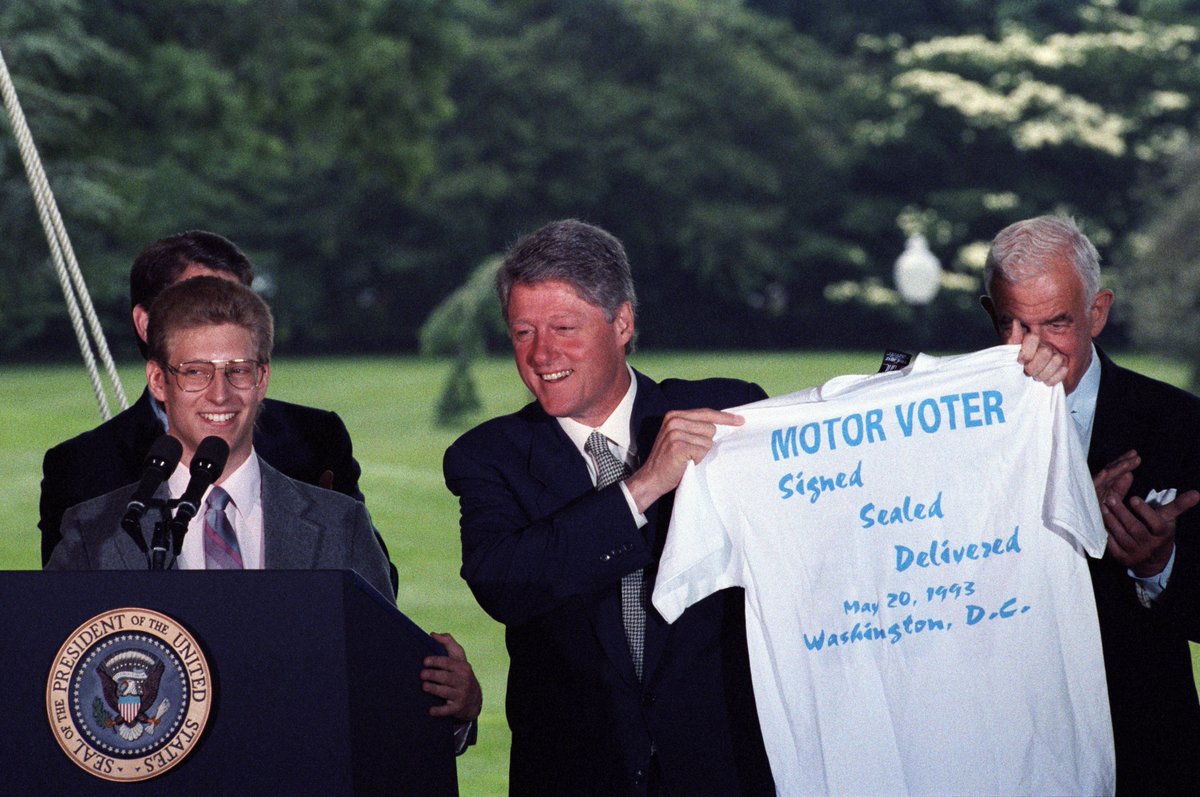
For decades, Congress has legislated in this space through statutes that set federal baselines for registration and election administration. The best-known anchor is the National Voter Registration Act of 1993 (NVRA), often called the Motor Voter law.
In practical terms, the NVRA requires states to offer voter registration opportunities through motor vehicle agencies, provides for a federal mail registration form for federal elections, and places guardrails on certain kinds of list maintenance, including notice and waiting-period requirements for some removals from the voter rolls.
NVRA registration commonly relies on an attestation under penalty of perjury. On the federal form, applicants are asked to affirm they are U.S. citizens and meet eligibility requirements, then sign under penalty of perjury. That baseline is the center of the proof-of-citizenship dispute: should a sworn statement be enough to get onto the rolls for federal elections, or must an applicant produce documents up front?
The Supreme Court addressed a key version of that conflict in Arizona v. Inter Tribal Council of Arizona (570 U.S. 1 (2013)). The Court held that Arizona could not require documentary proof of citizenship from people registering for federal elections using the NVRA federal form, because the NVRA’s accept-and-use requirement preempted that added state demand.
The Court also emphasized that states are not powerless, but the path is not automatic. A state may ask the Election Assistance Commission (EAC) to include additional state-specific instructions on the federal form. That process later produced additional litigation over EAC decisions and state requests, including disputes involving Kansas and Arizona over proof-of-citizenship instructions.
A common point of confusion is scope. The 2013 case was about the federal form for federal elections. It did not create a blanket rule that states can never ask for citizenship proof in any context. States have experimented with separate state forms and other mechanisms, subject to federal law, state law, and constitutional constraints.
Dual Systems Risk
A practical question is whether the SAVE Act would push states toward parallel tracks, one set of rules for federal registration and another for state-only registration. The bill is aimed at the federal registration baseline, but states administer registration, and many already operate systems where federal and state requirements do not line up perfectly.
If documentary proof becomes mandatory for covered NVRA registration for federal elections, election offices could face a choice in implementation: align state registration rules with the federal proof requirement for simplicity, or maintain separate pathways. Either way, the administrative burden is not abstract. It shows up as staffing, training, database workflows, and voter-facing error handling.
Implementation Issues
Even when the legal rule sounds simple, election administration is not. A documentary-proof mandate forces concrete design choices that can drive both access and litigation. The most important pressure points tend to be:
- Submission format: whether photocopies, scanned uploads, or in-person inspection are permitted, and how applicants are protected from document loss.
- Verification and mismatch: what happens when records do not match because of hyphenated names, transliterations, or data-entry errors, and whether the office must provide a standardized notice and cure path.
- Privacy and retention: whether copies are stored, for how long, and under what security requirements, especially if sensitive documents are uploaded or copied.
- Cure timelines: what notice is required, what the cure window is, and how close to an election an applicant can realistically fix a problem and still be registered on time.
These points are where early disputes tend to concentrate, because they determine who is successfully added to the rolls and how quickly problems can be corrected.
Who Feels It Most
Citizenship documentation rules tend to land hardest in ordinary edge cases. A few examples illustrate why processing details, notice, and error handling matter:
- Naturalized citizens: a voter may be fully eligible but need replacement naturalization or citizenship documents, which can take time and cost money.
- Name changes: a voter may have citizenship records in a prior name and need additional linking documentation.
- Older voters: some citizens, particularly those born at home or in jurisdictions with inconsistent early recordkeeping, may not have an easily obtainable birth record.
Supporters argue these issues can be reduced by a broad document list, clear acceptance rules, and workable cure procedures. Critics argue that even a well-administered documentation mandate creates friction that screens out eligible voters, especially near deadlines.
State Voter ID Rules
Many states already require some form of identification to vote, and those laws have been widely litigated. The constitutional analysis typically turns on a mix of:
- The state’s interest in preventing fraud and maintaining public confidence.
- The burden on voters, including how easy it is to obtain an acceptable ID and whether alternatives exist such as provisional ballots, affidavit options, or free IDs.
- Equal protection and voting rights constraints, especially if a law disproportionately burdens particular groups and the state cannot justify the design.
The federalism point is this: states can set rules for elections they administer, and those rules can apply to federal races on the ballot, unless federal law overrides them for federal elections. Congress’s authority over House and Senate election procedure is broad enough that Congress can impose national standards, loosen state standards, or tighten them, so long as it stays within constitutional boundaries.
Also note the practical reality: even in federal elections, registration is largely state-run. Federal statutes often work by setting floor rules and preempting conflicting state procedures, not by replacing state election offices.
What the Constitution Does Not Say
The Constitution does not contain a single sentence that says voters must show ID or that proof of citizenship is required at registration. Instead, it allocates authority and sets constraints, while leaving much of the machinery to statutes and election administration.
Citizenship is the dominant eligibility rule in modern American elections, but the constitutional framing is more nuanced than a single clause. For House elections, Article I ties the federal electorate to state voter qualifications, and later amendments limit how governments can exclude voters or impose discriminatory barriers. The fight becomes about the mechanics of proving eligibility and how burdensome those mechanics can be.
Why Rules Votes Stall
To outsiders, it can feel counterintuitive: why would a dispute over one bill freeze unrelated action? The answer is that the House runs on procedural gatekeeping.
What a Rule Is
A House rule is typically a simple resolution that sets the terms for debating a bill on the floor. It is not a statute. It does not go to the Senate. It is not signed by the President. It is the House setting its own operating conditions for a specific piece of legislation.
The Rules Committee
Most major bills reach the House floor under a rule reported by the House Rules Committee. That rule sets the terms of debate, including how long members can speak and which amendments are allowed.
If the House cannot adopt the rule for bringing legislation forward, the schedule can collapse. Even if a majority supports moving on to other priorities, the floor cannot easily proceed without the procedural vehicle.
June 2024 standoff
The June 2024 flare-up centered on special rules, with a clear demand from a conservative bloc: no more procedural votes for unrelated floor business unless leadership scheduled floor action on the SAVE Act.
June 12, 2024: the House considered H. Res. 1290, the special rule to bring up the annual National Defense Authorization Act package. The vote on ordering the previous question failed, 205 to 212, on Roll Call 246.
June 20, 2024: the House considered H. Res. 1321, the special rule for the Defense Appropriations bill. The vote on ordering the previous question failed, 193 to 203, on Roll Call 283.
Mechanically, a special rule is the gate for most major floor action. When the rule vote fails, the underlying bill is typically not brought up under that planned structure.
What Happened Next
The procedural fight did not stay hypothetical. The House ultimately held a floor vote on the SAVE Act itself.
House passage: H.R. 8281 passed the House on July 10, 2024 and was sent to the Senate.
Senate status: as of this update, the bill has not advanced in the Senate. In other words, the House did what the holdouts demanded, but the bill’s path from there still depends on Senate scheduling, procedure, and votes.
Can the House Force the Senate
Not directly. The House and Senate are separate chambers with separate calendars, separate rules, and separate political incentives. The House can pass a bill and send it to the Senate, but it cannot compel the Senate to take it up, vote on it, or pass it.
So why use a blockade to try to pressure Senate action? Because the only thing a bloc can reliably force is action inside the House. The theory is that internal cost changes leadership’s strategy, which changes messaging pressure on the Senate, which changes Senate incentives. That is politics, not constitutional command.
How Lawsuits Would Start
If a federal proof-of-citizenship requirement became law, the first wave of litigation would likely be fast and injunction-focused. Early cases would probably turn less on abstract theory and more on implementation details, especially close to an election.
- Likely plaintiffs: affected voters, voting-rights groups, state or local election officials depending on compliance burdens, and private plaintiffs empowered by the statute’s civil enforcement provisions.
- Early arguments: whether the requirement functions like an added qualification in practice, whether the burden is justified under Anderson-Burdick balancing, and whether the statute’s processing rules provide adequate notice and due-process protections for eligible applicants.
- Federal baseline fights: because the bill operates by changing the federal baseline under the NVRA framework, states and litigants would also fight about preemption and implementation, including how federal rules interact with existing state registration systems and deadlines.
- Immediate remedies: temporary restraining orders and preliminary injunctions aimed at stopping enforcement while courts evaluate the record.
What to Watch
The daily headlines will keep focusing on the drama: who is blocking what, who is furious at whom, and what leadership promised behind closed doors. If you want the civics underneath it, watch these signals instead:
- The qualifying document rules, including how the statute defines acceptable proof and how it treats common documents such as passports, birth records, and naturalization papers.
- The submission and cure rules, including what election offices must do when documentation is missing or mismatched and how close to an election a problem can be fixed.
- The enforcement design, including the mens rea requirement in the criminal provision and the statute’s civil enforcement tools that could accelerate litigation.
- The rollout timeline, because late implementation is where both voter friction and emergency litigation tend to spike.
The Constitution sets the stage, but it does not write the script. The SAVE Act debate is ultimately about how aggressively Congress should police eligibility in federal elections, and how much administrative risk the system is willing to accept in exchange for tighter up-front verification.