
When a high-profile political figure says new election-security intelligence has been declassified and released, the argument that follows is usually louder than the documents themselves. But the constitutional question underneath all the noise is actually straightforward.
Who has the power to secure American elections, especially the parts people argue about most: voter rolls, machines, foreign hacking, and the money Washington sends to help states run elections?
The Constitution does not give you a single neat “Election Security Clause.” It gives you a shared system with overlapping authority and, inevitably, overlapping conflict. That design is why election administration is mostly state-run, why Congress can still set national rules, and why federal agencies like DHS can do a lot, but not everything, even in the name of “integrity.”
Join the Discussion
The blueprint: states first, Congress can override
Start with two provisions that do most of the work.
Article I, Section 4: The Elections Clause
The Elections Clause says that the “Times, Places and Manner” of congressional elections are prescribed by state legislatures, but Congress may “at any time” make or alter such regulations. The Clause also contains an express carveout for “the Places of chusing Senators,” language that is largely mooted by the 17th Amendment but is worth quoting accurately.
That sentence is the Constitution’s power-sharing agreement for federal elections. It is also the reason both of these statements can be true at once:
- States administer elections day to day.
- Congress has broad authority to set nationwide rules for federal elections.
The Supreme Court has repeatedly described Congress’s Elections Clause power as expansive. In Arizona v. Inter Tribal Council of Arizona (2013), for example, the Court held that a federal statute governing voter registration for federal elections can preempt contrary state requirements.
Article II: The Electors Clause
Presidential elections are not directly governed by the Elections Clause. Article II says each state appoints presidential electors “in such Manner as the Legislature thereof may direct.” Over time, every state has chosen a popular election as that “manner,” but the constitutional source is different.
On the basic point that states have wide latitude to choose how they appoint electors, the Court has long said so directly. See McPherson v. Blacker (1892). At the same time, that state authority runs through ordinary state law constraints, including state constitutions and state courts’ ordinary interpretive role. The Court underscored that in Moore v. Harper (2023), rejecting the idea that state legislatures operate free of their state constitutions in federal-election settings.
Even so, Congress is not absent. The Constitution gives Congress authority over the time of choosing electors and the day they vote. And federal constitutional rights still apply to how a state conducts the process.
Voter rolls: state-run, federally bounded
“Voter rolls” sound like a simple list. In practice, they are the product of a constant tug of war between access and accuracy, with the Constitution acting as referee through both structure and rights.
Who maintains voter registration lists?
States and local election officials maintain voter registration databases. That is part of the “manner” of holding elections, which starts with the states. County registrars, state election directors, and secretaries of state typically control the mechanics: who is added, removed, marked inactive, or flagged for follow-up.
What federal laws shape list maintenance?
Congress has used its Elections Clause power (and, in some areas, its enforcement power under the Reconstruction Amendments) to regulate voter registration and list maintenance for federal elections. The major statutes include:
- The National Voter Registration Act of 1993 (NVRA), which governs registration opportunities and sets rules for list maintenance, including limits on systematic removals close to a federal election (the NVRA’s 90-day “quiet period”).
- The Help America Vote Act of 2002 (HAVA), which requires states to maintain a “single, uniform, official” statewide voter registration database and provides federal funds tied to certain election administration improvements.
- The Voting Rights Act of 1965 (VRA), which prohibits racial discrimination in voting and, through later amendments, includes language-access protections. The VRA is not a list-maintenance statute, but it often intersects with roll practices when removals, verification rules, or registration barriers have discriminatory effects.
These statutes do not “federalize” election administration. They set floors and rules for federal elections, leaving states substantial room to choose how they meet the requirements.
What the Constitution limits, even when a state controls the list
Even if a state “owns” the database, it cannot run it in ways that violate constitutional rights. The key constraints include:
- Equal Protection (14th Amendment): similarly situated voters cannot be treated arbitrarily differently without adequate justification.
- Due Process (14th Amendment): when the state deprives someone of the practical ability to vote by removing them, the procedures must be fundamentally fair in context.
- The 15th, 19th, 24th, and 26th Amendments: states cannot deny or abridge voting rights on the prohibited grounds (race, sex, poll taxes in federal elections, and age for citizens 18+).
This is why voter roll fights often end up sounding technical. They are technical. A purge policy can be lawful in the abstract and unlawful in application depending on notice, error rates, discrimination, and the practical burden imposed.
Machines and audits: federal guidance, state control
When people say “election security,” they often mean voting systems: the machines that mark or scan ballots, the tabulators that total results, and the post-election checks that test whether the totals match the paper.
What the federal government does here
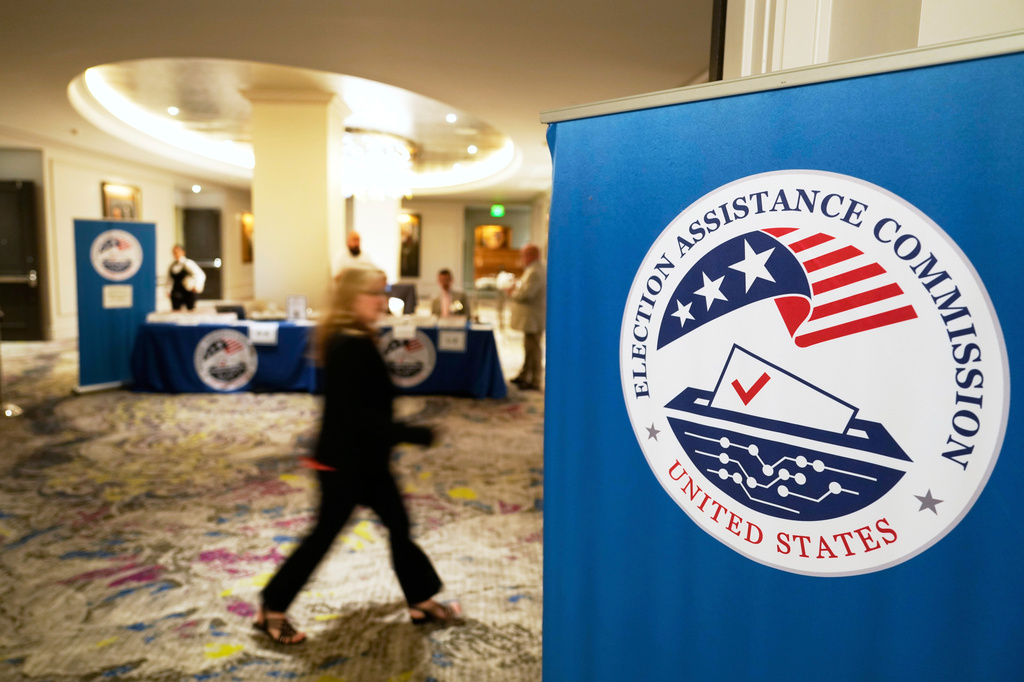
The federal government’s central institution for voting systems is the U.S. Election Assistance Commission (EAC). Under HAVA, the EAC supports testing and certification programs and issues the Voluntary Voting System Guidelines (VVSG). As the name says, the VVSG are voluntary at the federal level, but many states build their certification rules and procurement decisions around them.
Separately, federal constitutional and statutory rules still apply. For example, disability-access requirements and anti-discrimination rules can influence what systems states must deploy and how they must be usable.
What states do (and why it matters)
States decide what equipment to buy, how to certify it under state law, and what checks to run after an election. That includes recount rules and post-election audits, including risk-limiting audits in states that use them. These audits are not a constitutional requirement everywhere, but they are one of the clearest ways states can turn “security” into verifiable evidence, especially when the voting system produces a voter-verifiable paper record.
Election security and DHS: CISA coordinates, states administer
Modern election security lives at the intersection of law, technology, and federalism. That intersection is also where a lot of misunderstanding breeds.
What DHS can do
Within the Department of Homeland Security, the Cybersecurity and Infrastructure Security Agency (CISA) is the main hub for election security coordination. DHS designated election infrastructure as “critical infrastructure,” and CISA uses that framework to support collaboration with state and local officials.
In practice, that typically means threat briefings, information sharing, vulnerability assessments offered on request, incident response assistance, and best-practice guidance. It is help and coordination, not command.
What DHS cannot do, on its own
DHS is not a national election board. It cannot unilaterally rewrite state voter registration rules, commandeer state election officials, or impose new legal standards without statutory authority from Congress.
That limit comes from basic separation of powers (agencies need legal authority) and the anti-commandeering principle: the federal government generally cannot order state officials to administer a federal regulatory program. Washington can regulate individuals directly and it can preempt conflicting state rules in areas where it has constitutional power, but it cannot simply conscript state administrators because it would be more efficient.
Funding leverage: real, but limited
This is where “power” often hides, because it looks like money.
Congress has a Spending Clause power to tax and spend for the general welfare. That power is why federal election support exists at all, including grant programs created or expanded after 2000 and 2002.
It is also worth being precise about which entities do what. Much of the election-specific funding architecture runs through HAVA and the EAC. DHS and CISA, meanwhile, are most visible for services, coordination, and security assistance, and DHS-linked grant programs are generally broader homeland-security streams rather than the main pipeline for HAVA election administration money.
Conditions on federal funds are real, but not limitless
Congress can attach conditions to grants that states accept, and the executive branch can implement those conditions through agencies. But Supreme Court doctrine imposes guardrails. The classic framework comes from South Dakota v. Dole (1987) and later cases such as NFIB v. Sebelius (2012):
- Clarity: conditions must be stated unambiguously so states know what they are agreeing to.
- Relatedness: the condition should relate to the federal interest in the program.
- Constitutionality: the condition cannot require states to violate the Constitution.
- No coercion: at some point, “encouragement” becomes unconstitutional pressure, especially when the amount of money at stake leaves a state no practical choice.
So could Congress say, “If you want this election security grant, you must meet baseline cybersecurity practices for systems that support federal elections”? That is plausibly within Spending Clause norms if it is clear and connected to the purpose of the grant.
Could a federal agency, without clear congressional authorization, announce new voter-roll eligibility rules for all states and threaten to cut off unrelated funding? That is much harder to justify. The further the condition drifts from the program’s purpose, and the more it resembles compulsion rather than choice, the shakier the constitutional ground.
Declassified intelligence: what it proves, and what it does not
Declassification sounds like a verdict. It is not. It is an administrative decision about what information can be shared without damaging national security interests.
What declassified material can legitimately show
- Threat assessments: what agencies believed foreign actors were attempting, what tactics were observed, and what systems were targeted.
- Vulnerabilities: known or suspected weaknesses in election-related networks, software supply chains, or administrative processes.
- Attribution analysis: sometimes, the evidence and reasoning used to attribute a cyber operation to a foreign government or group.
What it usually cannot establish by itself
- That votes were changed: a vulnerability is not the same thing as exploitation, and exploitation is not the same thing as an outcome-altering change in tabulation. That is where paper records, audits, recounts, and chain-of-custody evidence matter.
- That a specific state process was unlawful: legality often turns on state statutes, federal statutes like NVRA and HAVA, and facts on the ground, not on intelligence summaries.
- That a remedy is constitutionally available: even a serious national security concern does not automatically create new federal powers. It still has to route through Congress’s enumerated powers and existing statutes.
In other words: declassified documents can be important evidence about risk. They are not a self-executing rewrite of election law.
Foreign interference: where federal power is strongest
If there is a category of election security that most clearly belongs to the federal government, it is foreign interference.
Even though states run elections, the national government has constitutional authorities related to foreign affairs and national defense, plus statutory tools enacted by Congress: federal criminal law, counterintelligence authorities, sanctions regimes, and incident response mechanisms. Cyber intrusions by foreign actors can trigger federal jurisdiction and federal action quickly.
But even here, there is a constitutional distinction worth keeping straight: the federal government can target the foreign actor and the cross-border operation aggressively. That does not necessarily mean it can dictate every aspect of how a county clerk runs list maintenance or how a state verifies voter registration, absent a statute that validly exercises congressional power.
Responsibility: divided by design
Americans want two things that can pull against each other: broad access to the ballot and strong assurance that only eligible voters vote and that every valid ballot is counted accurately.
The Constitution addresses that tension by splitting responsibility:
- States handle administration, including registration systems, voter rolls, polling logistics, equipment choices, and most practical security measures.
- Congress can set national rules for federal elections, and can fund improvements with conditions attached.
- Federal agencies can support, investigate, coordinate, and implement statutes, but cannot invent power outside the laws Congress has passed.
- Courts police the boundary lines: preemption, equal protection, due process, and the outer limits of conditional spending.
This is a feature, not a bug, of constitutional design. It is also why election integrity debates keep recurring. Our system is decentralized enough to resist a single point of failure, and fragmented enough that no single actor can promise perfection.
Quick answers
Can the federal government force states to clean voter rolls a certain way?
For federal elections, Congress can regulate registration and list maintenance through statutes grounded in the Elections Clause and other constitutional powers. States still do the work, but they must comply with valid federal law such as the NVRA and HAVA.
Can DHS set election security rules for states?
DHS, mainly through CISA, can coordinate and provide services. Binding legal rules generally require a statute (and, where appropriate, valid regulations under that statute). DHS cannot simply announce new nationwide election administration standards and compel states to follow them.
Does declassified intelligence prove an election was hacked?
Not by itself. It can support claims about threats and vulnerabilities. Proving an actual manipulation of votes requires evidence tied to systems, audits, paper records, chain-of-custody, and specific outcomes, not just the existence of risk.
Who ultimately certifies election results?
States certify their own results under state law. Presidential electors are appointed under state processes. Congress plays a limited role in counting electoral votes under federal law, but it does not run the state certification machinery.
The takeaway
Election security is real, and foreign threats are real. But the Constitution’s answer is not “give Washington total control.” It is “give Washington real tools, but make it earn them through law.”
That means the next time new “election integrity” documents drop, the key questions are not only technical. They are constitutional:
- What power is being invoked, Article I, Article II, or a statute?
- Is the federal government regulating federal elections, or trying to commandeer state administration?
- Is the leverage coming from preemption, from spending conditions, or from criminal and national security authority?
Those distinctions do not decide politics. They decide what the government is allowed to do next.