
The Electoral College is one of those civic objects everyone can name and almost no one feels they fully understand. That confusion spikes whenever critics call the system illegitimate, outdated, or even an “abomination.” The rhetoric is more prominent now. The structure is not.
The Electoral College is not a custom or a gentleman’s agreement. It is constitutional machinery. Its foundations begin in Article II, Section 1, and the modern system is materially shaped by the Twelfth Amendment (how electoral votes are cast and counted), the Twentieth Amendment (contingency timing around inauguration), and the Twenty-Third Amendment (DC’s electors), among others. Federal statutes in Title 3 of the U.S. Code, including the Electoral Count Reform Act of 2022, supply key process rules, such as the dates for elector voting and the procedures for Congress’s joint-session count. Any serious attempt to abolish the Electoral College runs straight into the amendment process, which is designed to be slow, difficult, and state-centered.
Join the Discussion
What it is
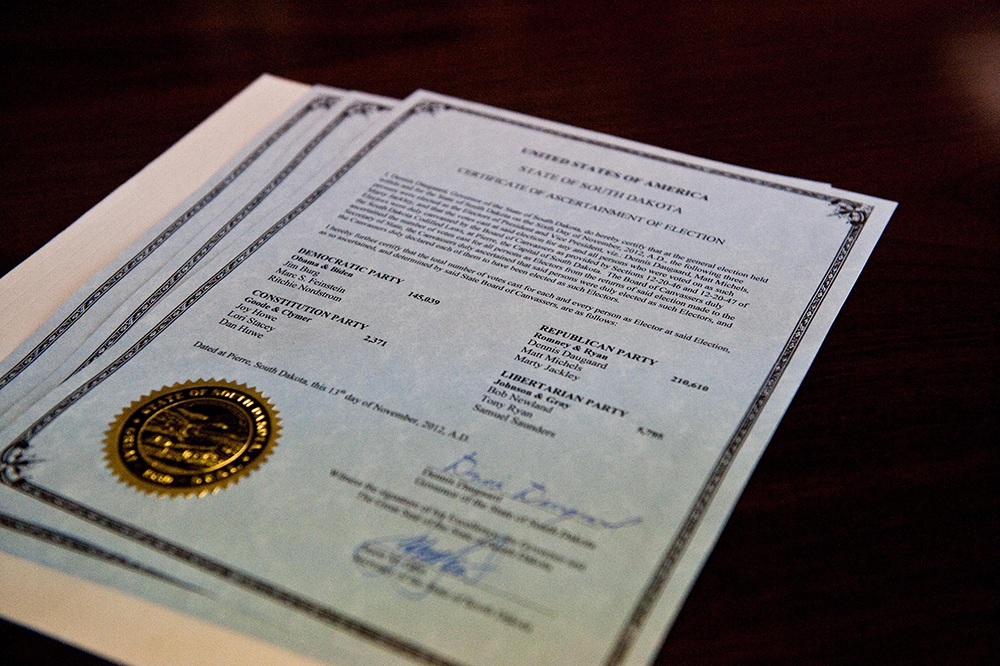
In plain terms, Americans do not vote directly for president. We vote for a slate of electors, and those electors cast the legally meaningful votes for president and vice president.
That indirect election is the Electoral College. It is a 538-member body today, because:
- Each state gets electors equal to its total representation in Congress: House members + 2 Senators.
- The District of Columbia gets 3 electors under the Twenty-Third Amendment.
- 270 electoral votes are needed to win a majority.
So when people say, “The popular vote does not decide the presidency,” they are not describing a glitch. They are describing the design.
Where the Constitution creates it
The Electoral College begins in Article II, Section 1, especially the clauses that authorize each state to appoint electors and set the basic process for casting and transmitting electoral votes. The core sentence is short but powerful: each state shall appoint electors “in such Manner as the Legislature thereof may direct.”
That means the Constitution leaves two critical choices largely to the states:
- How electors are chosen (today, states and DC conduct a popular election for electors, but Article II does not require a statewide popular vote).
- How the state’s electoral votes are allocated (winner-take-all is a state choice, not a constitutional command).
Article II also sets up the basic concept of electors meeting in their states and transmitting their votes for counting at the federal level.
Why the Twelfth Amendment matters
If you try to understand the Electoral College using only Article II, you are reading a first draft. The original design assumed electors would cast two votes for president, and the runner-up would become vice president. That produced a constitutional mess in the election of 1800.
The fix is the Twelfth Amendment (1804). It requires electors to cast distinct votes for president and vice president. It also formalizes the contingency plans if no candidate wins a majority:
- If no presidential candidate gets a majority of electoral votes, the election goes to the House of Representatives, choosing among the top three.
- In that House election, each state delegation gets one vote.
- If no vice presidential candidate gets a majority, the election goes to the Senate, choosing among the top two.
This is why the Electoral College is not just about election night maps. It is also about what happens if the map breaks.
How electors are allocated
The Constitution tells us how many electors each state gets. It does not tell states how to award them. Over time, states converged on a common rule: winner-take-all statewide.
Today, 48 states plus DC use winner-take-all. Two states use a different approach:
- Maine and Nebraska allocate some electors by congressional district, with additional electors for the statewide winner.
The important constitutional point is this: because Article II gives state legislatures the power to direct the “manner” of appointment, states can, within broad limits, redesign their own allocation systems without a federal constitutional amendment. In practice, those changes are constrained by federal constitutional doctrine (including equal protection and one-person, one-vote issues if districts are used), federal voting rights law, and each state’s own constitution and election statutes.
Why critics call it undemocratic
Critics generally focus on three features of the system, all of which are structural rather than accidental.
1) A candidate can win without winning the national popular vote
This is the most visible complaint, and it is not hypothetical. Because electoral votes are awarded state-by-state, a candidate can assemble 270 electoral votes while receiving fewer votes nationally. It has happened in modern elections, including 2000 and 2016.
2) Votes do not translate evenly across state lines
Because every state gets two electoral votes tied to its Senate seats, less populous states receive a baseline boost relative to population. That is a structural feature of the same small-state protection built into the Senate itself.
3) Winner-take-all amplifies narrow statewide margins
If a state awards all electors to the statewide winner, a close result can translate into a total sweep of that state’s electoral votes. But that amplification is not required by the Constitution. It is chosen by states, and it could be changed by states.
Why it exists
The Founding era arguments for an Electoral College were not one single reason, but a bundle of compromises and anxieties:
- Federalism: the president would be chosen through a process that runs through the states, not over them.
- Separation of powers: Congress would not directly choose the president in the ordinary course, reducing the risk of legislative dominance.
- Practical limits of the 1780s: slow information, weak national parties at the time, and concerns about coordinating a national vote.
- Compromise over representation: the same constitutional architecture that balanced large and small states in Congress influenced presidential selection.
Some of those justifications feel dated. Others remain tied to the Constitution’s deeper design choice: the United States is a republic of states, not a single national electoral district.
Can it be abolished?
Yes, but not by ordinary legislation. To abolish the Electoral College and replace it with a national popular vote, you would almost certainly need a constitutional amendment, because Article II and the Twelfth Amendment hard-code electors and an electoral vote count.
The amendment process is in Article V:
- Proposal by two-thirds of both Houses of Congress, or by a convention called by two-thirds of state legislatures.
- Ratification by three-fourths of the states, either by state legislatures or state ratifying conventions (as Congress chooses).
That threshold is why “abolish it” is constitutionally simple and politically difficult. Any reform that reduces the influence of smaller states asks those states to vote against their own leverage.
What can change without an amendment?
Quite a lot, actually. The Electoral College is a constitutional skeleton. States supply much of the muscle.
States can change allocation rules
States can move away from winner-take-all and adopt district-based allocation, proportional allocation, or other systems, subject to federal constitutional limits, federal voting rights law, and the guardrails of each state’s own legal framework.
States can join interstate agreements
The most discussed is the National Popular Vote Interstate Compact, an agreement among participating states to award their electors to the national popular vote winner once states totaling at least 270 electoral votes have joined.
Whether such a compact ultimately requires congressional consent under the Constitution’s Compact Clause is a recurring legal question. Its durability would likely be tested in court if it ever took effect in a close election.
Congress can set process details
Congress cannot delete the Electoral College by statute, but it can regulate parts of the process. Federal law sets key dates, including the day states choose electors and the day electors meet to vote, and it governs how Congress conducts the joint-session count.
Much of the modern timetable and counting framework sits in 3 U.S.C., and the Electoral Count Reform Act (2022) updated several guardrails, including raising the threshold for objections in Congress and clarifying the vice president’s limited, ministerial role in the count. The 2022 reforms also align with long-standing “safe harbor” concepts in federal law that encourage states to resolve election disputes by a set deadline so their certifications receive conclusive effect in the count.
Faithless electors
Another common question: can an elector ignore the state’s vote and pick someone else?
The Constitution does not explicitly require electors to follow the popular vote. But states have increasingly bound electors to the state’s result through laws and party rules. The Supreme Court upheld state authority to enforce elector pledges in Chiafalo v. Washington (2020), meaning states can penalize or replace electors who try to defect.
So while the idea of independent, deliberative electors exists in the origin story, modern constitutional law largely treats electors as agents of their state’s chosen process.
Timeline at a glance
If you want the process without the footnotes, the basic sequence looks like this:
- Election Day: voters choose slates of electors under state rules.
- After the election: states certify results and finalize which electors are appointed.
- Elector meeting day: electors meet in their states on the date set by federal law and cast ballots.
- Joint session of Congress: electoral votes are opened and counted under the procedures in 3 U.S.C., as updated in 2022.
What to watch in the next news cycle
When the Electoral College dominates headlines, two different claims tend to blur together.
- Claim A: “We should have a popular vote.” That is a policy argument, and reasonable people disagree.
- Claim B: “We can get a popular vote quickly.” That is a constitutional mechanics question, and the answer depends on whether you mean an Article V amendment or state-by-state workarounds.
If you want to evaluate proposals without getting dragged into a partisan trench, ask three concrete questions:
- Does the proposal require changing Article II or the Twelfth Amendment? If yes, it is an Article V amendment fight.
- Does it rely on states changing allocation rules? Then federalism, state politics, and partisan incentives do most of the work.
- Does it depend on an interstate compact? Then the Compact Clause and post-election litigation risk become central.
It also helps to know the calendar at a high level. States certify results and appoint electors under state law. Electors meet in their states on the federally set date to cast their ballots. Then Congress counts those votes in a joint session under the procedures in 3 U.S.C., as updated in 2022.
The bottom line
The Electoral College survives because it is not merely tradition. It is embedded in the Constitution’s choice to balance national democracy with state-based power. Critics call it an “abomination,” defenders call it a safeguard, and both sides can point to real consequences. But neither side can pretend it is easy to remove.
To change it permanently, you need to change constitutional text or build a stable state-by-state substitute that can survive courts, elections, and the next round of political incentives. That is the difference between an argument about what is fair and a plan that can actually become law.