
Hollywood loves a clean story arc: tension, stakes, a ticking clock, and a final scene that changes what comes next.
The 2026 midterms have all of that. Not because actors and executives are suddenly the main characters of American politics, but because campaigns still run on attention and money, and the entertainment industry can supply both.
This year, the energy is concentrating around a short list of contests that keep pulling people back in, largely because control of Congress and the Senate is on the line and candidates have been making the Los Angeles circuit. A handful of Senate races, the high-profile Los Angeles mayor’s race, and California’s Proposition 40 are the ones donors and organizers keep circling, even with visible fatigue. Propositions 41 and 42 are also in the mix, with Silicon Valley money involved there too.
Join the Discussion
Why it feels intense
Among left-leaning activists and donors in Hollywood, the dominant mood heading into Tuesday is anxiety, tempered by cautious optimism. That sits on top of something else that has been visible all cycle: fatigue.
People have been carrying the after-effects of the crushing losses of 2024, the devastating wildfires, and the industry’s production downturn. As candidates courted the industry’s deep pockets at tony backyard venues and through one-on-one phone calls, the burnout was hard to miss.
Still, the past month brought a shift. As Democrats’ chances of retaking control of the House and the Senate held steady or improved, more candidates rotated through Los Angeles, including Sen. Jon Ossoff, James Talarico, Sherrod Brown, and Abdul El-Sayed.
Jon Vein, an entrepreneur and longtime Democratic donor and activist, said the uptick is real. “People recognize the importance of taking the Senate as it relates to a whole bunch of things, including lifetime appointments to the Supreme Court,” he said.
At the top end, GLS Partners political consultant Andy Spahn described a different dynamic: “considerable dropoff at the major donor level, particularly if measured by support for major Democratic national committees.” But he also described “high energy” from smaller donors, including new donors and those giving directly to candidates such as Ossoff and Talarico.
The money picture
A few very specific checks help explain the shape of the cycle.
Netflix co-founder Reed Hastings has contributed more than $2.5 million to the House Majority PAC and $1 million to the Senate Majority PAC. He also gave $300,000 to Hakeem Jeffries’ Victory Fund and almost $600,000 to the Democratic Congressional Campaign Committee.
On the Republican side, Skydance CEO David Ellison late last year gave $250,000 to Security is Strength PAC, the committee formed to support the late Sen. Lindsey Graham (R-SC) and now backing Graham’s sister, Darline. Ellison also gave extensively to Democrats last cycle, including almost $1 million to Joe Biden’s campaign, with Kamala Harris taking over the campaign after he dropped out.
Organizing, not just donating
It has not all been about wiring money.
Mathew Littman, who leads The Working Group, which organizes Hollywood creatives, traveled to Michigan last month with about a dozen others to campaign with Jocelyn Benson, the Democratic nominee for governor, and to attend party rallies.
He also hosted a Zoom organizing and fundraising call that included candidates such as Sherrod Brown, Ohio gubernatorial candidate Amy Acton and Texas gubernatorial nominee Gina Hinojosa.
Georgia: Ossoff vs. Mike Collins
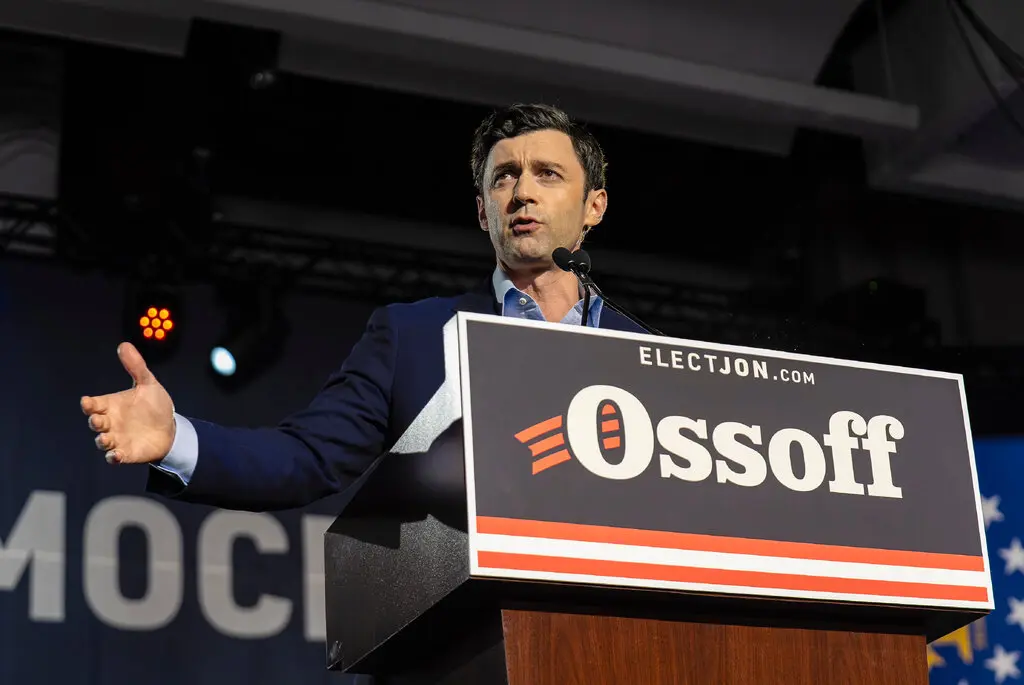
In Georgia, Sen. Jon Ossoff’s race against Mike Collins has become a clear example of where Hollywood giving is showing up most visibly. Donors have showered Ossoff with contributions, reflecting not just his multiple trips to the West Coast but also the possibility that he will be a 2028 presidential contender, even though he denies he is interested.
His most recent trip included two Hollywood-centered events in October, including one hosted by James Costos. Contributors include Sally Field, Peter Chernin, Joseph Gordon-Levitt, Chuck Lorre and David Geffen.
Ossoff is widely expected to hold his Senate seat. The question many donors are asking is what the margin looks like on election night.
Texas: Talarico vs. Paxton
Texas is one of the races that has turned Hollywood attention into a very specific question: Can a Democrat finally flip a statewide Senate seat there?
James Talarico, the Texas state senator running against Ken Paxton, has fueled hopes that the seat could flip. A win would make him the first Democrat to win election to the U.S. Senate in Texas since 1988.
Talarico has run a campaign free from much drama and focused on the baggage of his opponent. He also has benefited from the publicity surrounding the FCC’s crackdown on broadcasters and the Equal Time Rule. His appearances on The Late Show with Stephen Colbert and Jimmy Kimmel Live! were never broadcast but placed on YouTube, where they drew much larger audiences.
His donors include Barbra Streisand, Damon Lindelof, Connie Britton, Don Henley, Bob Odenkirk, Marcy Carsey and Jon Cryer.
Ohio: Brown vs. Husted
Ohio is another major money draw, with one of the cycle’s most expensive Senate battles. Sherrod Brown is trying to return to the U.S. Senate, taking on incumbent Sen. Jon Husted (R-OH), who was appointed to the seat after JD Vance was elected vice president.
Industry donors for Brown include Tom Rothman, Bradley Whitford, Herb Alpert, Peter Coyote, Lily Tomlin and Judd Apatow. Others, including Michael Douglas, have donated to the Senate Majority PAC, which distributes funds across candidates including the Ohio race.
Iowa: Turek vs. Hinson
One of the closest contests is in Iowa, where Democrats are watching the race for the open Senate seat as forecasts swing back and forth. Democrat Josh Turek faces a major challenge from Ashley Hinson.
Turek has drawn support from Hollywood names that include Lawrence Kasdan, Streisand, Field and Dayna Bochco.
Michigan: El-Sayed vs. Rogers
Even before the weekend jolt in Michigan, Abdul El-Sayed’s race was shaped by fissures in the Democratic donor world over his criticisms of Israel.
Haim Saban has donated to numerous committees to help Democrats win back the House majority, while also contributing $2 million to the United Democracy Project, the super PAC of the American Israel Public Affairs Committee. The group invested heavily in Haley Stevens’ campaign and opposing El-Sayed, and it recently started spending again in the race.
El-Sayed has received contributions from supporters including Cynthia Nixon, Susan Sarandon, Lindelof and Jeffrey Soros.
The contest was jolted over the weekend when Stevens, El-Sayed’s Democratic rival for the nomination, endorsed Republican Mike Rogers. Littman said the endorsement was “the greatest disappointment I’ve had in politics.” One day later, El-Sayed picked up an endorsement from Bruce Springsteen, who wrote that he was “in his corner 100%.”
Los Angeles: Bass vs. Raman
Los Angeles has its own parallel political universe this year: the mayor’s race. Karen Bass is seeking another term, but she is facing a serious challenge from Councilwoman Nithya Raman, and the entertainment industry is divided.
A Berkeley IGS/Los Angeles Times poll last week showed the race tied among likely voters. Before that poll, there was widespread sentiment that Raman was on track to defeat Bass, who has faced backlash over how she handled last year’s wildfires and over the ongoing problem of homelessness.
Bass has gotten a boost in recent weeks as some of her most ardent critics, including Rick Caruso, have said they would vote for her. Bass has drawn contributions from Saban, Byron Allen, Marta Kauffman, John Wells and J.J. Abrams, as well as Sony and Warner Bros. Discovery. Raman’s donor list includes Paul Downs, Dustin Lance Black, Adam Scott, Ed Zwick and Gale Ann Hurd.
If the race is close, it could be days, or even weeks, before a winner is declared, given the notoriously long vote-counting process in Los Angeles County.
Maine and California
A few other contests are getting attention even if they are not drawing the same level of support as the biggest magnets.
That includes Maine, where Troy Jackson is running for U.S. Senate against incumbent Sen. Susan Collins. Jackson’s donors include Kauffman and Soros, while Collins has collected contributions from donors including Ben Silverman and Patricia Glaser.
In California, the governor’s contest has been comparatively quiet. Democrat Xavier Becerra has had a sizable polling lead over Republican Steve Hilton, a former Fox News host.
Then there is Proposition 40, a ballot measure that would impose a 5% tax on certain residents with assets of $1 billion or more. Campaign finance records show relatively little entertainment-industry money on either side. The main financial push has come from Silicon Valley, where Sergey Brin and Eric Schmidt are among those funding opposition to Prop 40, while also backing Proposition 41 and Proposition 42. Even with much of the spending coming from up north, Prop 40 is still being watched closely, and not without some worry.
What to watch Tuesday
Littman sounded confident, but not starry-eyed. “We are going to do well [Tuesday],” he said. “Compared to where we were two years ago, it is a gigantic change. One of the reasons for the change is we are running great candidates.”
He also argued that the overall level of activity is still lower than in past cycles, blaming “a lot of PTSD from 2024.” Even if Democrats have a strong night, he said that kind of political shellshock may linger into 2028. “People are so burnt out by what happened,” he said.
- Senate control: Whether Democrats can retake the chamber.
- Texas: Whether the party’s statewide Senate drought, dating to 1988, finally breaks.
- Michigan: How the Stevens endorsement, renewed outside spending, and the Springsteen boost collide.
- Los Angeles: Turnout, and whether the counting stretches into days or weeks.
- Prop 40: Whether voters sign off on a new billionaire tax, with much of the money fight coming from Silicon Valley.
Hollywood is watching because it is invested, personally and financially. But the real point is more basic: these races decide who has power next, and which coalitions can still bring energy after the spotlight shifts somewhere else.