

Less than 24 hours before polls opened across the country, President Donald Trump delivered his final scheduled public remarks not from a battleground state, but from one of Washington’s most recognizable landmarks: the Lincoln Memorial Reflecting Pool.
In a midterm closing moment when voters have been signaling anxiety about the cost of living, Trump chose to spotlight construction, aesthetics, and the nuts-and-bolts details of a renovation project that has become a personal fixation of his second term.
Join the Discussion
A closing message in concrete
Trump’s remarks on Monday unfolded at the Reflecting Pool itself, with signage around the platform reading “Restoring Our Capitol” and “The Reflecting Pool.” Nearby, a poster promised the pool was “Back, and more beautiful than ever!”
Trump talked at length about the makeover: new grass, pipes, algae issues, and even the exact shade of blue he selected for the pool’s bottom. At one point, he held up enlarged photos of rusted pipes taken during renovation work. He also announced the pool’s official re-opening, joked that he wanted to name it after himself, and repeated his false claims that vandalism caused problems with the project.
“For some reason, the sitting president doesn’t win the midterms, but we gave this a very strong shot,” Trump said at the Reflecting Pool. “We have a lot of great things planned for Washington, and I could get into the nation, but for that you don’t have enough time.”
After he finished, Trump stood silently while triumphant music played and he held up a poster showing the previously algae-clogged pool.
Why the location stands out
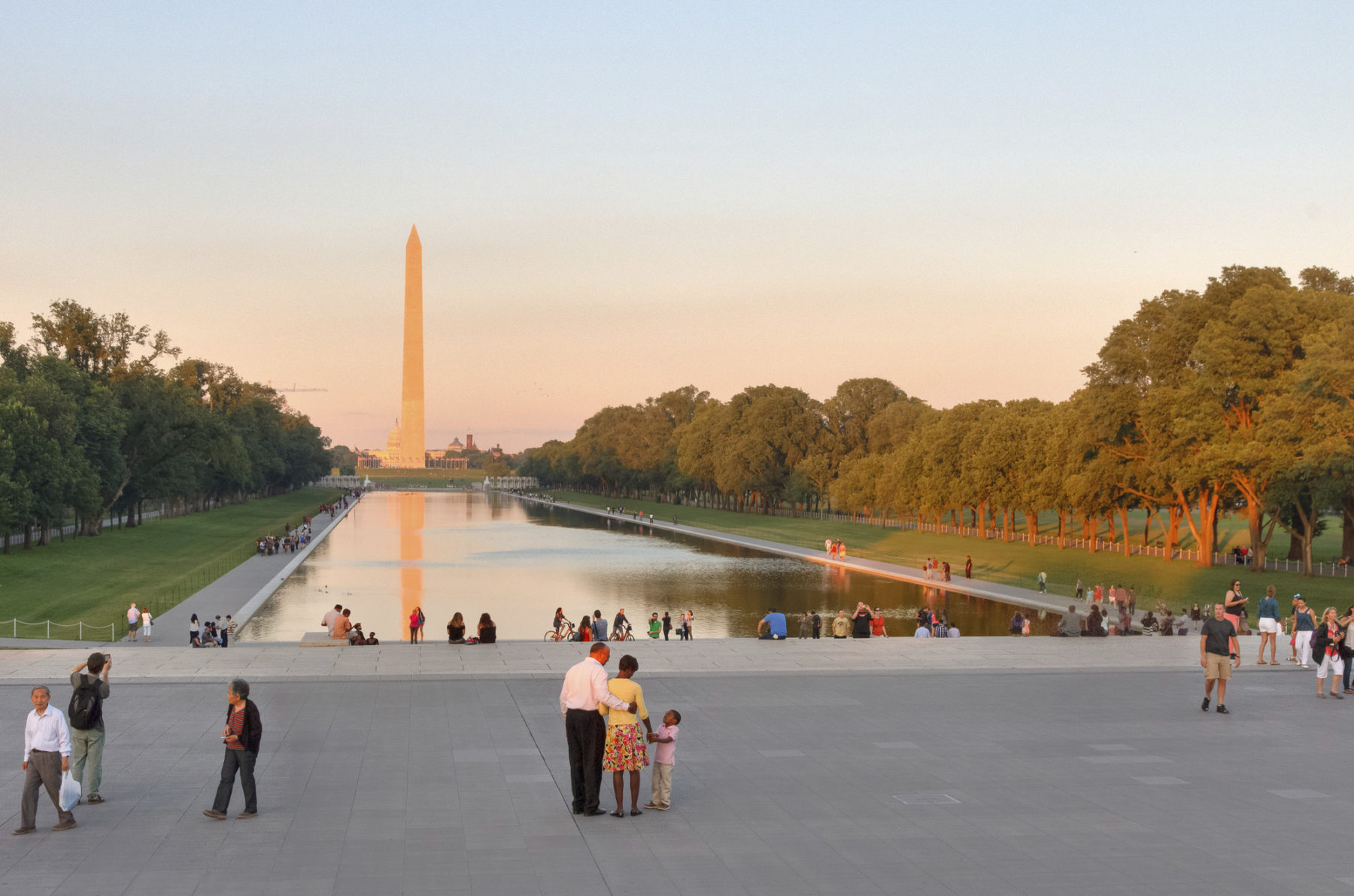
The Reflecting Pool, a long, narrow basin at the foot of the Lincoln Memorial, is one of Washington’s most iconic sites. Martin Luther King, Jr. delivered his 1963 “I Have a Dream” speech from the memorial’s steps, looking out over the pool.
The same site also served as the setting for Democrat Kamala Harris’ final pre Election Day 2024 address. That history is part of what makes Trump’s midterm-eve focus on pipes, paint, and landscaping feel so unusual.
Instead of making the location a backdrop for a broad, voter-centered argument, Trump treated the setting as the main event, even as Republicans and Democrats made their final pitch to voters across the country.
A makeover with setbacks
The project has been expensive and publicly messy. The shallow pool was soon clogged with algae blooms, and its “American-flag blue” liner began peeling and floating up in chunks.
The Justice Department charged former Olympian David Hearn with intentionally damaging the Reflecting Pool, but dropped the case this summer after determining he was not responsible.
Even so, Trump continued to repeat false claims that vandalism, rather than shoddy workmanship, was to blame for the new blue surface peeling away.
What was at stake
The dueling closing messages came as the nation’s two major parties battled for control of Congress and key governor’s offices, an outcome that could redefine Trump’s final two years in the White House.
Trump acknowledged that Tuesday’s election may not go well for him or his party. After his Reflecting Pool appearance, he was scheduled to participate in nine telerallies for Republican midterm candidates.
Vice President JD Vance, meanwhile, hit the campaign trail with more traditional stops in New York and Ohio, where Republicans were fighting for House and Senate seats.
Democrats push the economy amid a Michigan rift
Democrats, for their part, spent the eve of Election Day courting voters in areas where Republicans have long dominated, while trying to contain the fallout from a messy intraparty split in Michigan.
In that high-stakes Michigan Senate race, Democratic candidate Abdul El-Sayed brushed aside concerns that his prospects could be hurt after his former primary opponent threw her support behind his Republican opponent Mike Rogers. Haley Stevens, whom El-Sayed defeated in the August Democratic primary, endorsed Rogers on Sunday, infuriating Democrats who privately worried the infighting could change the outcome, especially if the final tally is close.
El-Sayed, campaigning in Ypsilanti alongside Michigan Democrat Debbie Dingell and Massachusetts Sen. Elizabeth Warren, told supporters: “If we’re nervous about where we’re going to go from here, go vote.”
In Iowa, where voters have not elected a Democratic governor in two decades, Democrat Rob Sand urged canvassers to use the final hours to try to flip the state. “This is it,” Sand said. “We have 30-whatever hours to change the direction of the state of Iowa.”