
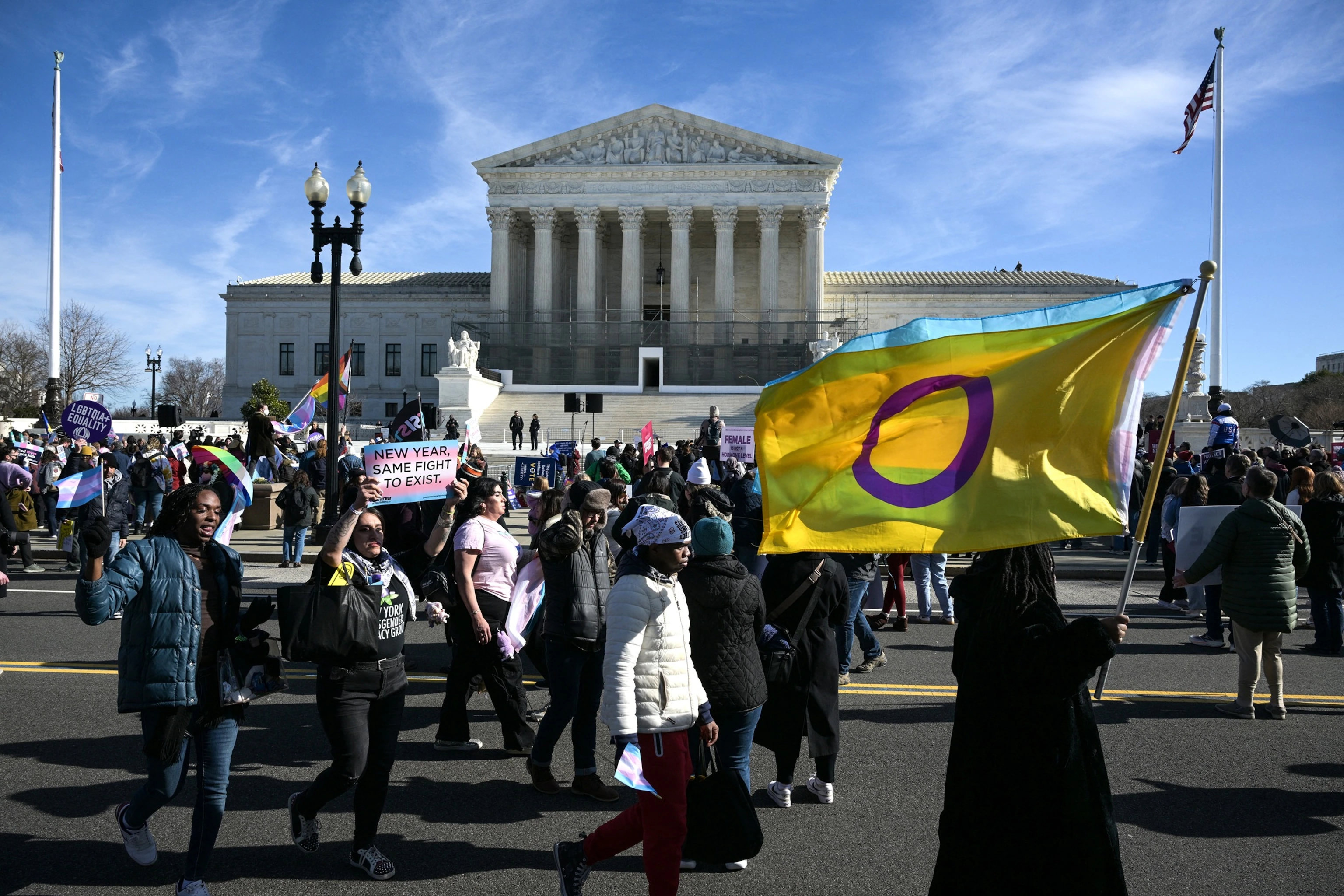
When the Supreme Court rules, the legal language can feel distant. But for many families with transgender kids, the Court’s June 30 decision hit like a personal announcement over the loudspeaker: you are not eligible. Not here. Not on this team. Not with your friends.
Parents described the moment they had to explain it to their child as something closer to grief than civics. One mother in Georgia put it plainly: telling her daughter she could no longer compete with her teammates was “probably one of the worst days of my life.”
Join the Discussion
What the Court decided
The case combined two disputes: Little v. Hecox and West Virginia v. BPJ. Together, they asked whether state rules that limit girls’ and women’s school sports teams to students classified as female at birth violate the Constitution’s Equal Protection Clause (14th Amendment) and whether they conflict with Title IX.
In a 6-3 ruling, the Court sided with West Virginia and Idaho. The practical result is that public schools and universities in West Virginia and Idaho may determine eligibility for women’s and girls’ sports based on “biological sex,” rather than gender identity.
Justice Brett Kavanaugh, writing for the majority, emphasized who should be making these calls. He wrote that “the legislatures and the schools are better equipped” to weigh “competing medical and scientific considerations” and that courts are not the right place for “highly intrusive athlete-by-athlete assessments.”
That framing matters because it signals restraint. The majority is saying that judges should not be the primary referees here. But restraint at the Court level can still translate into a hard stop for a student who just wants to run, throw, swim, or play.
What it does not do
It is easy to hear “Supreme Court ruling” and assume the decision permanently settles every related question nationwide. This one does not.
- It does not require every state to adopt a ban. It allows the bans in West Virginia and Idaho to stand, and it gives other states legal room to enact similar policies.
- It does not broadly limit Title IX protections for transgender students. Lawyers for the student athletes emphasized the Court did not broadly limit Title IX protections for transgender students in general.
- It does not block other states from allowing participation. The Court did not bar states from creating policies that allow transgender girls to participate with cisgender girls.
- It does not hold that transgender-status discrimination is always constitutional. The decision is focused on sex-based eligibility rules for sports teams, not an all-purpose permission slip.
Josh Block, senior counsel for the ACLU’s LGBTQ & HIV Project and a lawyer for the student athletes, called the outcome a “narrow, disappointing result,” while also stressing that the Court did not give states everything they sought. Sasha Buchert, director of nonbinary and transgender rights at Lambda Legal, described it as a serious loss for girls in states with bans, but not the end of the legal and policy fight, which will continue “state by state, school by school.”
The ripple effects for families
Families are not only worried about a lineup card. They are worried about what the ruling signals and what it incentivizes.
Mikael McLaren, whose daughter is now 21, remembers a time when her teams largely treated her like any other kid: show up, practice hard, be a good teammate. He considers his family fortunate that he did not have to go to war with a school district over eligibility. Now he fears other parents will not have that luck.
McLaren also points to a second, less discussed effect: broader scrutiny of girls’ bodies. “It’s a two-for-one deal for the legislators,” he said. “Not only do they get to continue to really put the boot on the throat of an already marginalized community, but they also get the added bonus of being able to police women’s bodies.”
He went further, describing an environment where exclusion in sports blends into a wider sense of vulnerability: “At this point, there is no safe space,” he said. “School is not a safe space anymore. Sports teams are not a safe space. Going out into public as a visible transgender person … is becoming less and less safe.”
Local control, uneven rights
The majority opinion leans on the idea that states, legislatures, and school associations are best positioned to make these policy calls. That may sound practical. In American constitutional life, many issues do get handled locally.
But there is a cost to that approach: students’ opportunities can change at the state line.
A Georgia parent, speaking anonymously out of safety concerns, described that fear as both immediate and moral. “It should not matter what state you live in,” she said. “This idea that we’re from Georgia, so now she can’t play is horrifying.”
In her telling, a state-level shift filtered quickly into school life. After a Georgia High School Association regulation codified birth-assigned sex rules, her daughter was removed from the team she had played on for years. The school offered alternatives like serving as a manager or practicing without competing, but the parent described those options as inadequate.

When a kid shows up anyway
Ali Munshi remembers how her daughter, Eliza Munshi, faced Virginia’s separation of teams by sex rather than gender identity. Even with support from friends and her school community, the policy blocked Eliza from competing on the girls’ track and field team.
Eliza chose a route that no teenager should have to choose just to be seen: she competed in boys’ events, including shot put and discus, to make a point about visibility. “As far as putting myself out there goes, I’m so comfortable in my gender and my expression and the way that I identify [that] putting myself out there is the least I could do,” she said.
She also tried to correct a caricature she sees driving public fear. “I think people have such an idea in their head of what this scary trans person looks like … and that’s just not what’s happening,” she said, adding that no one transitions for a competitive edge.
For her mother, the emotional core of the Court’s decision is the lesson it teaches by example. “The hardest part for me is the message that it sends: that, somehow, being trans is wrong and bad,” Ali Munshi said. “I don’t want kids to think that, and I don’t want parents to think that because affirming your kid is right and life-saving.”
Where policy stands now
Even before this ruling, the map was already uneven.
- Twenty-seven states have laws banning transgender students from participating in sports consistent with their gender identity.
- Two additional states have state regulations or agency policies that create similar bans.
- Of the 19 states with laws prohibiting discrimination in schools based on sexual orientation and gender identity, 17 have explicit guidance on the treatment and inclusion of transgender students.
In other words, the Court stepped into a landscape already defined by contrast: protection in one place, prohibition in another. The decision reinforces that contrast by giving states additional confidence that these sports restrictions can survive constitutional and Title IX challenges, at least in the form presented by West Virginia and Idaho.
Questions to ask next
If you are trying to understand what happens next, start with a few simple questions. They help separate what the Court actually held from what people assume it means.
- Who is making the rule? A state legislature, a school board, or an athletic association might all be involved, and each comes with different accountability mechanisms.
- What is the rule’s scope? Is it limited to K-12 sports, does it extend to colleges, and does it cover intramurals, clubs, or only varsity competition?
- What options are offered to the affected student? “Practice but do not compete” may sound like a compromise, but it can still mark a student as separate in a very public way.
- What protections remain? Even where a sports ban exists, students may have other legal rights at school under state law, district policy, or other federal rules.
The Constitution can feel abstract until it lands in someone’s daily routine. For families living this ruling, it landed in the most ordinary place. A school field, a track, a roster. A child who thought she belonged, being told she does not.