When a short slogan becomes a national controversy, the constitutional question is rarely about the slogan itself. It is about who gets to decide what it means, and what the government is allowed to do when it believes a political message sounds like danger.
The “86/47” flag has become that kind of flashpoint. Supporters describe it as blunt political protest. Critics argue it reads like a threat. The hard problem is that both reactions can be plausible at once, and the First Amendment forces courts to sort out whether the government is responding to a threat or to a viewpoint.
Editor’s note: Because there is no single, clearly documented, widely verifiable recent federal case centered on an “86/47” flag in the public record that can be responsibly named here with a judge, jurisdiction, and docket, this explainer does not claim that a specific federal judge has already ruled on the phrase in a specific lawsuit. Instead, it lays out the governing First Amendment framework that would control any real dispute over official action taken in response to an ambiguous political slogan.
That framework turns on a familiar First Amendment fault line: political expression is protected at the core, but “true threats” are not.
Join the Discussion
What does “86/47” mean?
In American slang, “86” is commonly used to mean to get rid of, to reject, or to remove. The term is old in restaurant and bar culture, where “86 it” can mean an item is out of stock or someone is being thrown out.
The “47” is widely understood, in current political usage, as a reference to Donald Trump and the idea of him being the 47th president. People sometimes use the number in slogans and merchandise as shorthand for that political identity.
Put together, “86/47” is used by some people to mean “remove 47” or “reject 47”, often in the sense of electoral defeat, impeachment, or political opposition. The reason it becomes legally sensitive is that some listeners may hear “86” as more aggressive than “vote out” or “oppose.” In some circles, people sometimes use “86” as a euphemism for serious harm, even though that is not its dominant everyday usage. Whether a particular use crosses the constitutional line depends heavily on context, audience, and intent.
Why protest is protected
If you are looking for the center of First Amendment protection, it is this: speech about politics and government.
The Supreme Court has repeatedly treated political expression as the speech most deserving of protection because it is tied to self-government. That does not mean political speech is consequence-free. It means the government has a very heavy burden if it wants to punish, ban, or restrict it.
This is true even when the speech is offensive, harsh, or unsettling. The First Amendment is not designed to protect only polite dissent. It is designed to keep the government from becoming the editor of acceptable politics.
Flags and symbols
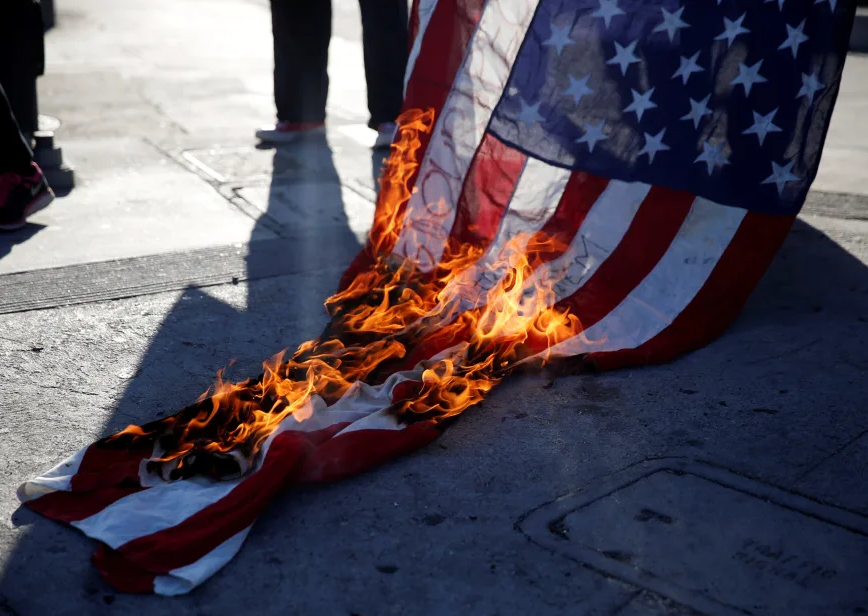
A flag is not just fabric. In constitutional law, it is often a classic example of symbolic speech, meaning conduct that communicates an idea.
That is why the Supreme Court has protected expressive acts like:
- Burning the American flag as political protest (Texas v. Johnson, 1989).
- Displaying political symbols that convey an idea through imagery rather than words (a theme running through modern First Amendment cases).
And the Court has also protected provocative political expression even when it is conveyed as plain language rather than symbolic conduct, such as:
- Wearing a jacket with profanity directed at the draft (Cohen v. California, 1971).
Those cases do not mean every use of a symbol is protected in every place. But they establish a starting point: a provocative political message is typically protected unless it falls into a narrow unprotected category.
The limit: true threats
The First Amendment does not protect a true threat. That phrase does a lot of work in modern law, especially when politics turns abrasive.
A true threat is not just angry rhetoric. It is communication that, in context, conveys a serious expression of intent to commit unlawful violence against a particular person or group.
One point of confusion is worth clearing up early: threats are about intimidation and fear of violence, while incitement is about urging others to commit imminent lawless action. The tests are different, and both are demanding for the government to satisfy.
The Supreme Court’s threat jurisprudence has evolved over time, but a few principles matter for understanding how a court would analyze an “86/47” display:
- Context matters. Courts look at where the message appeared, how it was delivered, and what else was going on.
- Targeting matters. A statement aimed at a specific person can be treated differently than a broad political slogan.
- Two questions often control. First, whether the communication would be understood as threatening in context. Second, whether the speaker had a constitutionally sufficient mental state.
- Mental state can matter. In Counterman v. Colorado (2023), the Court held that for criminal punishment based on “true threats,” the First Amendment requires proof of at least recklessness, meaning the speaker consciously disregarded a substantial risk that the communication would be viewed as threatening.
So the constitutional question is not, “Could someone interpret this as scary?” The question is closer to: In context, did it communicate a serious threat of unlawful violence, and did the speaker at least recklessly disregard the risk it would be taken that way (when the government is seeking criminal punishment for a true threat)?
Why it may be protected
In legal disputes over ambiguous political slogans, the fact pattern usually involves some version of this: someone displays a phrase at a rally, on a lawn, or on a vehicle; an official or agency treats it as menacing or disruptive; and the dispute becomes either a criminal case, a civil rights suit, or both.
A concrete way to see the difference context can make: a small “86/47” bumper sticker in ordinary traffic reads differently than the same phrase displayed outside an official’s home late at night alongside other intimidation cues (for example, repeated targeting, explicit violent language, or conduct that looks like stalking). The First Amendment analysis follows the facts.
When courts protect a slogan, it often follows a familiar pattern. The government may view a message as dangerous, but courts often require something more concrete than ambiguity and discomfort before allowing punishment or censorship.
If a slogan has plausible non-violent meanings in common usage, and if it appears in a typical setting of political protest, a court may treat it as core political expression rather than a true threat. That does not require the judge to endorse the slogan. It requires the judge to apply the First Amendment’s basic structure: the government does not get to punish political expression simply because it is inflammatory or because officials fear it may inspire others.
What government can still do
Even when speech is protected, the government can still respond in constitutionally valid ways.
1) Time, place, and manner rules
The government can impose content-neutral rules on demonstrations in certain settings, like permitting requirements, restrictions on blocking entrances, or limits on where signs can be posted, so long as the rules are narrowly tailored to serve significant interests and leave open alternative channels for communication.
2) Security decisions
Agencies responsible for protecting officials can treat ambiguous symbols as potential risk indicators for security planning, even if they cannot punish the expression itself. The First Amendment limits criminalization and censorship more than it limits internal protective assessment.
3) Civil vs. criminal consequences
It also matters what kind of consequence is at issue. Counterman addresses the mental-state requirement for criminal punishment for true threats. Some civil restrictions, workplace discipline, or school settings can involve different standards and balancing tests, even though the First Amendment still constrains government actors.
4) Forum and setting
It also matters where the flag is displayed.
- Criminal prosecution requires meeting constitutional standards for threats, incitement, or another offense, and after Counterman that includes the required mental-state showing for true-threat crimes.
- Government property rules can be stricter in limited public forums or nonpublic forums (for example, inside certain government buildings), but restrictions still cannot be viewpoint-based and must satisfy the applicable forum standard.
- Private property and private platforms can remove or restrict speech under their own rules without triggering the First Amendment in the same way.
- Workplace and school settings have their own First Amendment doctrines and balancing tests that do not map neatly onto street-corner protest rules.
5) Other unprotected categories
In narrower situations, speech can lose protection if it qualifies as:
- Incitement to imminent lawless action (Brandenburg v. Ohio, 1969), which is a demanding standard.
- Harassment or stalking conduct, especially when repeated and targeted, depending on the statute and proof.
- Conspiracy or other criminal coordination, where speech is used as an instrument of crime rather than persuasion.
In other words, protected protest does not become a shield for targeted intimidation or planning unlawful violence.
The tension
This controversy feels modern, but the tension is old: a free society must tolerate some unsettling speech because the alternative is letting government define which political messages are too dangerous to exist.
At the same time, the state has a real obligation to prevent violence and protect public officials. The true threats doctrine is the attempt to draw a workable line between those two responsibilities.
“86/47” sits on that line because it is compressed language. Compressed language invites projection. One side hears “vote them out.” The other hears “take them out.” The First Amendment does not require us to pretend those competing readings do not exist. It requires courts to be careful about punishment or censorship when the evidence of a serious threat is thin, and to apply both parts of the modern inquiry: what the words communicated in context, and what the speaker at least recklessly risked communicating when criminal penalties are on the table.
Takeaways
- Meaning: “86” often means remove or get rid of; “47” is commonly used as shorthand for Donald Trump as the would-be 47th president. People disagree about whether the phrase implies violence.
- Protected speech baseline: Political slogans and flags are generally protected, even when provocative.
- Main legal limit: The government can act against a message if it is a true threat. Courts look at threatening character in context, and criminal punishment for true threats requires the mental-state showing described in Counterman.
- Government responses still exist: Even when speech is protected, security planning and neutral protest regulations can still apply. Setting, forum rules, and civil versus criminal posture can change the analysis.
The deeper point is the durable one: in First Amendment law, the difference between protest and threat is not just the words. It is how the communication functions in context, and whether the government can prove the required mental state when it seeks to impose criminal penalties for a true threat.