
When a surge of immigration-related filings hits a federal district court, judges face a practical problem: dozens or hundreds of emergency petitions can arrive at once, raising overlapping legal questions on tight timelines.
That is the context for a recent controversy in Minnesota. Sahan Journal reported that internal emails and shared draft language circulated among judges and chambers staff in the U.S. District Court for the District of Minnesota as the court processed a cluster of immigration habeas filings tied, in the reporting, to heightened enforcement activity in the Twin Cities. The reporting described the materials as later becoming public outside the court’s ordinary docketing process. The reporting did not specify how the emails were obtained; we can only say they were later published.
The headline question is not partisan. It is structural: can Article III judges coordinate at all , and if so, what kind of coordination is ordinary case management versus ethically risky when liberty is at stake?

Join the Discussion
The baseline
Start with the core promise of Article III: federal judges are meant to be independent. Lifetime tenure during “good Behaviour” and salary protection are not perks. They are insulation. The system is designed so each judge decides cases based on law and the record, not on pressure from the political branches or internal institutional momentum.
At the same time, the judiciary is one branch of government with one job: deciding cases. That job is constrained by the case-or-controversy requirement and by due process. Due process is not just about having a lawyer and a hearing. At a minimum, it means decisions should be grounded in the law and the record created in the case, with notice and a meaningful opportunity for each side to respond.
So the guiding principle is best stated as a general rule, not a bright-line command: Article III courts can coordinate administratively to keep the court functioning, but due process requires decisional independence and record-based judging. Where the line falls is fact-specific.
What is reported
To keep the facts straight, it helps to separate what can be said confidently from what may require additional confirmation from the underlying documents. The controversy, as described in the reporting, involves (1) a cluster of immigration habeas filings in Minnesota during a period of heightened enforcement activity, (2) internal court emails and draft language shared among judges and chambers staff while those matters were being processed, and (3) subsequent public disclosure of those internal materials outside normal docket filing.
Beyond those broad contours, readers should treat details such as the exact dates, the precise link between any particular filing and any particular enforcement action, the number of petitions, what specific wording appeared in drafts, and whether any draft language spoke to merits outcomes as questions to be answered by the documents themselves and any on-the-record explanations from the court or litigants.
What coordination can mean
People hear “judges coordinated” and picture something sinister: a backroom vote on who wins. But in federal courts, “coordination” can describe very different things, some routine and some not.
In immigration-detention surges, the federal government is usually a recurring party. ICE and DHS generally control detention decisions and are often involved in custody-related litigation. In habeas practice, the named respondent is typically the immediate custodian, sometimes alongside other federal officials depending on the claim and local practice.
Usually normal
- Scheduling and triage. Coordinating who handles emergency motions first, how to stagger hearings, and how to avoid contradictory deadlines.
- Clerks’ office process. Standard instructions for filing, sealing, translation needs, or how petitions are routed.
- Neutral legal research support. Courts may share non-case-specific research on recurring procedural questions through staff attorneys, as long as parties still have a chance to address the legal issues in their case.
- Templates for routine procedure. For example, a standard order that sets a briefing schedule or requires a government response within 48 hours.
Potential red flags
- Merits-leaning templates. Draft language that effectively resolves contested merits issues in advance, such as a prewritten conclusion that detention is unlawful for reasons not litigated in the individual case.
- Off-the-record fact sharing. Discussion of facts about a specific detainee or petition that are not in that case’s record, especially if those facts could influence the outcome.
- Strategic case assignment. Efforts to route cases to a particular judge for a predicted outcome.
- Internal argument substitution. Internal communications that supply new arguments or reasoning one side did not make, without giving the parties a fair chance to respond on the record.
The same tool can be harmless or harmful depending on what it contains. A template that says “respond within 48 hours” is administration. A template that says “the court finds detention unlawful because X” can begin to look like a coordinated merits posture. The constitutional question then becomes whether each judge is still independently deciding the case in front of them, on the record, after adversarial testing.
Why habeas moves fast
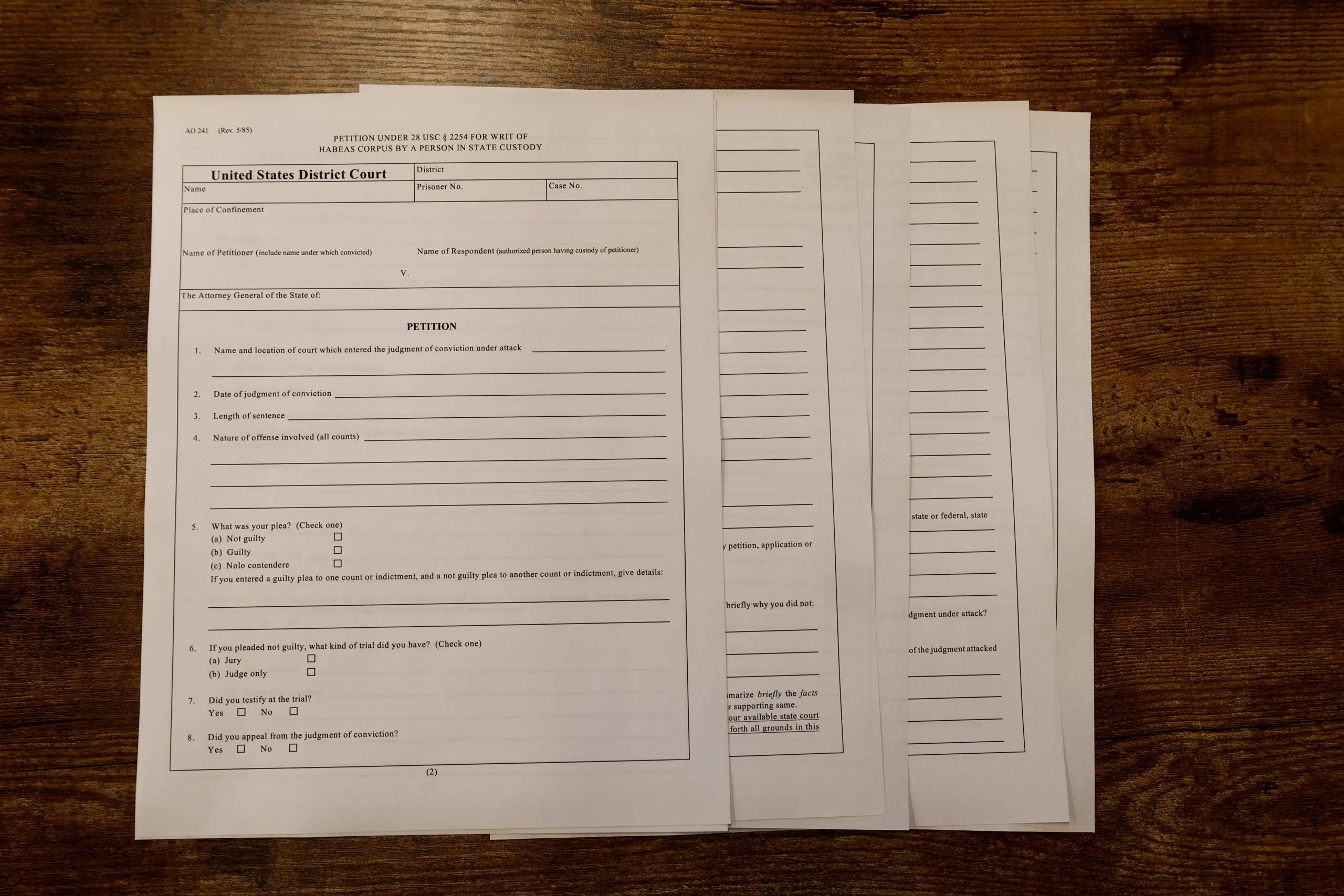
The controversy centers on habeas petitions , so it helps to define the tool before getting lost in ethics vocabulary.
Habeas corpus is the legal mechanism for asking a court a basic question: does the government have lawful authority to hold this person in custody? The Constitution protects the privilege of the writ in the Suspension Clause. In modern federal practice, immigration-detention habeas challenges in district court are typically brought under 28 U.S.C. § 2241. (Other habeas and post-conviction statutes, such as § 2254 and § 2255, generally address criminal convictions rather than civil immigration detention.)
In immigration matters, habeas petitions often appear when someone argues they are being unlawfully detained, transferred in a way that impairs access to counsel or the court, or held under the wrong statutory authority. These cases can become urgent because detention and removal can move quickly. If someone is transferred out of a district or removed from the country, the practical ability to litigate can evaporate.
One important caveat: the availability and scope of habeas and other federal court review in immigration is not always straightforward. Jurisdiction can be contested depending on the statute and procedural posture, including channeling provisions and limits on review that may push some claims into petitions for review in the courts of appeals rather than district court litigation. That statutory complexity is one reason recurring issues can show up in batches.

The ethics issues
Federal judicial ethics is not textually laid out in Article III. It is enforced through statutes (including the judicial disqualification statute), the Code of Conduct for United States Judges, and due process principles requiring courts to be fair and perceived as fair.
Three ideas do most of the work in controversies like this:
- Extra-record influence. Judges are supposed to decide based on the record and the law. If understanding of disputed facts is shaped by internal communications about specific cases, that resembles information the parties cannot test.
- Ex parte problems in another form. Judges can consult colleagues in a general, collegial way about legal issues, but the risk rises if internal messages introduce new authority, factual assertions, or arguments that functionally replace adversarial briefing. In many settings, one safer course is disclosure on the record and a chance to respond, especially when shared reasoning could matter to the outcome.
- Impartiality and appearance. Even when a judge believes they were fair, behind-the-scenes coordination on active merits issues can create a reasonable fear that outcomes were harmonized before argument.
There is also a legitimacy concern that is easy to misunderstand. The issue is not that judges can never coordinate. It is that when judges appear to be acting as a unit on merits questions, the judiciary can start to look less like independent adjudication and more like internal policymaking, which is exactly the kind of perception courts try to avoid.
What is allowed
Constitutionally, federal courts can adopt procedures that keep the courthouse running during emergencies. No one benefits if the system bottlenecks and people sit in custody for weeks because the court cannot process filings. The question is not whether judges may talk to each other. The question is what they are talking about and whether it affects a litigant’s ability to be heard on the record.
- Safer: shared scheduling orders and filing instructions; coordinated hearing times and courtroom availability; administrative allocation of staff resources; public, neutral citations to binding precedent.
- Riskier: sharing draft merits language that pressures uniform outcomes; discussing credibility of specific parties, attorneys, or detainees outside the record; developing a joint litigation “strategy” against one side rather than managing the docket neutrally; creating internal guidance that effectively becomes a shadow rulebook the parties cannot see or challenge.
Notice what is missing from both lists: “immigration” itself. The constitutional concerns would look similar in any detention surge. Immigration just makes the time pressure acute, because transfers and removals can move faster than ordinary civil litigation.
Better tools
The federal system already has mechanisms for handling many similar cases without relying on informal internal guidance that parties never see. But there are also limits, and not every mass-case tool fits habeas.
- Related-case procedures and reassignment. Where permitted, related matters can be assigned or reassigned so overlapping issues are handled transparently.
- Standing orders and local rules. Districts can adopt standing orders that set uniform procedures for certain categories of filings. The advantage is visibility. Parties can read them and argue about them.
- Chief-judge administrative orders. Courts can issue public administrative orders on intake and triage during a surge, which is often cleaner than informal, undisclosed guidance.
- A note on what does not fit. Multidistrict litigation is a statutory transfer and pretrial coordination device for civil actions. Habeas operates under its own statutory scheme and often turns on individualized custody and jurisdiction questions, which limits how much an MDL-style approach can do.
- On-the-record disclosures. If a court uses a standard approach to initial orders in a surge, one clean option is to file the template or standing order on the docket so litigants can address it.
Those tools exist for a reason: legitimacy in court depends on a simple idea. The rules should not be hidden.
Transparency and remedies
If litigants believe internal coordination crossed from logistics into merits influence, there are established ways to surface and test the issue:
- Requests for disclosure on the record. Parties can ask whether templates or standing guidance were used and seek a chance to respond to any shared reasoning that affected the decision.
- Motions to recuse or disqualify. In appropriate circumstances, parties can seek recusal based on impartiality concerns, recognizing that the standard is demanding and fact-specific.
- Appellate review. If coordination altered the legal basis for a decision or denied a meaningful chance to respond, the normal corrective is review by a higher court, often the U.S. Court of Appeals for the Eighth Circuit for cases out of Minnesota.
These remedies are not about theatrics. They are about preserving the basic structure of adjudication: reasons stated on the record, grounded in the parties’ arguments and the controlling law.

Why it matters
Immigration detention cases sit at a constitutional crossroads. On one side is the federal government’s broad authority over immigration. On the other is the foundational principle that custody demands justification. Habeas exists precisely because governments, even well-intentioned ones, sometimes slide from lawful detention into detention by habit.
When a court is flooded with petitions, coordination can be a sign of competence. It can also create a risk that efficiency quietly overpowers the obligation to be individualized. Due process is not always loud. Sometimes it is the unglamorous insistence that each file is a person, not a batch.
FAQ
Can federal judges email each other about active cases?
Judges can communicate about administration and court operations, and they may consult colleagues on general legal questions. The constitutional and ethical concern arises when communications influence merits decisions through facts, arguments, or authority that are not in the record or not presented by the parties, without notice and an opportunity to respond.
Is a shared template order automatically unethical?
No. Many templates are purely procedural and save time, like a standardized order requiring the government to respond by a deadline. The risk grows when a template predetermines contested outcomes or contains merits reasoning that the parties never get a fair chance to address.
What does habeas corpus do in immigration detention?
Habeas is a mechanism to challenge unlawful custody. In immigration matters, it is often used to contest detention authority and process failures tied to custody. In district court, that vehicle is typically 28 U.S.C. § 2241, though the scope of review can be contested and may depend on statutes that channel certain claims to other forms of review.
If judges coordinate, does that violate Article III?
Not by itself. Article III does not forbid administrative coordination. The constitutional problem appears when coordination undermines decisional independence or due process, meaning the right to a fair, record-based adjudication with a meaningful chance to respond.
The takeaway
The federal judiciary is allowed to be efficient. It is not supposed to decide individual liberty claims by internal consensus or undisclosed, merits-driven templates. Article III protects independent judging, and due process protects the right to be heard on the record, with reasons that can be tested and appealed.
When controversies like the Minnesota episode flare up, the best question is not “did the judges talk?” It is: did anything in that coordination replace the adversarial process? If the answer is yes, the problem is not merely optics. It is structural.