
Most immigration removals happen in the ordinary system: a Department of Homeland Security trial attorney in an immigration court, an immigration judge in the Department of Justice’s Executive Office for Immigration Review (EOIR), and an appeal to the Board of Immigration Appeals. That is the familiar pipeline.
The Alien Terrorist Removal Court is not that pipeline. It is a separate, Congress-created proceeding designed for a specific problem: how to pursue removal on terrorism grounds when the government says its most important evidence is classified and cannot be litigated openly in a normal immigration courtroom.
The court is rarely discussed because it is rarely used. When it comes up, the natural questions are the same: what is this tribunal, what statute created it, and what does due process look like when the key evidence may be secret?
Join the Discussion
What it is
The Alien Terrorist Removal Court (often shortened to ATRC) is a special federal removal court created in the 1990s and codified at 8 U.S.C. § 1531 et seq. Its role is narrow: to decide whether the government has proved that a noncitizen is an “alien terrorist” under that statute, and if so, to enter a removal order under this specialized process.
Structurally, the ATRC is not immigration court, and it is not a standard U.S. district court docket either. Under 8 U.S.C. § 1532, the court consists of five U.S. district judges designated by the Chief Justice of the United States. Congress built it as a judicial proceeding conducted by Article III judges, rather than an administrative adjudication inside EOIR, because the procedure is the point: the statute is designed to let the government rely on classified information through protective, in camera (reviewed by the judge privately), and sometimes ex parte (with only one side present) handling that would be difficult to run in a conventional removal hearing.
In plain terms, the ATRC is a separate lane for a very specific kind of removal case: terrorism allegations where secrecy is central to the government’s proof. That does not mean it is guaranteed to be fast. Classified-information litigation can be slow anywhere.

Why Congress created it
Congress built the ATRC during a period of expanding counterterrorism authorities, when officials repeatedly confronted a structural tension: intelligence agencies gather information under national security rules, but adjudication typically depends on disclosure, cross-examination, and open testing of evidence.
That tension was not abstract. In the 1990s, the government’s use of secret evidence in immigration-related proceedings became a public controversy, including in high-profile deportation efforts involving alleged terrorism ties. The ATRC was Congress’s attempt to create a forum that could issue a removal order while still protecting classified sources and methods.
The ATRC is not a criminal court. It does not impose prison time. It is a civil removal forum that aims to produce a judicial order while managing classified information.

How it differs
1) Different decision-makers
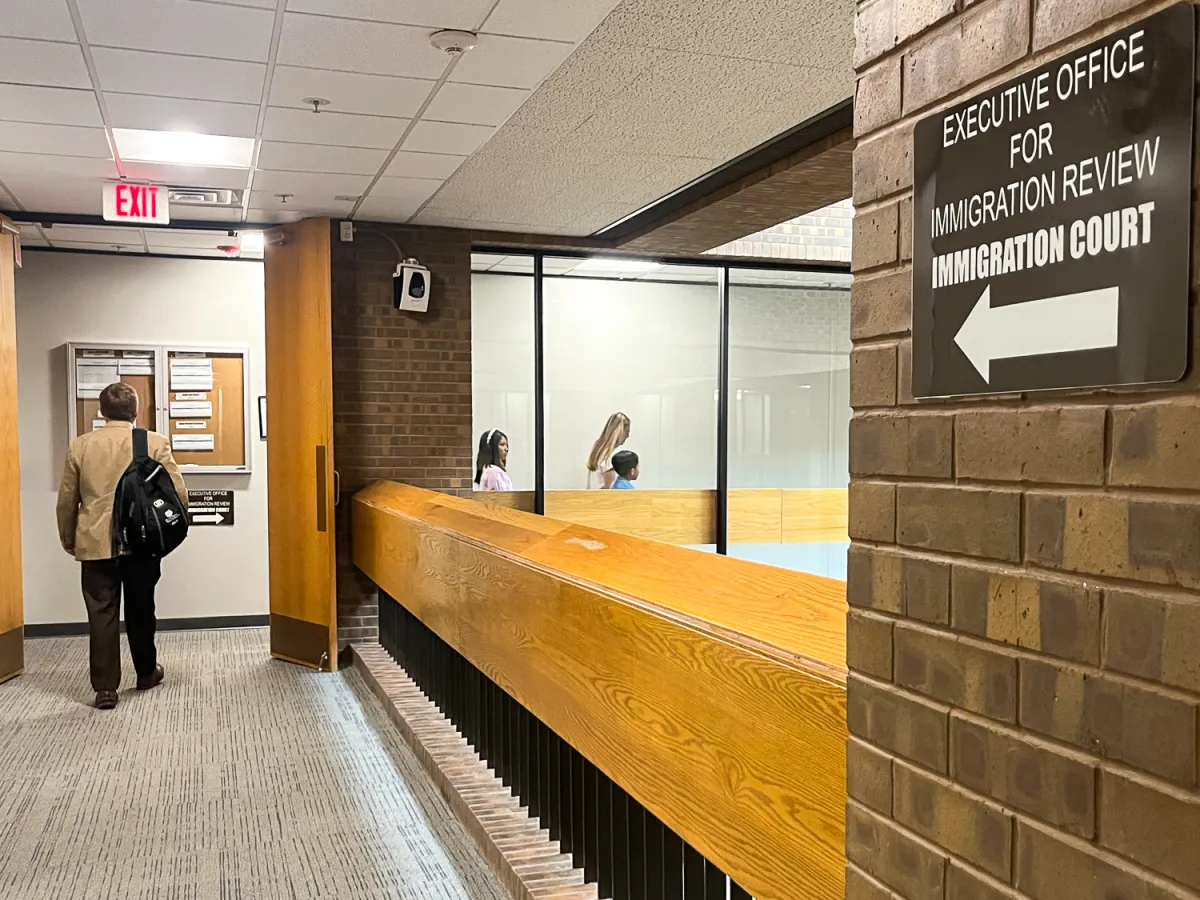
Immigration judges sit in EOIR, an agency within the Department of Justice. In the typical case, the Department of Homeland Security brings the case through its trial attorneys, and the immigration judge adjudicates it inside that administrative system.
The ATRC instead is heard by Chief Justice-designated U.S. district judges under 8 U.S.C. § 1532. The practical difference is not just a label. EOIR removal hearings are administrative adjudications; the ATRC is a specialized judicial proceeding staffed by Article III judges operating under a custom statutory procedure.
2) Classified evidence is the center of gravity
The ATRC is designed for cases where the government expects to rely on classified information. The statute authorizes the court to consider classified submissions through in camera and, in some circumstances, ex parte procedures, and it contemplates summaries or substitutions where feasible. The core framework for these handling rules sits in 8 U.S.C. § 1533.
That is where the due process pressure point lives: if a person cannot see the evidence against them, what does a meaningful opportunity to contest the case look like? Congress’s answer is procedure plus judicial supervision, and the adequacy of any summary or substitution is necessarily case-specific.
3) Narrow jurisdiction
Immigration court covers a wide range of cases: visa overstays, criminal removability, asylum claims, and more. The ATRC is confined to the defined terrorism-based category and process Congress created in 8 U.S.C. § 1531 et seq.
What “alien terrorist” means
In everyday speech, “terrorist” is a broad label. In immigration law, terrorism is a web of statutory definitions and consequences. The INA includes terrorism-related grounds of inadmissibility and removability, such as engaging in terrorist activity, providing material support in certain circumstances, and other specified conduct.
The ATRC uses its own statutory definition of “alien terrorist” within the Title V framework, rather than simply importing the full set of broader INA terrorism provisions wholesale. The definition and the court’s jurisdiction live in the ATRC statute itself. The important point for readers is that this is a civil immigration determination under federal statute, not a criminal verdict.
Two cautions help keep the category in focus:
- It is not a criminal conviction. A person can face immigration consequences on terrorism grounds without being convicted of a terrorism offense, because removal is civil.
- Definitions do the work. These cases can turn on technical elements: what counts as “support,” what counts as a qualifying “organization,” and what mental state is required under the relevant statutory provisions.
Constitutional issues
Congress and court design
Congress has broad authority to structure federal adjudication and to set procedures for immigration, an area where federal power is at its apex. The ATRC is best understood as a statutory design choice inside that system: a specialized court process created by Congress and staffed by district judges designated under 8 U.S.C. § 1532.
The executive’s role
Even when a judge issues an order, removal is carried out by the executive branch, principally the Department of Homeland Security. Congress sets the grounds and procedures, the executive prosecutes and executes, and courts decide contested cases within the statutory framework and constitutional limits.
Due process and secrecy
Noncitizens in the United States generally have due process protections when the government seeks detention or removal. But due process is a standard, not a single script. Classified evidence makes the question harder because the government argues that full disclosure can itself cause harm.
The ATRC is Congress’s attempt to live inside that tension. The constitutional question is not whether secrecy is ever allowed. It is whether, in a particular case, the procedures still preserve a meaningful opportunity to be heard and to rebut the government’s case.
How a case works
Because the ATRC has not been used in practice, the clearest way to understand it is to map the process Congress set up, with a special focus on the classified-information steps. The key relationship to keep in mind is this: the ATRC is an alternative removal pathway created by statute. It is not an appeal from EOIR, and it is not a normal immigration court case with a different judge. It is its own proceeding, triggered when the government chooses this route under the Title V framework.
- The Attorney General initiates the case by application. The proceeding begins when the Attorney General files an application with the court seeking a removal order under 8 U.S.C. § 1533, alleging that the respondent is an “alien terrorist” as defined by the ATRC statute.
- A designated judge is assigned. The case is heard by a U.S. district judge serving on the ATRC pursuant to 8 U.S.C. § 1532.
- Classified-information procedures come first. The court manages what will be reviewed in camera, what may be submitted ex parte, and what, if anything, can be disclosed through summaries or substitutions, under the framework in 8 U.S.C. § 1533.
- The hearing proceeds under the statute’s rules. Hearing procedures are set out in 8 U.S.C. § 1534, including how the court conducts the proceeding and how classified material is handled alongside any unclassified evidence.
- The government bears the burden of proof. The government must establish that the respondent is an alien terrorist by a preponderance of the evidence under 8 U.S.C. § 1534(c).
- The respondent appears with counsel, subject to classification limits. The respondent may be represented, but access to classified information raises practical constraints. The statute includes representation and disclosure rules within the Title V framework, and in real life the friction point is often this: if counsel cannot obtain access to key classified material, the ability to test the government’s case may depend heavily on what the judge orders by way of summaries, substitutions, or other protective procedures.
- The court issues an order. If the government meets its burden under the statute, the ATRC can enter a removal order under this specialized process.
- Appeal goes to the D.C. Circuit. The statute routes appellate review to the U.S. Court of Appeals for the District of Columbia Circuit under 8 U.S.C. § 1535, with classified materials handled under seal as necessary.
What you should not expect here is a jury. Removal is civil, and jury-trial rights attach to criminal prosecutions, not deportation proceedings. An ATRC order is a removal order. It is not a criminal judgment and it does not impose criminal punishment.
Why it has not been used
The ATRC has existed for decades, but it has never been used to adjudicate a case or to deport anyone through this special process. Government-facing summaries of the statute have repeatedly noted its non-use, which is why it remains better known as a paper procedure than as a working courtroom.
There are practical reasons a tool like this can sit dormant:
- Ordinary removal often suffices. The government can pursue removal in EOIR on other grounds using unclassified evidence, criminal convictions, or public records.
- Criminal prosecution may be preferred. If prosecutors believe they can prove a crime beyond a reasonable doubt, they may choose a criminal case first, then removal later.
- Classified evidence is hard anywhere. Litigation over classification, summaries, and what must be disclosed can be slow and uncertain even in specialized procedures.
- Diplomacy and logistics still matter. A removal order does not automatically solve the problem of where a person can be sent and whether a receiving country will accept them.
So the ATRC sits in a category of federal power that is real, lawful, and unused. It is a fire extinguisher behind glass. You forget it exists until the day someone breaks the case.
What to watch
When the Alien Terrorist Removal Court appears in a headline, the most important questions are procedural, because procedure is where constitutional limits live. And because public reporting about classified-evidence litigation is often incomplete, readers should expect the sharpest disputes to be about what was disclosed and what was not.
- What was classified, and what did the respondent actually get to see? Summaries and substitutions can be acceptable or inadequate depending on whether they preserve a meaningful chance to rebut.
- What was the conduct alleged? “Terrorism” in immigration law can cover a wide range of conduct and is not always synonymous with participating in an attack.
- Was there detention, and under what authority? Detention can raise distinct due process issues and separate litigation.
- What review is available in practice? In ATRC cases, review runs to the D.C. Circuit under 8 U.S.C. § 1535, and the record can be complicated when classified evidence is involved.
FAQ
Is the ATRC the same as the FISA Court?
No. The Foreign Intelligence Surveillance Court authorizes certain surveillance activities. The Alien Terrorist Removal Court adjudicates a specialized removal application for certain noncitizens under 8 U.S.C. § 1531 et seq. Both can involve classified information, but they do different jobs under different statutes.
Can someone be removed on terrorism grounds without a criminal conviction?
Yes, in some circumstances. Removal is civil, and immigration law includes terrorism-related grounds that do not necessarily require a criminal conviction. In the ATRC specifically, the government must prove its case by a preponderance of the evidence under 8 U.S.C. § 1534(c).
Do noncitizens have constitutional rights in removal proceedings?
Many noncitizens physically present in the United States have due process protections. The hardest questions arise when the government relies on secrecy, because the ability to see evidence and challenge it is a core component of procedural fairness.
Does an ATRC order mean someone is guilty of terrorism?
No. An ATRC order is a civil removal determination under a statutory definition. It is not a criminal verdict.