
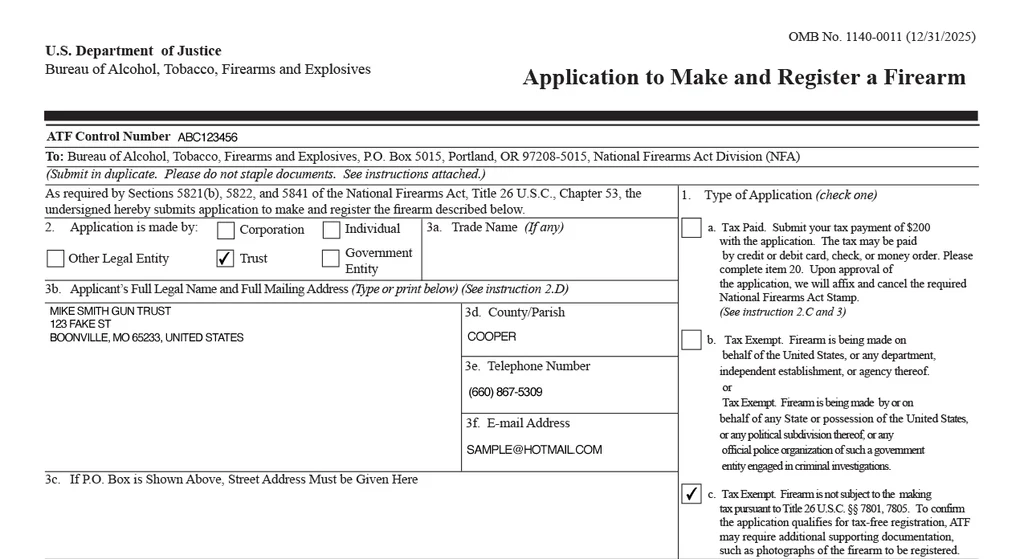
The National Firearms Act, or NFA, is one of those federal laws that reshaped how certain firearms and firearm devices are bought, transferred, and prosecuted through forms, approvals, and penalties.
It does not categorically prohibit silencers for civilians nationwide. Instead, it creates a federal registration and tax system that can turn an unapproved transfer or possession into a serious federal crime.
That is why court rulings about the NFA matter. When a judge changes how the NFA can be enforced, the consequences are not theoretical. They show up at real gun counters, real dealer safes, and in real risk calculations for anyone trying to stay on the right side of federal and state law.
Join the Discussion
What the NFA is
Congress passed the NFA in 1934, in the shadow of Prohibition-era crime and public anxiety about weapons associated with gang violence. The law created a federal system to regulate certain items that lawmakers viewed as especially dangerous or misuse-prone.
The NFA focuses on what federal law calls “NFA firearms,” a term that includes several categories:
- Machine guns
- Short-barreled rifles (SBRs)
- Short-barreled shotguns (SBSs)
- “Destructive devices” (such as certain explosives and large-bore weapons)
- “Any Other Weapon” (AOW), a catch-all category for certain disguised or unusual firearms
- Silencers (also called suppressors)
Constitutionally, the NFA is often described as a tax-and-registration scheme, built around the tax stamp and the federal registry, with criminal penalties attached to noncompliance. Later federal firearms laws leaned more heavily on the commerce power, but the NFA’s original architecture is the tax, the registration requirement, and the criminal enforcement that backs them up.
How suppressors are regulated
Under federal law and longstanding federal practice, a suppressor is regulated as an NFA item whether or not it is attached to a firearm. And while people often describe suppressors as “accessories” in ordinary conversation, federal statutes treat a silencer as a regulated “firearm” as a defined legal term for NFA and Gun Control Act purposes, not because it is a standalone gun in the everyday sense.
Traditionally, the basic federal requirements have included:
- Registration in the federal NFA registry.
- Pre-approval before making or transferring the item.
- A tax often described as a “tax stamp” (commonly $200 for many suppressor transfers).
- Fingerprint-based background check as part of the ATF application process. It is not the retail counter NICS check. It is an NFA application background check processed through ATF and the FBI.
- Criminal penalties for possession or transfer that does not comply, often charged as possession of an unregistered NFA firearm.
Suppressors are also not a niche item in the way they once were. ATF registration data reflects millions of lawfully registered suppressors in the United States, which is part of why modern Second Amendment challenges often frame them as increasingly common for lawful use.
States also layer their own laws on top. Many states allow suppressors if you comply with federal law. Some states ban civilian possession entirely, and others allow possession but restrict hunting use or particular locations. State laws also change, so anyone making a real-world decision should verify current state statutes. A federal ruling that changes how the NFA is enforced does not automatically rewrite state law.
How the process works
In practice, most lawful suppressor acquisitions happen through a dealer who is federally licensed and registered to handle NFA items (often called an FFL/SOT). A typical transfer uses ATF Form 4 (including purchases by individuals and by trusts or other legal entities), while a typical make uses ATF Form 1 (subject to ATF rules and state law).
For a transfer, the suppressor generally stays with the dealer during the pending Form 4 approval. The applicant submits identifying information and fingerprints, pays the tax, and waits for approval before taking possession. Wait times vary and can be significant. That is part of why sudden litigation over the NFA can feel immediate to people trying to plan a purchase.
How viral claims happen
The viral “suppressors are now legal” wave usually traces back to a single court order that gets flattened into a national rule online. Most often, the spark is a district court decision in a specific prosecution or a preliminary order in a civil lawsuit, where a judge limits enforcement in a narrow way while the bigger legal fight continues.
In plain terms, these are frequently case-specific rulings, not a nationwide repeal of the NFA. They also do not create a general “no tax stamp needed” rule for everyone.
Even when a ruling is genuinely significant, state statutes do not nullify federal criminal law. States can limit what their own officials do, including cooperation and enforcement priorities under state law. But that does not bind federal prosecutors or federal agents enforcing federal statutes.
When defendants or civil plaintiffs raise constitutional arguments, the scope of any relief depends on the posture of the case and the exact order entered. That is where the practical world lives: dismissals, injunctions, stays, and appeals, not slogans.
What these rulings do in practice is highlight a post-Bruen pressure point now being litigated: whether suppressors are protected “arms,” and if they are, whether a 1934 registration and tax regime can survive the Supreme Court’s history-and-tradition test.
1) Courts can limit enforcement
Congress wrote the NFA, and a district judge does not erase it. What a judge can do is rule that a specific application of the law is unconstitutional, suppress evidence, dismiss charges, or enjoin enforcement in a civil case where the plaintiffs meet the standards for that kind of relief.
That difference is why a headline can sound sweeping while the legal reality remains narrow.
2) Scope matters
Some orders apply only to the named defendant in a single prosecution. Others apply only to the named plaintiffs in a civil case. And even when a court issues broader relief, an appellate court can enter a stay that pauses it while the appeal is pending.
So the practical question is: Who is covered, where, and for how long, while litigation and appeals unfold?

Are suppressors legal without registration?
For most Americans, the general rule remains: federal law still treats suppressors as NFA items. Possession or transfer outside the NFA process can carry major criminal exposure.
The short-term answer in any one lawsuit can be more conditional, but it is usually conditional in a way that does not travel well on the internet. A criminal defendant can win a ruling in a specific case and still leave everyone else under the same NFA obligations. A civil plaintiff can obtain an injunction and still face an immediate appeal and a stay.
If you are reading because you want a personal yes-or-no compliance answer, the frustrating truth is that federal criminal exposure is determined by details. The jurisdiction matters. The parties matter. The current status of any injunction or stay matters. Something that appears permitted on Monday can look very different after an emergency stay on Friday.
Other federal limits still apply
NFA compliance is not the only legal hurdle. Separate federal law can bar possession of firearms by prohibited persons, including certain felons and people subject to specific domestic violence-related prohibitions. Even if a court narrowed one part of NFA enforcement in one case, other federal disqualifiers can still independently create criminal exposure.
Why these are Second Amendment cases
For decades, many gun regulations were defended in court through interest balancing. Judges often asked whether a law seemed reasonable, or whether the government’s safety rationale outweighed the burden on individuals.
The Supreme Court’s modern Second Amendment cases changed that framework.
Heller
In District of Columbia v. Heller (2008), the Court held that the Second Amendment protects an individual right to keep and bear arms for self-defense, especially in the home. The Court also signaled that some longstanding regulations could remain.
Bruen
In New York State Rifle & Pistol Association v. Bruen (2022), the Court rejected the familiar interest-balancing approach for many Second Amendment challenges. Instead, it instructed courts to ask whether a modern firearms regulation is consistent with the nation’s historical tradition of firearm regulation.
That shift matters for suppressors because the NFA is a 1934 law. Under Bruen, governments defending a restriction often need to point to historical analogues. Plaintiffs argue that if the regulated item is an “arm” and commonly possessed for lawful purposes, sweeping restrictions should face a much harder constitutional road.
At the same time, even if a suppressor is treated as an “arm,” that does not automatically mean all regulation falls. A court could still uphold some form of regulation if the government can point to a sufficiently close historical tradition, and if the court views the NFA as regulation rather than a ban.
Is a suppressor an arm?
This is one of the core legal questions beneath the headlines, and it is trickier than it looks.
The Second Amendment protects the right to keep and bear “Arms.” The word does not come with a list. Courts have had to decide what counts as an “arm” and what counts as an item the government can regulate more aggressively.
Suppressor challengers typically argue:
- A suppressor is integral to the effective and safer use of a firearm because it reduces noise and can reduce hearing damage.
- Suppressors are increasingly common for lawful purposes, including sport shooting and hunting, and many are lawfully registered under federal law.
- If suppressors are treated as protected “arms,” the government must justify restrictions using the Bruen history-and-tradition test.
Governments typically respond:
- A suppressor is not itself a weapon and can be regulated as a separate item.
- Even if protected, the NFA is a regulatory scheme rather than a categorical ban, and the historical tradition supports regulating unusually dangerous or misuse-prone items.
- Suppressors can facilitate crime by reducing report, so restrictions fit within a tradition of regulating methods of concealed or enhanced violence.
Different courts can weigh these premises differently. And under Bruen, the outcome often turns on how a judge defines the relevant historical question: whether the tradition is about firearms generally, about dangerous innovations, or about items that change how weapons function.
When paperwork becomes criminal law
There is another constitutional pressure point in these cases that gets less public attention: the boundary between agency administration and criminal punishment.
The NFA is enforced through a combination of statutes, regulations, forms, and agency practice. When the practical rules of possession and transfer depend on administrative interpretations, defendants can argue that the government is effectively creating criminal exposure through bureaucracy rather than clear statutory commands.
Courts sometimes confront questions like:
- Is the law giving ordinary people clear notice of what is illegal?
- Is the agency interpreting the statute in ways Congress did not clearly authorize?
- Is the enforcement scheme consistent with due process when the penalty is prison?
It is also worth remembering what makes the NFA different in daily life: the NFA registry is not open to the public. Compliance is proven through paperwork and approvals, not a search anyone can run. That reality, combined with severe penalties for an “unregistered NFA firearm,” is why litigation over the NFA can quickly become litigation over notice, power, and process.
Pitfalls and myths
Even without turning this into a how-to guide, it helps to name a few recurring points of confusion:
- Make versus transfer: Form 1 is generally about making, Form 4 is generally about transferring. Mixing them up leads people to misunderstand what they are allowed to possess at each stage.
- Interstate travel: ATF Form 5320.20 travel permission is required for some NFA items (commonly SBRs, SBSs, machine guns, and destructive devices). It is not typically required for suppressors, but state and local possession rules can still create serious risk when you cross a border.
- “Constructive possession”: People use this phrase loosely online. In actual cases, it is a fact-heavy theory that can turn on what you have, what you can readily assemble, and what prosecutors think your intent was. The safe takeaway is that if the government believes you possess an unregistered NFA item, the legal fight can quickly become expensive and high-stakes, even before you get to the merits.
What to watch next
If suppressor litigation keeps moving, several things can happen quickly:
- A stay, which pauses the effect of an order while an appellate court reviews it.
- A narrowed ruling, limiting who can rely on it and under what circumstances.
- A broader precedent, if appellate courts affirm and the reasoning spreads to other jurisdictions.
- Supreme Court review, if the legal conflict deepens and lower courts split on suppressor regulation under Bruen.
Even if suppressor restrictions change, the larger constitutional story remains the same: the Second Amendment is now litigated through history. That test is not self-executing. It forces courts to decide which past counts, which analogies are close enough, and how much regulatory tradition is enough to justify modern controls.
Quick answers
Does the NFA ban silencers?
No. It does not categorically prohibit them nationwide, but it regulates them through registration, taxation, and transfer approvals backed by criminal penalties. Other federal and state restrictions may apply.
Can I legally buy a suppressor today?
In many states, yes, but typically only by following federal NFA procedures and state law. Claims about skipping the NFA steps usually collapse once you look at who is covered by a specific court order and whether that order is stayed or limited.
Is this settled law now?
No. A high-profile district court ruling can change what happens in a specific case, but the last word often comes later on appeal, and sometimes at the Supreme Court.
What question is being tested?
Whether suppressor restrictions fit within the Second Amendment as interpreted after Heller and Bruen. Courts are also testing how criminal consequences interact with administrative regimes, especially when rules depend on agency processes and interpretations.