
“Pleading the Fifth” is one of those phrases Americans use as shorthand for guilt, stonewalling, or scandal. Constitutionally, it means something narrower and more technical: a witness is invoking the Fifth Amendment’s privilege against compelled self-incrimination, the rule that the government cannot force you to provide testimonial answers that could help build a criminal case against you.
That matters whenever Congress calls witnesses to explain controversial events or government decisions. The headline changes from year to year. The underlying question is old: when Congress investigates, how far can it push a witness to talk, and where does the Constitution draw the line?
Join the Discussion
The Fifth Amendment, in plain English
The text is short, and worth quoting accurately: “No person ... shall be compelled in any criminal case to be a witness against himself.” That single sentence created a core American principle: the state must prove its case without turning the suspect into the prosecution’s most convenient source of evidence.
Three points are easy to miss:
- It is about compulsion. You can confess voluntarily. You can choose to answer questions. The Constitution restricts what the government can force.
- It is about self-incrimination. Not embarrassment. Not political fallout. Not reputational damage. The privilege is triggered by a real risk that your words could be used against you in a criminal investigation or prosecution.
- It applies in many settings. The privilege can be invoked in any proceeding, civil or criminal, administrative or judicial, investigatory or adjudicatory, when answers could later be used in a criminal case. That includes depositions, police questioning (with Miranda rules layered on top in custodial settings), and congressional hearings.
What it looks like in a Senate hearing
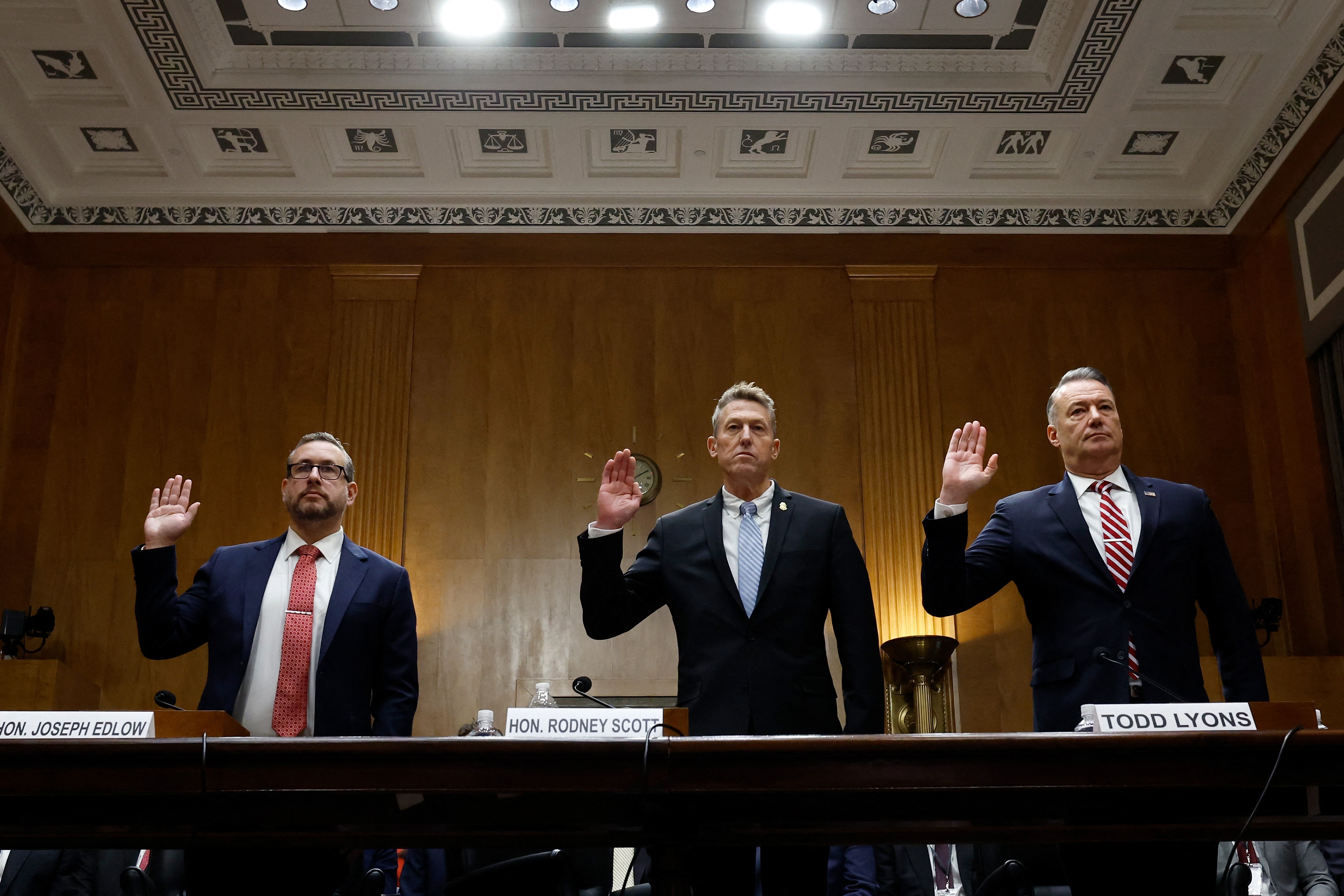
In practice, invoking the Fifth usually happens question by question. A senator asks something. The witness responds with some version of: “On the advice of counsel, I respectfully invoke my Fifth Amendment privilege against self-incrimination.”
That can happen once, or it can happen dozens of times, depending on how the questions are framed. A witness might answer harmless background questions but invoke the privilege on anything that touches a potentially criminal topic. Or the witness might invoke broadly if the investigation is sprawling and the risk is difficult to cabin.
One precision point: the privilege is typically asserted to specific questions. A committee can require the witness to appear and may insist the witness invoke the privilege in response to particular questions rather than accepting a blanket refusal as a procedural shortcut. But that does not mean Congress can override the privilege. If an answer is genuinely incriminating, Congress still cannot force it without changing the legal conditions, usually through some form of immunity.
When can you legally invoke the Fifth?
The test is not “will I look bad if I answer?” The test is whether answering could reasonably provide a link in the chain of evidence that might lead to criminal liability.
That risk can be direct or indirect. A truthful answer might:
- admit an element of a crime
- contradict prior statements and create exposure for perjury or false statements
- identify other actors or documents that investigators could pursue
- lock the witness into a timeline that prosecutors can attack
Courts have long held that the danger of incrimination must be “real and appreciable,” not imaginary. But the witness is not required to prove a crime exists. For obvious reasons, forcing a witness to explain why an answer would incriminate them can itself be incriminating.
Also, the privilege is not limited to federal crimes. If an answer could reasonably expose you to prosecution under state law, the Fifth Amendment can still apply.
Testimony vs. documents and evidence
Another common misconception is that the Fifth Amendment blocks every subpoena. It usually does not.
- Testimony: The privilege squarely protects you from being compelled to provide incriminating testimonial statements.
- Physical evidence and most existing records: The Fifth Amendment generally does not let a witness refuse to produce existing documents or physical evidence simply because they are incriminating.
- The act of production: There is an important wrinkle. In some situations, the very act of producing materials can be “testimonial,” because it implicitly communicates facts such as “these documents exist,” “they are authentic,” or “they are in my control.” That “act-of-production” issue is fact-specific, and it is one reason document subpoenas can still raise Fifth Amendment fights even when the subpoena is not asking questions out loud.
Can the Senate compel testimony anyway?
Congress has significant investigatory power, tied to its legislative functions. Committees can hold hearings, demand documents, and issue subpoenas. But that power runs into constitutional walls, and the Fifth Amendment is one of the tallest.
So the answer is: Congress can compel appearance (show up, be sworn in, respond), but it generally cannot compel incriminating answers unless it changes the equation by granting immunity.
Subpoena to appear vs. subpoena to answer
A subpoena can require a witness to show up. If a witness simply refuses to appear, Congress can pursue contempt processes. But once the witness is present, the Fifth Amendment can still block specific questions.
This distinction is why you will sometimes see high-stakes standoffs where a witness appears, says their name, and then declines to answer on Fifth Amendment grounds for the rest.
When a committee challenges an invocation
Disputes do not always end with the words “I invoke the Fifth.” A committee may press a witness to answer, argue that the risk is not real, or reframe questions to test whether the privilege truly applies.
In a hearing, these calls are often managed in real time by the chair and committee counsel, and sometimes by negotiated limits agreed to in advance. If Congress escalates to enforcement, courts can end up deciding whether a privilege claim was valid in the context of a subpoena fight. The key takeaway is practical: the privilege is strong, but it is not self-executing in every dispute. It gets tested through process.
Immunity: the key that can unlock Fifth Amendment silence
The privilege against self-incrimination is not a magic phrase that makes all questions disappear. It is a constitutional trade: the government can force answers only if it takes away the criminal risk created by those answers.
Congress can seek an immunity order, typically a form called use and derivative use immunity. That means prosecutors cannot use the compelled testimony itself, or evidence derived from it, against the witness in a criminal case. (It does not necessarily prevent prosecution altogether, but it raises the bar for proving the case came from independent sources.)
One procedural clarification: congressional committees do not grant immunity unilaterally. The process generally requires a committee vote and a court order under the federal immunity statute, with notice to the Justice Department.
There is also a separation-of-powers tension here: Congress wants facts. Prosecutors want to preserve criminal options. Immunity can complicate later prosecutions because it creates disputes over whether evidence is “tainted” by compelled testimony. That is one reason immunity is used selectively and strategically.
If you plead the Fifth, does that mean you are guilty?
No. Constitutionally, it means you are asserting a right not to be forced into helping the government build a criminal case against you.
Socially and politically, people make their own inferences. Legally, the consequences depend on the forum:
- In a criminal trial, jurors generally cannot be told to treat a defendant’s silence as evidence of guilt.
- In congressional hearings, the rules are political, not adjudicative. Senators can criticize a witness. The public can draw conclusions. But a valid Fifth Amendment invocation is a defense to contempt for that question, and the government still cannot impose criminal penalties for the invocation itself.
- In some civil contexts, a factfinder may sometimes draw adverse inferences from a party’s refusal to answer. The common contrast is: no adverse inference against a criminal defendant for silence, but sometimes possible in civil disputes.
The Fifth Amendment is not a guarantee that silence will be cost-free. It is a guarantee that silence will not be criminally punished when the privilege applies.
Refusing to testify at all
News disputes often blend two different issues:
- Substance: whether the witness can refuse to answer certain questions (the Fifth Amendment question).
- Process: whether the witness must appear again, when, and under what terms (a mix of subpoena law, committee procedure, and negotiation).
A witness can argue that repeated demands are improper or harassing, and Congress can argue that oversight requires persistence. The Constitution does not include a simple “no harassment” clause for congressional oversight. Instead, fights over repeat appearances usually play out through:
- committee votes and negotiations over scope
- subpoena issuance and enforcement choices
- court challenges in some circumstances
- political pressure and public accountability
If Congress issues a valid subpoena, the witness’s options narrow. But even then, the Fifth Amendment remains available for incriminating questions unless immunity is granted.
Contempt of Congress
Congress has multiple tools when a witness refuses to comply with a subpoena. The landscape is complicated, but the basic menu looks like this:
- Criminal contempt referral (a statutory process that can be referred to the Justice Department for prosecution).
- Civil enforcement (seeking a court order compelling compliance, depending on context).
- Inherent contempt (a rarely used historical power involving detention by Congress itself).
These are serious tools, but they do not override the Fifth Amendment. A contempt theory that amounts to “answer incriminating questions anyway” runs headfirst into the privilege. More commonly, contempt risk arises when a witness refuses to appear, refuses to answer questions that are not incriminating, or refuses to comply after a court order or immunity grant changes the legal landscape.
Common misconceptions
“Only guilty people plead the Fifth.”
Innocent people can face criminal exposure through misunderstandings, imperfect memories, document trails they have not seen, or contradictions with other witnesses. The privilege is designed for risk, not moral certainty.
“The Fifth only applies if you are under arrest.”
Arrest triggers additional protections like Miranda warnings in custodial interrogation, but the privilege itself is broader. It can be invoked whenever compelled answers could be used criminally.
“Congressional hearings are political, so the Fifth does not apply.”
Congress is political. The Fifth Amendment is constitutional. If testimony in a hearing could later be used in a criminal case, the privilege is in play.
“You can plead the Fifth to avoid answering anything.”
No. The privilege is not a general right to avoid inconvenience. If a question does not pose a realistic risk of self-incrimination, a refusal can be challenged.
The big picture
Congress investigates because it writes laws, funds programs, and oversees the executive branch. Witnesses invoke the Fifth because the Constitution assumes the government’s hunger for information can become coercive.
That tension is not a glitch in the system. It is the system. Oversight without limits becomes intimidation. Privilege without boundaries becomes impunity. The Fifth Amendment is one of the places the Constitution tries to keep both dangers on a short leash.
Quick FAQ
Can you refuse to testify before the Senate?
You can sometimes refuse to answer specific questions by invoking the Fifth Amendment. If you are subpoenaed to appear, refusing to show up entirely can expose you to contempt proceedings, depending on the circumstances.
Can the Senate force you to answer if you plead the Fifth?
Not if the answer could reasonably incriminate you, unless immunity is granted in a way that removes the criminal risk created by compelled testimony.
Is pleading the Fifth the same as “taking the Fifth”?
Yes. Both are informal phrases for invoking the Fifth Amendment privilege against self-incrimination.
Does “I plead the Fifth” have to be the exact phrase?
No. The witness has to clearly assert the privilege. Lawyers usually use a standardized statement to avoid ambiguity.