
You can refuse to testify if your answer could incriminate you. That is the Fifth Amendment in its most familiar form.
But in federal court, that refusal is not always the end of the story. A prosecutor can ask a judge to order you to testify anyway, as long as the government gives you a specific kind of protection called immunity. That is where people start mixing up terms, and where the difference between use immunity and transactional immunity becomes more than vocabulary. It becomes a central risk calculation for a witness, and a central evidence problem for the government.
Join the Discussion
The Fifth Amendment problem immunity solves
The Fifth Amendment says no person “shall be compelled in any criminal case to be a witness against himself.” In practice, that means:
- If you are asked a question under oath and a truthful answer could reasonably expose you to criminal liability, you can invoke the privilege and refuse to answer.
- The government generally cannot punish you merely for a valid invocation. But if the government obtains a proper immunity order, a court can compel testimony, and you can be held in contempt if you still refuse.
But the privilege creates a collision with another goal of the justice system: finding facts. Grand juries need witnesses to explain what happened. Trials often depend on witnesses to fill in what documents and forensics cannot. Conspiracies are hard to prove without insiders.
Immunity is the compromise: the government gets your testimony, and you get protection against that testimony being used to prosecute you.
Two kinds of immunity
Use immunity (and derivative use immunity)
In federal practice, the main statutory tool is what is commonly called use and derivative use immunity under 18 U.S.C. §§ 6002 to 6003. The promise is narrow but powerful:
- Use immunity: the government cannot use your compelled testimony against you in a criminal case.
- Derivative use immunity: the government also cannot use evidence that it discovered because of your compelled testimony.
This matters because evidence rarely arrives with a label saying where it came from. If your immunized testimony “leads” agents to a document, a witness, a bank account, or a new theory of the case, derivative use immunity says the government cannot use those fruits either, unless it can prove it had an independent source.
The Supreme Court’s anchor case is Kastigar v. United States (1972). The basic idea is that compelled testimony must not leave you worse off than if you had stayed silent, and the government bears the burden of showing its later evidence is not tainted by what it compelled.
Transactional immunity
Transactional immunity is broader. It is often described as immunity “for the transaction.” In other words, if the immunity covers a particular set of events, the government cannot prosecute you for crimes arising from those events at all, even if it has independent evidence.
Transactional immunity can be offered by some states. In federal practice, it is not the baseline statutory model, and it is comparatively uncommon.
One important clarification: sometimes people use “transactional immunity” to describe a non-prosecution agreement or other negotiated promise not to charge. Those agreements can function similarly, but they are not statutory immunity. They are negotiated commitments, and their scope depends on the contract language.
That is the first big takeaway: in federal court, immunity usually does not mean you cannot be charged. It usually means the government cannot use what it forced out of your mouth, or anything that grew out of it.
How federal immunity is granted
There is a popular myth that a prosecutor can simply “give immunity” on the spot, like handing out hall passes.
In federal court, formal statutory immunity generally requires a process, and each player has a role:
- The prosecutor decides whether immunizing a witness serves the investigation, and whether the office is willing to accept the future limitations that come with it.
- Supervisory approval inside the Department of Justice is typically required for statutory immunity requests.
- The judge issues an order compelling testimony once the statutory requirements are met. The judge is not usually bargaining over the terms. The judge is authorizing compulsion.
- The witness, once ordered to testify and protected by the immunity order, can be held in contempt for continued refusal.
So the mechanics look like this: the witness invokes the Fifth Amendment, the government seeks an immunity order, the court compels testimony, and then the witness must answer.
Grand juries and immunity
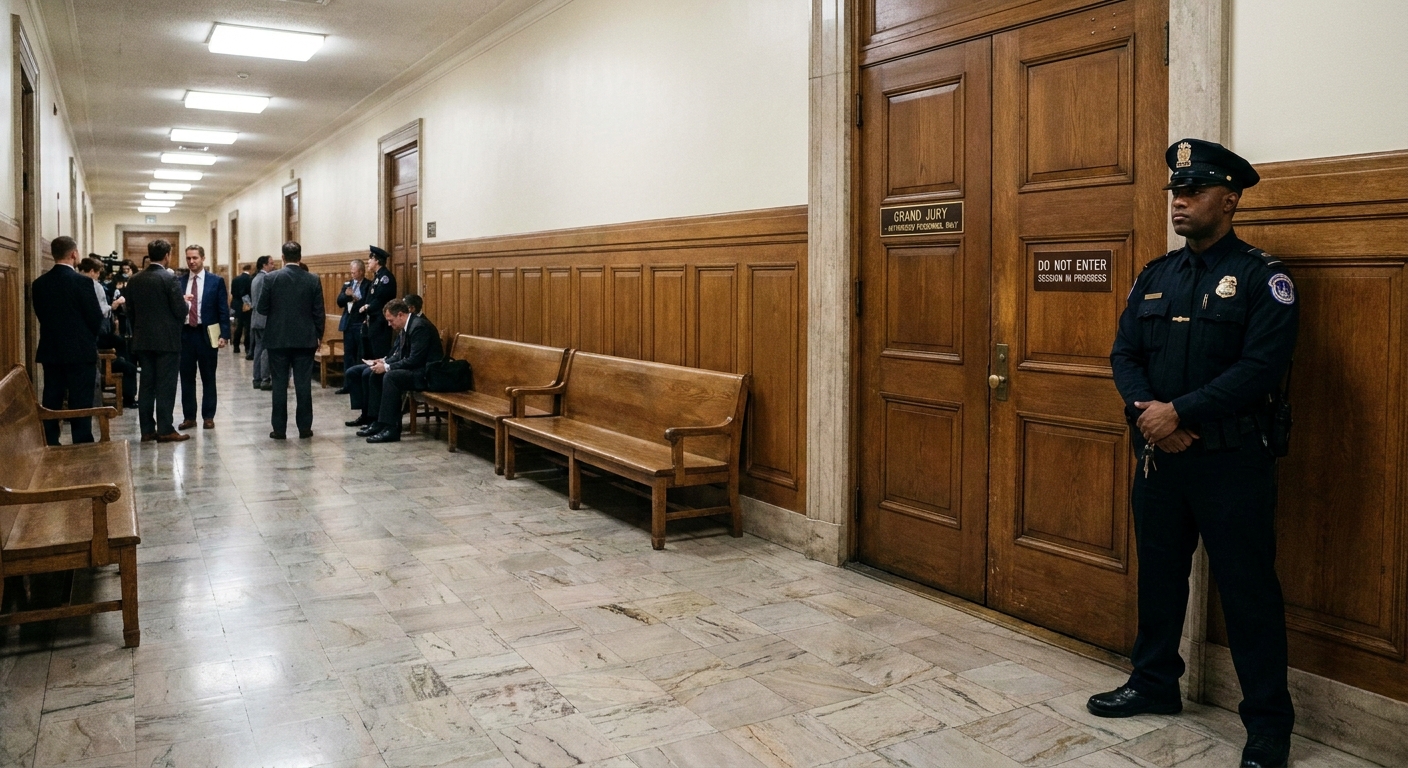
Grand juries investigate. They do not decide guilt. They decide whether to return an indictment, which in practice means determining whether there is probable cause to charge.
That investigative posture creates two pressures that make immunity common:
- Many key witnesses have exposure. Anyone close enough to a scheme to explain it may have participated in it.
- The government wants testimony early, before stories harden and before targets coordinate.
Immunity can turn a stalled subpoena into a usable testimony record, but it also creates a record the government must live with later. If the witness is ever prosecuted, the government may have to show that its evidence came from somewhere other than the compelled testimony.
That is why prosecutors treat immunity like a one-way door. Once compelled testimony is on the record, it can be difficult to disentangle an investigation from what was said.
Use immunity at trial
Use immunity is easy to describe and hard to administer. The problem is not whether the government can quote the immunized testimony at trial. It cannot. The problem is everything else.
If the immunized witness later becomes a defendant, the government must show that its case is built on evidence it obtained independently. This is where the judge’s role becomes central. Courts may require the government to demonstrate, often in a pretrial evidentiary hearing called a Kastigar hearing, that:
- investigators already had certain leads before the immunized testimony, or
- the same evidence was obtained through a separate chain of events that was not prompted by the testimony.
In practice, prosecutors may use screening procedures to reduce taint risk. Depending on the office and the case, that can include separating personnel who were exposed to immunized testimony from those building the prosecution, and documenting what was known before the testimony and how each later piece of evidence was acquired.
This is not procedural fussiness. It is how the system tries to keep compelled self-incrimination from sneaking back in through the side door.
A simple timeline
Consider a narrow hypothetical. No dramatic twists, just the way cases sometimes unfold:
- Day 1: A witness receives a grand jury subpoena and invokes the Fifth Amendment (often through counsel, and often question by question).
- Day 10: The prosecutor seeks a court order for use and derivative use immunity under 18 U.S.C. §§ 6002 to 6003. The judge issues the order. The witness testifies.
- Month 4: Agents discover independent evidence from another source suggesting the witness had a larger role than previously believed.
- Month 8: The government considers charging the witness.
With use immunity, charging is not automatically prohibited. But the government is now locked into a demanding proof obligation: it must show that none of the trial evidence comes from the compelled testimony, directly or indirectly.
With transactional immunity, if it covered that same misconduct, the charging decision would be largely off the table regardless of independent evidence.
Immunity vs. deals
People often use “immunity” as a catch-all for any arrangement where a witness talks. But legally and practically, these tools are different.
Statutory immunity (court ordered)
- Typically triggered by the witness invoking the Fifth Amendment.
- Backed by a judge’s order compelling testimony.
- Protection is defined by law, not just by negotiation.
Plea agreements
- The witness is a defendant pleading guilty to something.
- Any benefit is negotiated, often including reduced charges or sentencing recommendations.
- The witness typically must testify truthfully as part of the deal.
Cooperation and non-prosecution agreements
- The government promises certain charging decisions in exchange for cooperation.
- These are contractual in feel, but enforced in court when disputes arise.
- They can be broad or narrow, and the language matters.
Why it matters: immunity is about compulsion and the Fifth Amendment. Deals are about bargaining and prosecutorial discretion.
What immunity does not cover
Even strong immunity does not make a witness untouchable.
Perjury and false statements
If you lie under oath after receiving immunity, you can be prosecuted for perjury. Immunity is a tool to obtain truthful testimony, not a permission slip to invent a story.
Obstruction and witness tampering
Immunity for testimony about past events does not grant license to interfere with an investigation.
Prosecution based on independent evidence
Under use and derivative use immunity, prosecution remains possible if the government can prove its evidence is independent.
Civil and regulatory exposure
The Fifth Amendment is a criminal privilege. Immunity granted to compel testimony in a criminal investigation may not automatically resolve civil liability, professional discipline, or regulatory consequences. The overlap depends on the forum and the specific terms of any agreement.
Other jurisdictions
Immunity is also a jurisdictional puzzle. State and federal systems are separate sovereigns, and cross-jurisdiction use of compelled testimony is a specialized issue. In general terms, courts have held that compelled testimony cannot be used to prosecute you in another jurisdiction either, but the details are fact-specific and worth treating as a separate legal question if multiple sovereigns are in play.
Why prosecutors use immunity carefully
Immunity can unlock an investigation, but it can also narrow future options. A prosecutor deciding whether to immunize a witness is weighing at least three things:
- Necessity: is this testimony essential, or merely helpful?
- Credibility: will the witness hold up under cross-examination?
- Cost: will immunizing this witness complicate later cases if the witness becomes chargeable?
In a conspiracy case, the government may immunize a minor participant to reach a major one. But if it misjudges who is “minor,” it can end up with an immunized witness who later looks like the central actor, and a courtroom fight about taint that consumes the case.
The judge’s role
Judges are often described as umpires. In immunity, they really do serve that function. They:
- issue the compulsion order (the legal trigger that forces testimony),
- rule on contempt if the witness refuses after the order, and
- police the downstream use of immunized testimony if the witness is later prosecuted, including deciding whether the government has met its burden to show independent evidence under Kastigar.
The judge does not “give” immunity as a favor. The judge enforces a constitutional boundary: if the government compels answers, it must accept the limits that keep the Fifth Amendment from becoming meaningless.
The bottom line
The Fifth Amendment is not a right to silence as an aesthetic preference. It is a rule about compulsion and self-incrimination. Federal witness immunity exists because the government sometimes needs your words, and the Constitution says it cannot take them without paying a price.
Use and derivative use immunity is that price in most federal cases. It forces testimony while promising the testimony and its fruits will not be used to convict you, and it puts the burden on the government to prove independence later.
Transactional immunity is a stronger promise, but it is not the default federal model. It is closer to a commitment not to prosecute at all for the covered conduct.
And that distinction explains why immunity can feel both protective and precarious at the same time. You may be compelled to speak, and still not be guaranteed a clean exit. The protection lives in what the government can prove later about where its evidence came from.