
For most Americans, “mailing a handgun” sounds like something that is obviously illegal, like putting fireworks in a box and hoping nobody notices. But the law has never been that simple. It has been a layered system of federal statutes, postal regulations, and the background reality that the Second Amendment now plays a far larger role in firearm policy than it did a century ago.
Now the U.S. Postal Service has proposed a rule that would, for the first time in nearly 100 years, open the mail stream to concealable firearms such as pistols and revolvers. The proposal has triggered sharp responses from state attorneys general, gun-rights advocates, and gun-safety groups. It is not just a logistics tweak. It is a dispute about constitutional rights, public safety, and who gets to decide what happens when a federal statute collides with an executive-branch constitutional view.

Join the Discussion
What USPS is proposing
Under current postal rules, some firearms can already move through the mail. Long guns such as rifles and shotguns may be mailed if they are unloaded and packaged securely. Handguns are treated differently, largely because federal law has historically treated concealable firearms as a special category.
The proposed USPS rule would expand what can be mailed to include concealable firearms, with safety conditions intended to mirror the guardrails already used for rifles and shotguns. In other words, the change is not framed as “anything goes.” It is framed as “handguns get treated more like other lawful firearms,” with requirements on unloading and packaging still doing the day-to-day safety work.
Why handguns were blocked
This is not a modern invention. The handgun-by-mail prohibition has deep roots.
In 1927, Congress passed a law barring the USPS from mailing concealable firearms unless they were from licensed dealers, in an effort to curb crime. That 1927 choice hardened into routine. For decades, “you cannot mail a handgun” became less a debated policy and more a baseline assumption.
But assumptions built in one constitutional climate do not always survive in another.
The legal pivot: Section 1715
The immediate trigger for the new proposal is a constitutional judgment coming from inside the executive branch.
In January, the Department of Justice revisited the federal handgun mailing ban, specifically the provision in 18 U.S.C. § 1715 that prohibits mailing concealable firearms. The Department concluded the ban is unconstitutional under the Second Amendment and urged USPS to adjust its regulations to match that view.
The Department’s position is sweeping in principle. As it put it, so long as Congress chooses to operate a parcel service, “the Second Amendment precludes it from refusing to ship constitutionally protected firearms to and from law-abiding citizens, even if they are not licensed manufacturers or dealers.”
USPS has tied its proposed rule to that analysis. USPS spokesperson David Walton said the rule was proposed April 2 “to conform with the opinion of the Department of Justice's Office of Legal Counsel regarding the constitutionality of Section 1715 of title 18 U.S. Code, which prohibits the mailing of concealable firearms.” He added: “The public comment period ended close of business May 4th, and we are reviewing comments.”
What it would allow in-state
The most consequential shift is inside state lines.
Under the proposal, a person could sell and ship a handgun to another person within the same state. That is the part that has drawn the most alarm from opponents, because intrastate transfer rules vary widely by state and enforcement often depends on licensed dealers as checkpoints.
In many states, the safest and most legally straightforward path for a private transfer is to route it through a federally licensed firearms dealer, the familiar FFL, to ensure background checks and paperwork happen correctly. The proposed rule would expand the availability of transfers that do not run through that traditional compliance bottleneck, even if federal and state law still applies.
What it would allow across states
Interstate mailing is treated more cautiously under the proposal. It does not simply open the door to shipping a handgun to another person in another state.
Instead, the proposed framework would allow a person to mail a handgun across state lines only to themselves, in the care of another person, with the requirement that the gun be opened by the owner. The idea is to help people traveling to another state where they might want to use a gun for recreation.
The executive branch has emphasized scenarios like hunting, target shooting, and self-defense. It has also argued that the patchwork of state firearm laws can make physical travel with a gun difficult or legally risky, leaving the mail, in the Department’s words, “the only viable method of transportation” in some circumstances.
The core dispute
The biggest legal objection is not about cardboard boxes or postal clerks. It is about who has authority when a statute is still on the books.
Attorneys general in two dozen states submitted a multistate comment urging USPS to withdraw the proposed rule. Their central argument is structural: Congress enacted a statute, and the executive branch does not have the authority to ignore that law through a regulatory change. They also argue the proposal would override state gun laws.
If the federal ban is unconstitutional, opponents argue the cleanest pathway is a court decision that says so or congressional action that revises the law. The proposed rule attempts something more administratively direct: treat the statute as invalid, then conform postal regulations to that conclusion. That approach is likely to invite litigation if the rule is finalized.
What states fear
The state attorneys general focus on an enforcement reality: many state-law protections work because transfers funnel through known, regulated actors.
The multistate comment warns that expanded handgun mailing could make it easier for people who cannot legally possess firearms, including people with felony convictions or domestic violence histories, to obtain them. They also say it will make it more difficult to solve gun crimes.
The letter points to state requirements such as firearms safety courses, background searches, and mental health history checks. They argue those requirements are regulated through state entities and would be bypassed if the rule change is implemented. They also argue there would be no way to guarantee someone is following the rules and not shipping a handgun across state lines to another person.
The attorneys general add that law enforcement would have to create a new tracking structure for firearms mailed through the postal service, placing added burdens on state budgets.
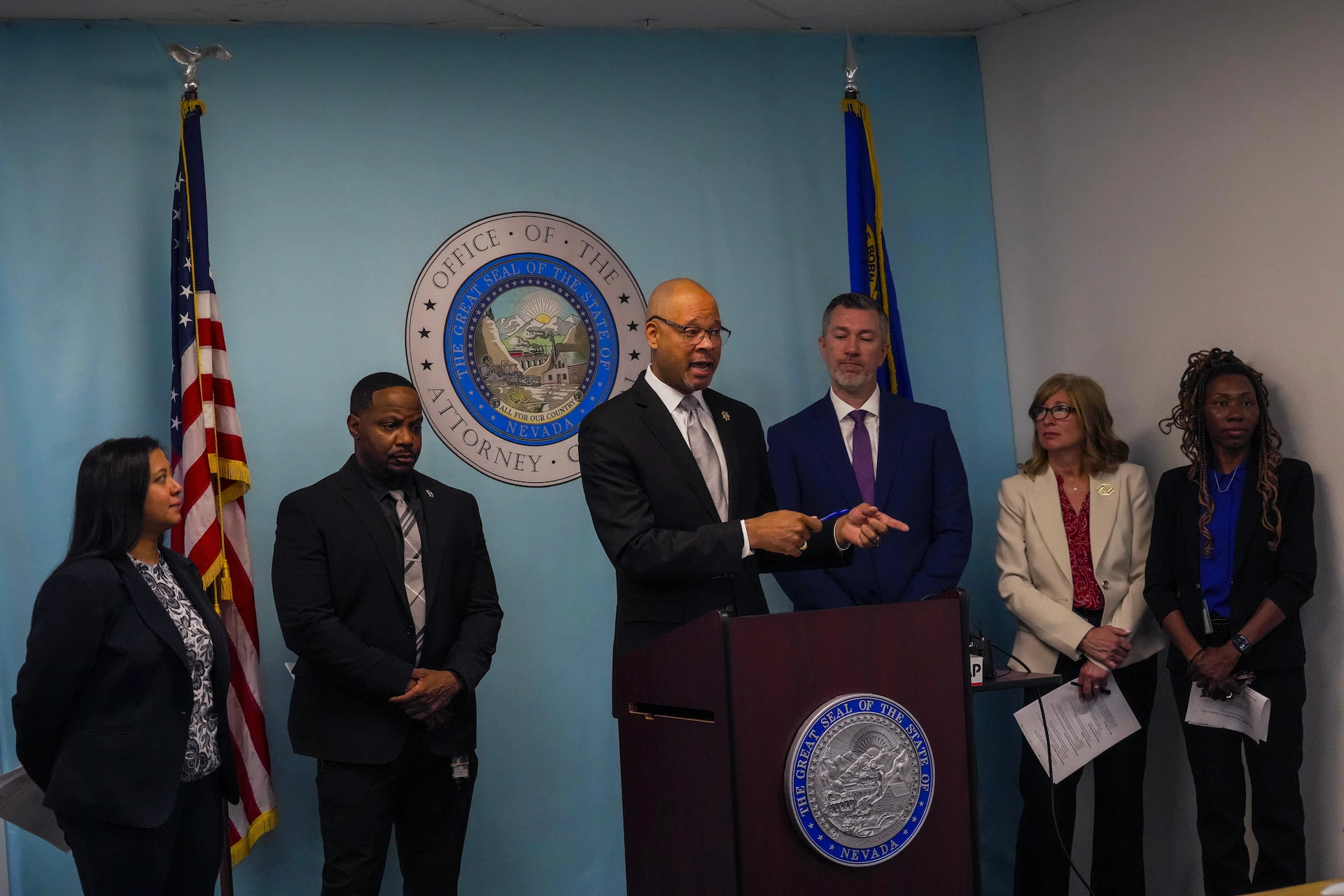
Nevada Attorney General Aaron Ford, a Democrat who is running for governor, framed the proposal as undermining state efforts to curb gun violence. Nevada experienced the deadliest mass shooting in modern U.S. history on Oct. 1, 2017, when a gunman in Las Vegas killed 60 people. Following the shooting, Nevada passed a law requiring state-administered background checks on most private gun sales or transfers.
Ford’s objection is blunt: “Our state has suffered enough, and to suggest we make it easier for criminals and abusers to access firearms is a slap in the face to gun violence survivors and law enforcement.”
Private carriers
One reason this debate feels jarring is that Americans are used to thinking of mail as a public utility. But firearm shipping already exists in the private sector, just under tighter corporate policies.
Private companies like UPS and FedEx restrict gun shipments to customers with federal firearms licenses, such as importers, manufacturers, dealers, and collectors. FedEx requires shippers with a federal firearms license to work with a FedEx account executive to obtain approval, according to the company’s website.
Supporters and critics
Supporters see a civil-rights alignment. If a firearm is constitutionally protected and a citizen is law-abiding, a federal shipping service should not single out a particular kind of firearm as unshippable.
John Commerford, executive director of the lobbying arm of the National Rifle Association of America, praised the proposal as a win for gun owners. “Thanks to President Trump and his administration, USPS will finally allow these firearms to be shipped under the same commonsense safety conditions as rifles and shotguns,” he said.
Critics see a trafficking risk. John Feinblatt, president of Everytown for Gun Safety, warned that the change would turn USPS into a “gun trafficking pipeline” for illegal weapons “while stripping law enforcement of the tools they need to prevent and investigate gun crime.”
Who sets the rules
Congress
Congress enacted the underlying criminal statute that has long prohibited mailing concealable firearms. If Congress changes the law, the debate shifts overnight.
The executive branch
The Department of Justice, through constitutional analysis by the Office of Legal Counsel, has taken the position that the federal ban is unconstitutional. USPS is responding by proposing regulatory changes that match that view.
USPS
USPS writes and enforces its mailing standards and runs the notice-and-comment process for major rules. In this case, USPS proposed the rule April 2, closed public comments May 4, and is reviewing submissions.
The courts
Courts are where this is likely to end if the rule is finalized. If states or other challengers sue, judges will have to address both the Second Amendment question and the administrative-law question. Can an agency regulate as if a statute is invalid based on an executive-branch constitutional view, or must it wait for Congress or the judiciary to say so?
Why it matters
This is a familiar American storyline: a federal statute from one era collides with a constitutional doctrine from another, and the fight becomes less about policy design and more about institutional legitimacy.
If the proposed rule becomes final, the practical question will be how effectively “law-abiding citizen” limitations and packaging safeguards can be verified in a system designed to move millions of parcels quickly. But the deeper question is more civics than logistics: when Congress writes a rule and the executive branch believes the Constitution forbids it, who has the authority to make that constitutional judgment binding for everyone else?