
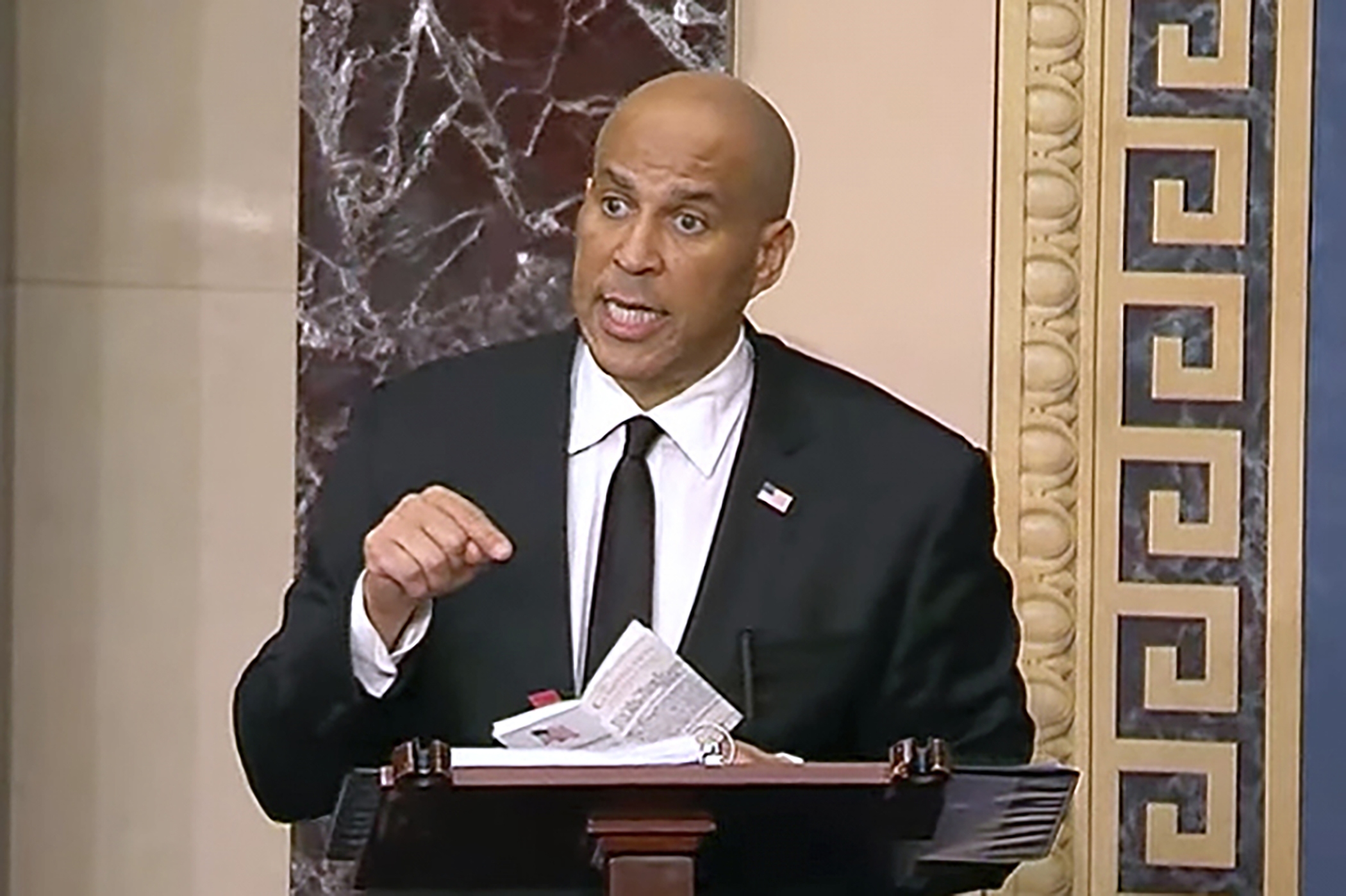
Sen. Cory Booker is making a straightforward midterm argument about the Supreme Court: if Democrats take control of Congress, he says they will “reform” the Court.
The question that prompted his remarks was framed as part of a long American tradition of political conflict over the Court, pointing to the Lincoln-Douglas debates and the backlash to Dred Scott as moments when people felt the Court was “out of control.” Booker responded by tying “reform” to two concrete ideas he says have broad public support: stronger ethics rules and term limits.
That word, reform, can stretch. Sometimes it means tightening ethical guardrails. Sometimes it means changing how long justices serve. And in the wider political argument, it can also refer to structural moves that change the Court’s trajectory.
One clarification up front: Booker did not call for expanding the Court in this exchange. He focused on ethics and term limits, and he argued reform is needed to bring the Court “back into alignment” after recent rulings he says have rolled back progress and enabled renewed vote suppression.
That leaves a civic question worth asking as we talk about “reform”: are we talking about insulating the judiciary from conflicts of interest, or are we talking about rebalancing power in response to outcomes we dislike?
Join the Discussion
What Booker said
Booker’s case centers on two reforms he says “most Americans agree” on, along with a broader claim that the Court’s recent direction is undermining progress and democratic participation.
1) Ethics
Booker argues that the Court operates with unusually weak ethical guardrails. In his words, “The Supreme Court is another example of an area where most Americans agree. Most Americans agree that the highest court in the land should not have the lowest of ethics laws.”
He adds that “billionaires can routinely shower, Supreme Court justices with gifts from mobile homes to fancy, expensive vacations.” His point is not only about policy. It is about legitimacy. Courts do not have the purse or the sword. What they have is public trust, and trust does not survive the appearance of a private benefits pipeline.
2) Term limits
Booker also targets life tenure as it functions in a hyperpartisan era. “Most Americans agree that Supreme Court justices shouldn’t sit on those benches until they’re so ailing,” he says, describing a modern incentive to hold on “well past perhaps even senility” until “their president” aligns with their “jurisprudence philosophies.” His conclusion: “That’s why term limits, are a good thing as well.”
Notice the logic: the argument is not only about age or health. It is about the strategic pressure life tenure can create, where retirement becomes a political calculation and each vacancy becomes a national emergency.
3) “Back into alignment”
Booker frames reform as bringing the Court “back into alignment,” arguing that recent rulings have “eviscerate[d] years and years and years of progress” and “throw us back to those dark years,” where, he says, “so many people were successfully suppressing the votes of minority groups throughout the South.”
What reform can mean
Booker’s specific “reform” list here is ethics rules and term limits. Still, the national debate often uses the same word to cover a range of proposals, some narrow and some structural. Congress has multiple levers it can pull, and not all of them require a constitutional amendment. But each lever raises a shared concern: does it strengthen judicial independence, or make the Court more dependent on whichever party wins the next election?
Ethics rules
Ethics reform is the easiest to describe as institutional upkeep: disclosure rules, gift restrictions, recusal standards, and some kind of enforcement mechanism with teeth.
The hard part is not writing rules. The hard part is designing enforcement that does not become political supervision. If Congress can effectively discipline justices, it can also intimidate them. A reform that begins as accountability can end as leverage.
Term limits
Term limits are popular because they promise regular turnover and may lower the temperature around retirements and confirmations. They also raise a constitutional puzzle.
- The Constitution’s text: federal judges “hold their Offices during good Behaviour.” That has long been treated as life tenure unless impeached and removed.
- The workaround idea: some proposals try to keep “office” for life while moving justices into senior status after a set term, preserving pay and title.
Even if a statute could survive a court challenge, there is still a broader question about consequences. A more routine appointment cycle can reduce chaos. It can also make the Court feel more like a rotating political branch on a schedule.
Court size
Not part of Booker’s stated agenda in this exchange, but frequently bundled into the wider “court reform” debate, is changing the number of justices.
Congress can change the number of justices by statute. The Constitution does not set the size of the Supreme Court.
Still, altering the Court’s size is the lever most likely to trigger escalation. If one party uses it to reverse outcomes, the other party will face pressure to respond in kind. At that point, the Court risks becoming less an independent institution and more a recurring political prize.
The core tension
Americans like to talk about “checks and balances” as if each branch politely stays in its lane. The reality is messier. The branches push and pull, particularly when the Court issues decisions that land like a shock to the political system.
Booker’s “alignment” language can be read in two directions at once. He is making a legitimacy argument about confidence in the Court’s rules and ethics. He is also making a directional argument about rulings he believes are reversing progress and enabling minority vote suppression.
But the civics question remains: alignment with what? With public opinion? With one party’s priorities? With a particular constitutional interpretation? The Court’s job sometimes requires being out of step, especially when rights are unpopular. Reform that treats unpopularity as a defect can become reform that trains the Court to follow the crowd.
If Democrats win
Booker is framing the Court as an institution whose rules are not beyond political reach, and he is explicitly linking a Democratic win to an effort to change those rules. In this clip, the changes he names are ethics standards and term limits.
The midterm question is not only whether voters want different outcomes from the Court. It is also whether they want Congress to more actively rewrite the rules that shape how the Court functions, and how far they want that to go.
A simple stress test applies to every reform tool: would you still support it if the other party controlled it next?