
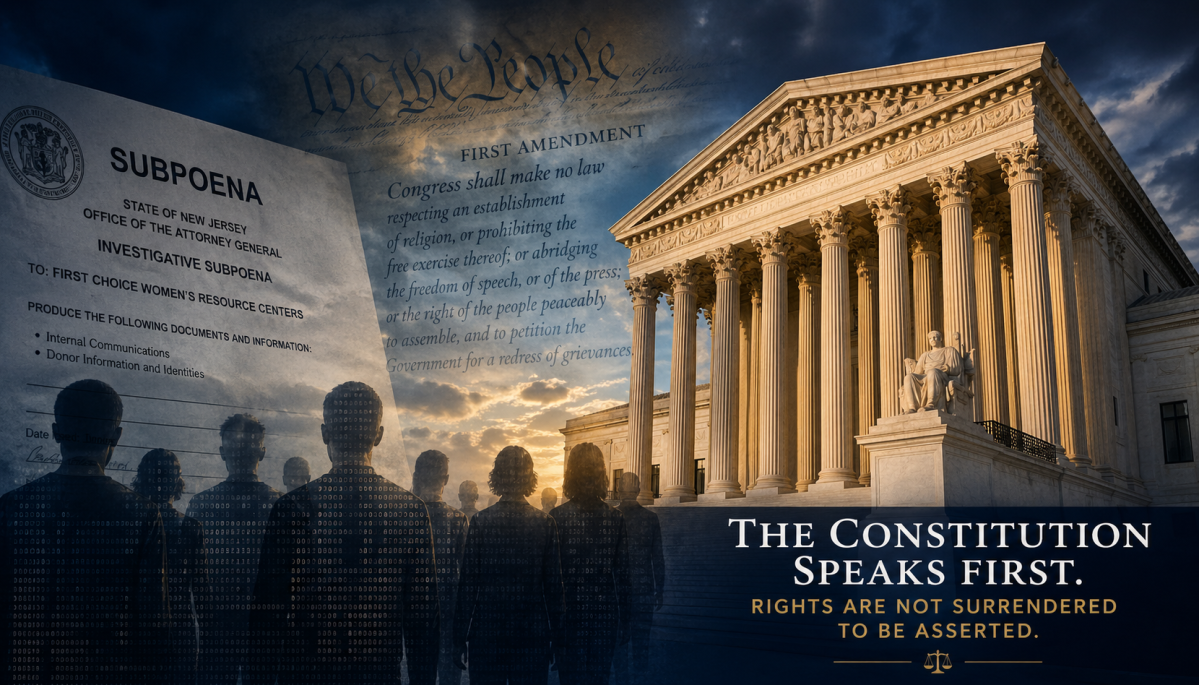
Constitutional law does not always arrive with a sweeping statute or a landmark opinion that everyone recognizes on sight. Sometimes it starts with something smaller and more procedural: a demand for records.
That is the posture of a dispute now unfolding in New Jersey. The state attorney general is seeking to compel a pregnancy center to turn over donor information, and the request raises a potential First Amendment question in light of a Supreme Court precedent often cited in donor-disclosure disputes.
Public details are limited at this stage. The precise scope of the request and the legal vehicle being used to compel it are not fully clear here. But the constitutional tension is familiar: when the government seeks a list of supporters, courts often have to decide whether the request is justified and narrowly tailored, or whether it risks chilling association.
Join the Discussion
What is happening
The immediate issue is narrow: can the New Jersey attorney general force a pregnancy center to hand over donor information?
The broader issue is legal rather than personal. Donor lists are not just administrative records. In many contexts, they function as a map of who supports what. When the government seeks that map, the question becomes whether compelled disclosure burdens association and speech protected by the First Amendment.
Why the Supreme Court matters
This New Jersey fight matters because it sits alongside a Supreme Court precedent that is often read to constrain when governments can demand donor and supporter information.
That boundary does not automatically resolve every later dispute. The facts matter, and so does the government’s stated purpose. But the existence of a high-court framework changes the terrain. It pushes lower courts toward practical questions such as:
- Scope: Is the request narrowly targeted, or broad enough to sweep in information that is not necessary?
- Purpose: What, specifically, does the government claim it needs donor information for?
- Chill: What is the plausible risk that disclosure will deter people from supporting a cause?
- Safeguards: Are there protections that minimize exposure while still allowing legitimate oversight?
Framed this way, the dispute is best read as a test of how a Supreme Court standard applies to an investigative demand for names, not as a foregone conclusion about who is right.
How rules change
It is tempting to think constitutional change is mostly legislative. In practice, many shifts come through impact litigation, meaning cases that end with a rule that governs future disputes.
The mechanics are straightforward. A government actor seeks information or enforcement power. A targeted group challenges that action as unconstitutional. Courts then decide not only who wins, but what test applies next time.
In donor-disclosure fights, that usually means courts are asked to balance two realities that both matter:
- Government oversight: states have interests in investigations and enforcement.
- Associational privacy: compelled disclosure can deter people from supporting causes, especially controversial ones.
What to watch
If you want to understand how this kind of case can reshape constitutional law, watch the steps as much as the outcome. The most important details tend to be procedural.
- What is demanded: how much donor information, and for what time period?
- How it is demanded: what tool is being used to compel production?
- How courts apply the Supreme Court standard: do they treat this as the kind of compelled disclosure that triggers heightened scrutiny?
- How narrow the ruling is: does a court resolve only this dispute, or announce a broader rule for future investigations?
The civics lesson is practical. Constitutional doctrine often gets clarified through record demands and court challenges long before most people notice a change has happened.