
Over a Saturday morning on Truth Social, Trump posted two surveys for his followers: one workshopping a derogatory nickname for Democrats, and another floating a rebrand of Immigration and Customs Enforcement. On the surface, it is politics-as-entertainment. Underneath, it is also a live demonstration of something the Constitution never anticipated: the presidency as a constant feedback loop, where messaging, governance, and personal brand blur into one another.
Join the Discussion
The nickname poll
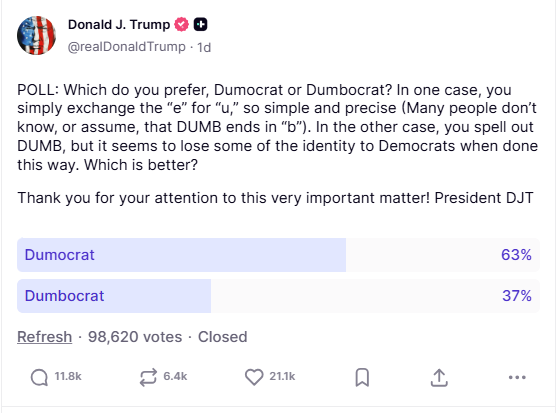
Trump’s first poll asked supporters to choose between two spellings of a taunt aimed at Democrats: “Dumocrat” or “Dumbocrat.” He framed it like a miniature tutorial in phonics and branding.
“POLL: Which do you prefer, Dumocrat or Dumbocrat? In one case, you simply exchange the ‘e’ for ‘u,’ so simple and precise (Many people don’t know, or assume, that DUMB ends in ‘b’),” Trump wrote. “In the other case, you spell out DUMB, but it seems to lose some of the identity to Democrats when done this way. Which is better?”
By Saturday afternoon, the poll had drawn more than 60,000 votes.
This is not new behavior for Trump. Nicknames have been one of his most consistent political tools, a way to compress an argument into a meme-sized label that supporters can repeat and opponents have to spend time denying. The poll adds a twist: it turns that rhetorical weapon into a participatory event. The audience is not just consuming the insult. They are helping manufacture it.
The ICE poll
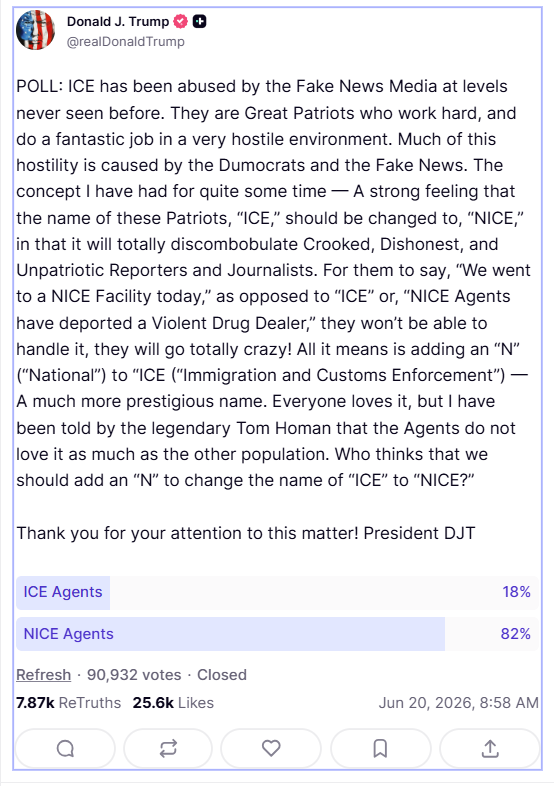
About an hour later, Trump posted a second poll: should Immigration and Customs Enforcement add the word “National” to its name, shifting ICE to “NICE” and recasting personnel as “NICE agents” rather than “ICE agents”?
He offered an explicit rationale: he claimed there is “hostility” toward ICE agents and blamed “Dumocrats and the Fake News.” He also described the rebrand as a way to frustrate reporters, writing that the phrase “NICE Facility” would “totally discombobulate Crooked, Dishonest, and Unpatriotic Reporters and Journalists.”
“All it means is adding an ‘N’ (’National’) to ‘ICE (‘Immigration and Customs Enforcement’) — A much more prestigious name,” Trump wrote.
He also acknowledged internal resistance. Trump said he had been told by Tom Homan that “the Agents do not love it as much as the other population.” In a May interview, Trump put it more bluntly: “But I’m not sure that the guys liked it, because ... I think they like their image of being strong, and they’ve done a great job.”
By Saturday afternoon, that second poll had received more than 45,000 votes.
A Truth Social poll is not law. It does not carry the force of an executive order, a regulation, or even a formal White House directive. But it can still matter for three reasons that are easy to miss if you treat it as mere trolling.
- It tests a message inside a friendly crowd: The constitutional system gives presidents immense formal power over executive messaging, but no guarantee that the public will accept it. A poll provides instant, low-cost validation.
- It signals priorities to the bureaucracy: Executive agencies are staffed by career professionals, but they respond to presidential attention. Even a speculative “should we rename this agency?” prompt can function as a nudge.
- It turns governance into identity: When policy is framed as a branding decision, it invites supporters to treat the government itself as an extension of a political team, complete with slogans and merch.
That last point matters because the Constitution is built on a different assumption: that government is an institution, not a fandom. It is designed to channel passions, not amplify them.
The constitutional angle
Nothing in Article II gives a president a “right to rename an agency by vibe.” Executive power is real, but it is structured. Agencies exist because Congress creates them and funds them. Their names, authorities, and missions are often embedded in statutes, appropriations language, and regulations.
In practice, presidents can still influence names, branding, and public-facing terminology, especially through executive branch communications. But a formal name change for an entity like ICE could raise practical and legal questions depending on what Congress wrote into law and what the executive branch is authorized to alter administratively.
This is where the polls become revealing. They are not just about what Trump might do. They are about how he frames what he is doing. A president who invites followers to vote on a rebrand is implicitly presenting the executive branch as something that can be crowd-shaped. That is culturally powerful, even when it is legally incomplete.
ICE opinion and naming
The second poll also lands in a country already arguing about ICE’s role and legitimacy. The Trump administration’s hardline immigration agenda has sparked anti-ICE protests across the country over the last year and a half, and public opinion is not uniformly supportive.
A February poll found that nearly three-quarters of U.S. adults wanted some changes to ICE, with 29 percent saying the agency should be abolished entirely.
In that environment, a name change is not just cosmetics. It is an attempt to contest the frame. If “ICE” has become synonymous with a particular set of enforcement tactics in the public mind, “NICE” is an effort to relabel the same institution with a softer sound and a more “patriotic” prefix. The question is whether the public treats that as clarification or camouflage.
Why it matters
It is tempting to file these polls under the familiar category of Trumpian theater. But the deeper civic lesson is broader than one politician and one platform.
We are watching a modern presidency experiment with a new kind of direct relationship: not just speaking to the public, but asking the public to help script the performance in real time. The Constitution assumes elections are the main feedback mechanism, spaced out to cool the temperature and force deliberation. Social media collapses that distance. It makes politics constant, reactive, and personal.
That can energize participation. It can also cheapen it, turning constitutional citizenship into brand management. The republic survives when people demand more than slogans, even when slogans are funny, satisfying, or viral.
And this is the question worth asking after the polls close: when a president crowdsources a nickname or a rebrand, is he listening to the people, or training them to cheer on command?