
When the Supreme Court struck down the Trump administration’s emergency tariffs earlier this year, a lot of Americans heard one simple idea: those tariffs are gone, so the government has to give the money back. True, as far as it goes.
But the more uncomfortable civics question is this: who exactly is “the public” in a refund? The answer, at least in how the system actually works, is not “everyone who paid higher prices at the register.” It is the businesses that wrote the checks to the federal government at the border.
Now that Customs and Border Protection has opened a new online path for claims, the refund story is no longer just a court fight. It is a test of administrative capacity, and a reminder that when government pushes costs into the economy, the refund does not necessarily flow back to the people who felt the pinch.

Join the Discussion
What CAPE is
The federal government has launched a tariff refund portal using a platform called Consolidated Administration and Processing of Entries, or CAPE, operated by U.S. Customs and Border Protection (CBP). It is designed to process refunds for tariffs imposed under the International Emergency Economic Powers Act (IEEPA) that are now invalid after the Supreme Court’s decision.
In plain English: duties were collected at the border, and the government now has to return eligible payments to eligible importers.
And we are not talking about pocket change. The government may owe up to $175 billion across tens of thousands of importers.
Who gets refunds
If you are a consumer hoping for a direct refund, the basic structure of the tariff system is the bad news: tariffs are collected from the importer of record, not from the retail customer.
So the refund check, if and when it arrives, goes to the business that paid the duty to CBP. That includes:
- Small businesses importing finished goods or components.
- Manufacturers importing parts and materials.
- Large retailers importing goods under their own customs entries.
It typically does not include:
- Consumers who paid higher shelf prices.
- Small retailers who bought from a distributor that served as importer.
That is not a moral judgment. It is the mechanical reality of how tariff collection works.
Early glitches
A portal can be “live” and still be unusable. On launch day, some importers reported difficulty filing claims.
Rick Woldenberg, CEO of Learning Resources, said his company encountered an error message: "The system is currently experiencing high volume, please try again later," and described the situation bluntly: "The system seems to have gone blinky."
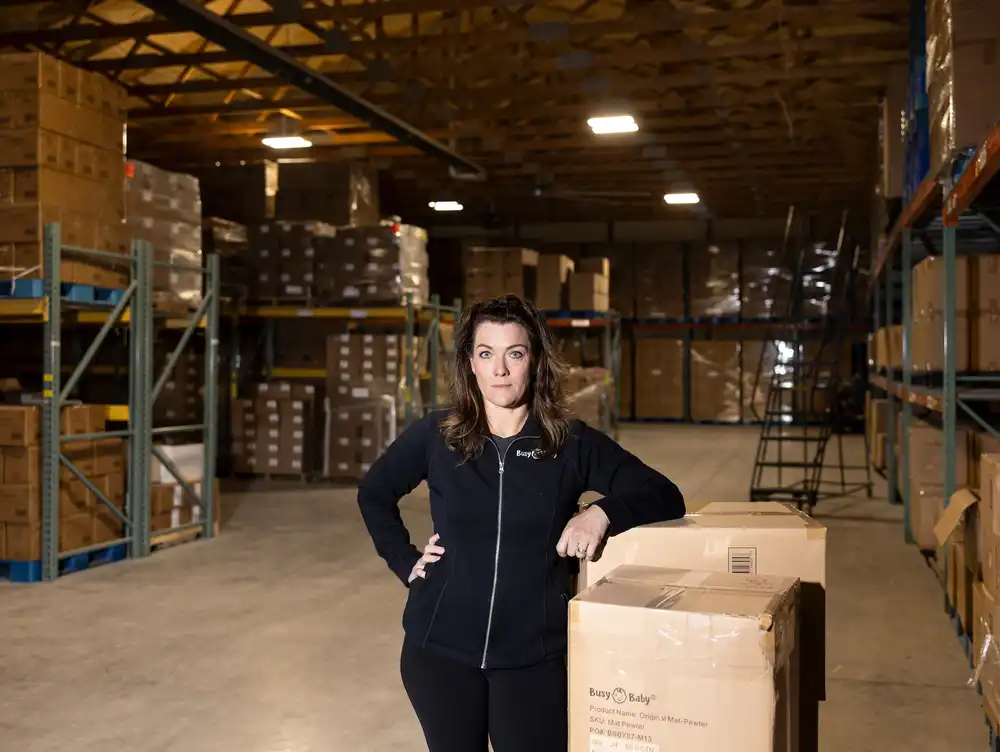
Others ran into account issues that prevented them from even getting to the filing stage. Beth Benike, co-founder of Busy Baby, said she spent more than four hours on hold with CBP over the weekend trying to resolve an issue with an account businesses need to file claims. She received an error stating "Duplicate tax ID", which she said suggested her importer account was tied to someone else. She is seeking to submit a claim for $50,000 in tariffs.
CBP has said it is looking into reports of problems using the system.
Eligibility basics
This is the part most Americans never see, but it controls everything. CAPE refunds are limited.
- Only IEEPA tariffs are eligible for refunds.
- As of April 9, more than 56,000 U.S. importers had registered to receive refunds.
- CBP has said up to 82% of IEEPA duty payments, totaling $127 billion, are eligible in CAPE’s initial deployment.
- CAPE requires importers to have an account in CBP’s Automated Commercial Environment (ACE).
- Initially, CAPE accepts refund requests for estimated tariffs and those finalized by CBP within the past 80 days.
CBP has said valid claims will be refunded within 60 to 90 days of approval, although that can stretch if paperwork errors require corrections.
Will prices fall?
Courts can strike down a tariff. They cannot automatically unwind the thousands of private decisions the tariff triggered.
Some companies raised prices or added tariff surcharges. Others swallowed as much cost as they could to avoid losing customers. Many did a little of both.
Aaron Powell, founder of Bunch Bikes, described what this looks like in the real economy. Even after increasing the price of an e-bike from $5,799 to $6,599, he said the company’s profit margin fell and sales shrank. On refunds, his bottom line was unsentimental: "Getting a refund won’t make up the money we’ve lost," and "It’s not like we’ll have so much extra cash that I can hand it out."
In other words, a refund can stabilize a business without producing a visible drop in consumer prices.
Could shoppers benefit?
They could, but not in a uniform or automatic way. Retail analyst Deborah Weinswig noted that retailers often try hard to limit price increases because they do not want to drive away shoppers, and that in many cases businesses absorbed most of the tariff costs. She also pointed out one possible consumer-facing response: "They could offer customers a refund coupon, depending on how they want to approach it."
That kind of gesture might build goodwill, but it will also be selective. It will show up as a business decision, not as a legal entitlement.
Why the portal matters
Here is the unglamorous second act after a major court ruling: implementation. A remedy can exist on paper and still get stuck in delays, high-volume errors, and account problems. That is why a refund portal is not just an IT rollout. It is how the government proves that the money can come back out as cleanly as it went in.
If the government can collect enormous sums quickly but struggles to return them efficiently, you get a predictable civic result: people lose faith that “winning in court” actually fixes anything.
What to watch
- Portal stability: whether high-volume errors and account problems are resolved quickly.
- Refund speed: whether the 60 to 90 day target is met at scale.
- Replacement tariffs: the Trump administration has indicated it may pursue other levies to replace the invalidated IEEPA tariffs, which could blunt any price relief.
- Business choices: whether firms use refunds to rebuild inventory, restart hiring, pay down debt, or reduce sticker prices.
For consumers, the honest takeaway is simple: you may benefit indirectly if refunds keep firms alive and supply lines moving. But do not confuse that with a refund check for last year’s higher prices. In this system, the border is where the money was collected, and the border is where it is being returned.