Washington runs on confirmations. But it also runs on vacancies.
When a top job requiring Senate confirmation suddenly goes empty, the government cannot just pause. Someone has to sign the orders, approve the spending, supervise the workforce, and answer Congress. The Federal Vacancies Reform Act of 1998, usually shortened to the FVRA, is the default rulebook for who may temporarily do that job, and for how long.
It is not a glamorous statute. It is procedural, time-limited, and full of definitions. That is exactly why it matters. The FVRA is where the separation of powers becomes paperwork, and where presidents and agencies sometimes try to turn “temporary” into “close enough to permanent.”
Join the Discussion
What the FVRA does and when it applies
The FVRA governs temporary service in many federal positions that normally require presidential appointment and Senate confirmation. Lawyers often call these “PAS” positions. The core provisions are codified at 5 U.S.C. §§ 3345–3349d.
The basic trigger
The FVRA applies when a covered PAS office becomes vacant because the official:
- dies
- resigns
- is otherwise unable to perform the functions and duties of the office
“Unable to perform” is a statutory term that has generated disputes in real cases. It is sometimes argued to include removal or forced departure, but that application is context-dependent and has been contested.
Not always the only statute
The FVRA describes itself as the default mechanism unless another statute provides a different succession method for a particular office. Some departments and agencies have office-specific succession laws or provisions that can operate alongside, or sometimes in tension with, the FVRA’s framework.
That “default unless” structure is a major source of controversy. Administrations may prefer agency-specific succession rules that offer more flexibility. Congress often prefers the FVRA’s tighter time limits and reporting requirements.
Important exclusions and overrides
Not every vacancy is an FVRA vacancy. Some positions are carved out by statute, and some agency-specific succession statutes can displace the FVRA for particular offices. Practically, the first question in any dispute is not “Who is the acting?” but “Which vacancy statute, if any, controls this job?”
Key terms
Acting official
An acting official is the person temporarily performing the role of a vacant PAS office. “Acting” is not a ceremonial title. Under the FVRA, it is a legal status with a clock attached.
First assistant
The FVRA’s first default option is the “first assistant” to the vacant office. Think of this as the principal deputy role that sits closest to the job. When a Senate-confirmed officer leaves, the first assistant generally becomes the acting officer automatically under 5 U.S.C. § 3345(a)(1), unless the President instead designates an eligible person under § 3345(a)(2) or (a)(3).
The tricky part is that “first assistant” can be defined by statute, regulation, or agency practice, and administrations sometimes reshuffle titles right before or right after a vacancy to get the person they want into the first-assistant lane.
Functions and duties
The FVRA does not treat all work the same. Its strongest enforcement mechanism focuses on the office’s nondelegable “functions and duties.” In plain terms: if the law or regulation says only the Senate-confirmed officer may do a specific thing, an improperly serving acting official cannot legally do that thing.
There is also a technical nuance that matters in court: the FVRA defines “function or duty” in a time-linked way, including a lookback period that generally focuses on duties that were required by statute or regulation to be performed only by the vacant officer (or that officer’s delegate) during a defined period before the vacancy. That definition limits which actions are subject to the FVRA’s automatic invalidity rule.
Agencies know this, so a common workaround is to rewrite internal regulations to make more responsibilities delegable. That can be lawful. It can also look like gaming the system, depending on timing and intent.
Who can serve as acting
The FVRA provides three main paths. If you want a quick mental model, it is: deputy, already confirmed, or senior employee.
1) The first assistant
The first assistant may serve as acting by default once the vacancy occurs. But the President can choose a different eligible person under the other FVRA options, and there are special limits when the acting official is also the President’s nominee for that same vacant office.
2) A Senate-confirmed official from another job
The President may direct a person who already holds a different PAS position to serve as the acting official under 5 U.S.C. § 3345(a)(2). This is how you sometimes see a confirmed official temporarily wearing two hats.
3) A senior agency employee
The President may select a senior employee from the same agency to serve as acting under 5 U.S.C. § 3345(a)(3), so long as that employee meets the FVRA’s tenure and pay-level requirements.
This third option is the one that draws the most attention in confirmation fights because it allows a nonconfirmed person to run a major office temporarily. The FVRA allows it, but only within its time limits and only if the eligibility requirements are met.
The nominee limit
The FVRA also tries to prevent a simple end run around advice and consent: in many circumstances, a person who is nominated to fill the vacant office cannot keep serving as the acting officer for that same office. The key restriction is in 5 U.S.C. § 3345(b)(1), and it regularly shapes the strategy around who gets designated, when the nomination is sent, and whether a would-be acting is first positioned as a Senate-confirmed deputy.

The constitutional backdrop
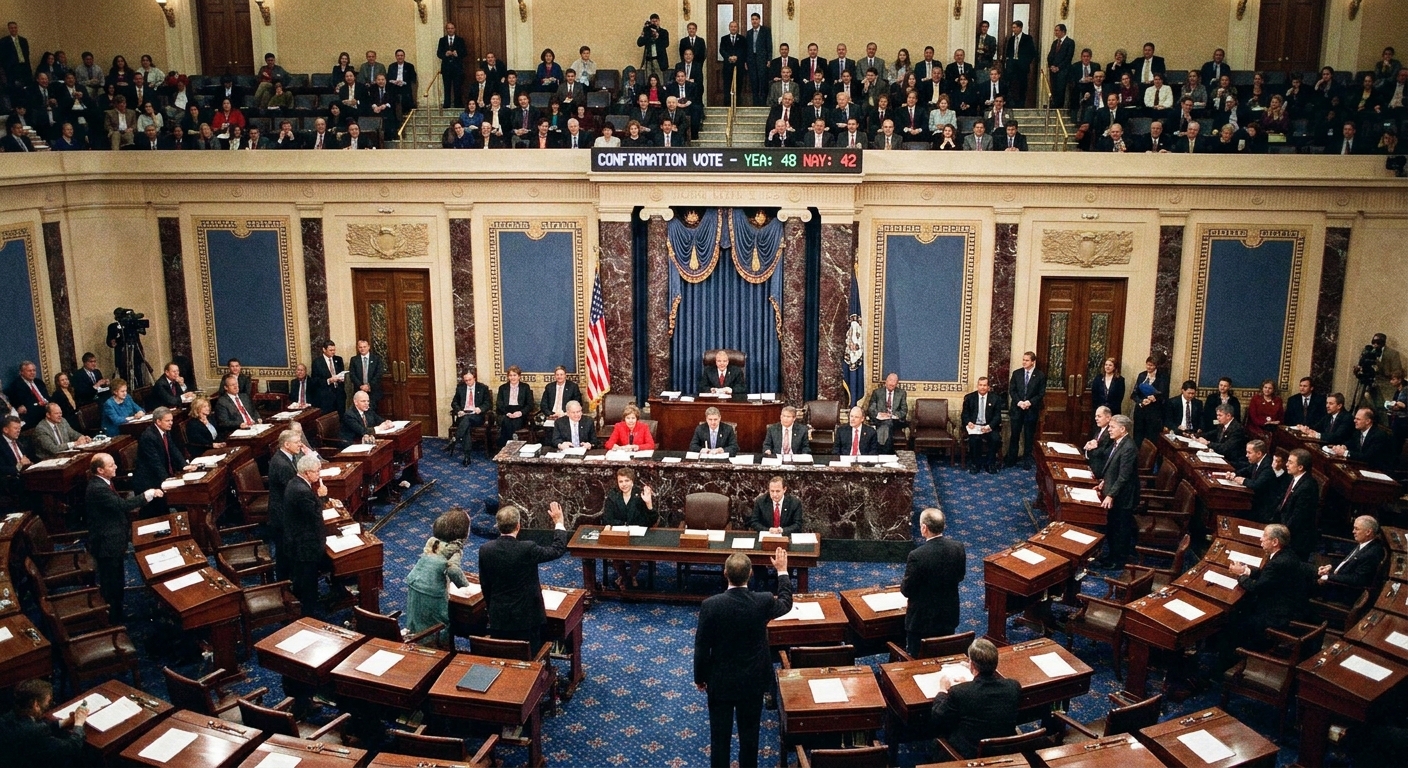
If you zoom out, the FVRA is Congress writing rules for a problem the Constitution creates but does not fully detail: how do you keep the executive branch functioning when the Appointments Clause demands Senate confirmation for principal officers?
The Appointments Clause
Article II requires that principal officers be appointed by the President with the advice and consent of the Senate, while allowing Congress to permit different appointment methods for inferior officers.
Why acting roles exist
The Constitution does not ban temporary acting service. It also does not provide a full vacancy framework. Historically, Congress has filled that gap with statutes, and courts have generally treated properly limited acting service as compatible with the Appointments Clause.
Where the tension lives
The Senate confirmation process is supposed to be a real constraint. Acting service, if stretched, can become a way to exercise the powers of an office without ever confronting the Senate. That is not just a personnel dispute. It is a structural question about whether the executive can effectively bypass advice and consent through serial “temporary” leadership.
Time limits
The FVRA is built around time. It does not merely authorize an acting official. It authorizes acting service for a limited period, measured in days from the vacancy. The key time rules live in 5 U.S.C. § 3346.
The baseline clock
As a baseline, acting service is permitted for 210 days beginning when the vacancy occurs. The statute contains special rules and extensions, but 210 days is the number that anchors most real-world timelines.
What nominations do to the clock
A nomination can extend acting service. Once the President submits a nomination to the Senate, acting service is generally permitted while the nomination is pending. If the nomination is rejected, withdrawn, or returned, the FVRA provides an additional limited period of acting service, and those extra days depend on the sequence of events.
One simplified way to read the incentives is: nomination keeps the government running while the Senate decides, but repeated failed nominations do not give the executive unlimited acting time.
The transition rule
The FVRA includes a special rule tied to a presidential transition that effectively allows a longer initial acting period early in a new administration (often described as a 300-day starting window, reflecting the baseline period plus the transition-related extension in the statute). This is one reason acting leadership tends to surge at the start of a presidency.
A quick example
Suppose a Senate-confirmed administrator resigns on Day 0. An eligible acting official can generally serve for up to 210 days. If the President submits a nominee on Day 120, the acting official can generally continue serving while the nomination is pending. If that nomination is later returned, the FVRA provides a new, limited post-return period for acting service. The details are technical, but the takeaway is simple: the calendar is the battleground.
Reporting and transparency
The FVRA is not only about who and how long. It is also about public accountability.
When an acting official begins serving under the FVRA, agencies must report key facts, including the vacancy and the acting official’s service. The Government Accountability Office (GAO) tracks vacancies and issues legal opinions when questions arise about whether acting service complies with the statute. Those GAO opinions are influential but generally nonbinding.
These reporting duties matter because vacancy controversies often turn on dates, titles, and whether the person in charge is really the “first assistant” or really meets the experience threshold. Without a paper trail, the statute is much harder to enforce through oversight, litigation, and internal controls.

Common controversies
Most FVRA disputes are not about whether the government needs continuity. Everyone agrees it does. They are about whether the continuity is being used as a substitute for confirmation.
Title engineering
One recurring fight is whether an administration can name or rename a “first assistant” in a way that effectively chooses the acting official without Senate involvement. If the first assistant role is created, filled, or modified right around the vacancy, critics argue the administration is manufacturing eligibility. Supporters argue the statute allows agencies to structure their leadership and that first assistants have always been part of executive branch management.
Delegation and the definition of duties
The FVRA’s strongest remedy focuses on “functions and duties” as defined by the statute. If an agency rewrites rules so fewer responsibilities are exclusive to the vacant office, more work becomes delegable, and the practical difference between a lawful acting official and an unlawful one can shrink. That is why FVRA disputes often sound technical while feeling political. They are both. A small regulatory tweak can decide whether a major policy action is valid.
Acting leadership as strategy
Acting officials can be easier to remove, easier to direct, and less likely to generate Senate backlash during confirmation. That can make acting leadership attractive for fast-moving administrations. It can also create instability inside agencies and weaken long-term accountability, because acting officials may be perceived as temporary messengers rather than confirmed leaders with independent statutory responsibilities.
If the FVRA is violated
The FVRA’s teeth are not primarily criminal or personal. They are institutional.
Invalid actions
If a person serves in violation of the FVRA, actions taken in the performance of the office’s nondelegable “functions and duties” as defined by the statute generally have no force or effect under 5 U.S.C. § 3348(d). In other words, for that category of work, the signature can be treated as legally meaningless.
Ratification and cleanup
Administrations often try to cure problems by having a properly authorized official later ratify actions taken during a questionable acting period. Courts sometimes accept ratification for delegable actions when the authorized official genuinely reconsiders the decision and adopts it as their own.
But the FVRA draws a hard line for the most sensitive category: the statute expressly bars ratification of actions that fall within the office’s covered nondelegable “functions and duties” performed by an unauthorized acting official. That is the point of 5 U.S.C. § 3348(d): for those defined duties, “cleanup” is not supposed to be a magic eraser.
Litigation and standing
Even when an FVRA problem exists, not every dispute becomes a court case. Plaintiffs need standing and a cause of action. That means many FVRA controversies play out through congressional oversight, inspector general reviews, and GAO opinions rather than final court judgments.
How to read acting headlines
When you see news about an acting secretary, acting administrator, or acting director, these are the questions that separate ordinary churn from a genuine Appointments Clause confrontation:
- Is the position a PAS office? If not, the FVRA may not be the controlling rule.
- Which legal authority is being used? FVRA, an agency-specific succession statute, or another office-specific provision.
- Which FVRA path is claimed? First assistant, already confirmed officer, or senior employee.
- Is the acting also the nominee? If so, check the nominee limits in 5 U.S.C. § 3345(b)(1).
- When did the vacancy begin? The clock is everything.
- Is there a nomination pending? Nominations can extend acting service, and their failure can trigger additional but limited windows.
- Are key duties legally exclusive? The FVRA’s strongest remedy focuses on defined nondelegable “functions and duties.”
- Is the government using “temporary” as a bridge, or as a substitute? That is where the constitutional stakes live.
Why the FVRA matters
The Appointments Clause is supposed to force a conversation between branches. The President chooses. The Senate consents or refuses. The public can see the terms of the bargain.
The FVRA is what prevents that conversation from being skipped during the most convenient moment to skip it: a vacancy. When it works, it is boring continuity. When it is stretched, it becomes a quiet but consequential transfer of power away from the Senate and toward unilateral executive control.
And because acting officials can shape policy, enforcement priorities, and internal agency culture, the FVRA is not simply a staffing statute. It is one of the places where the Constitution’s design either holds, or gets negotiated into something softer.