
Voters sometimes assume that if two candidates share a name, one of them must be barred from the ballot. In practice, election law often takes the opposite approach. Many states try to reduce confusion through ballot formatting and disclosure, not by limiting who may run.
This matters in Alaska because, under current law, many state and federal offices are elected through a nonpartisan top-four primary followed by a general election decided by ranked choice voting. This system was adopted by Ballot Measure 2 (2020) and is codified in Alaska election statutes. For most voters, the key takeaway is scope: it applies to state executive offices (such as governor and lieutenant governor), the Alaska Legislature, and Alaska’s U.S. Senate and U.S. House seats. It does not apply to presidential elections, which follow a different process. Many municipal and other local elections are governed by separate local rules and may not use the same primary and general election structure.
Candidates of all affiliations appear on the same primary ballot. So the legal question is usually not whether a party can “protect” a primary from a confusing name. It is whether state election officials, under state law, may change how a name appears on the ballot or exclude a candidate entirely based on the risk of voter confusion.
Join the Discussion
How Alaska elections work
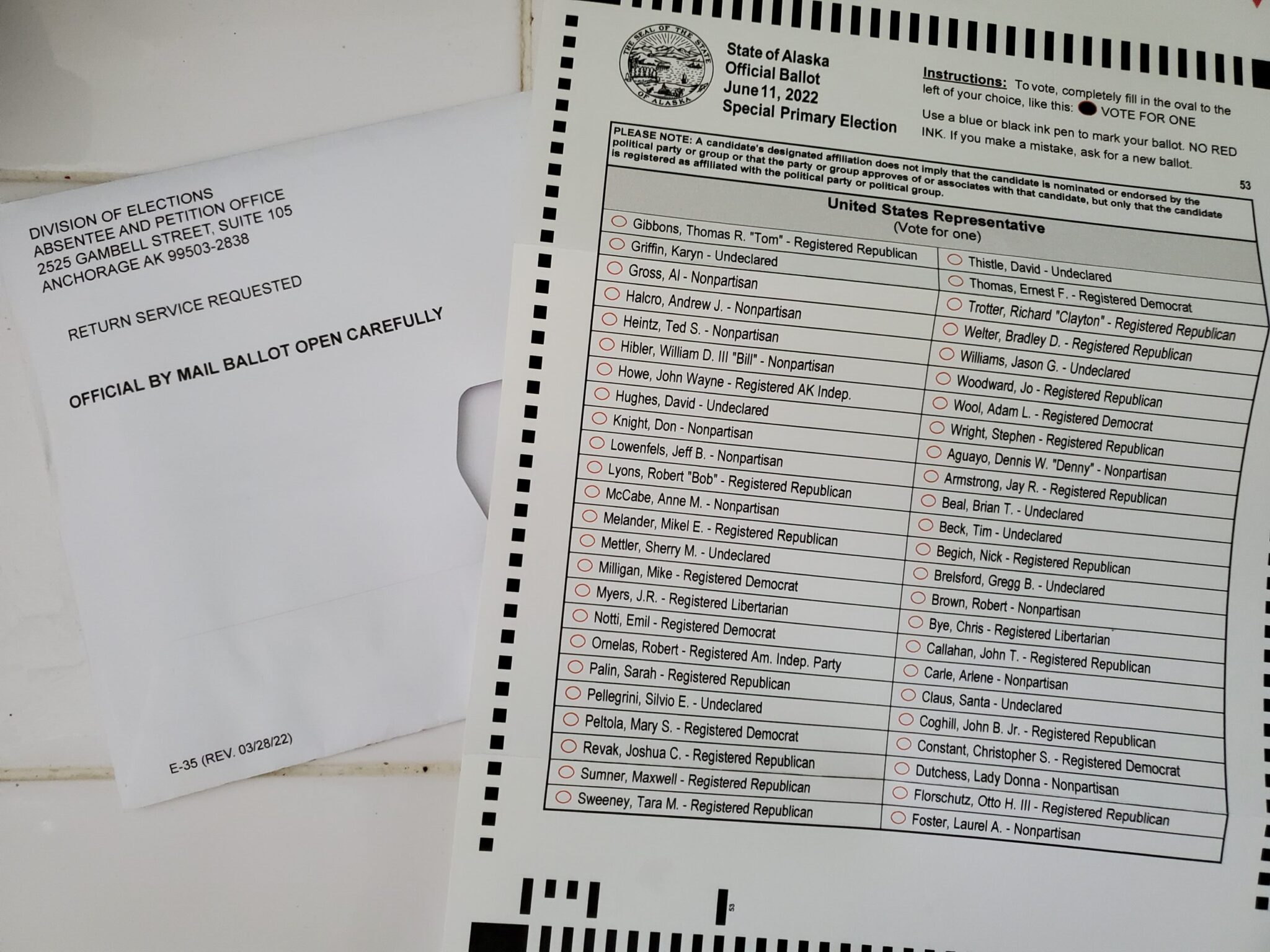
Alaska uses a single nonpartisan primary format that lists all candidates together (rather than separate party primary ballots) for covered state and federal offices. All candidates run together, and the top four vote-getters advance to the general election. The general election uses ranked choice voting, meaning voters can rank candidates in order of preference.
That structure can change practical incentives, but it does not eliminate the risk of voter confusion. Name confusion can still affect first-choice rankings, and in a close race that can matter even if voters can rank backups.
Even with that structure, Alaska still has to administer the basics: filing deadlines, eligibility checks, and how candidate names are printed. Those rules come from statute and regulation, are enforced by election administrators, and can be reviewed by courts when challenged.
What Alaska law says
In Alaska, the ballot-name question is not mostly an open-ended, case-by-case judgment call. The core instruction is statutory. Under AS 15.15.030, the director prepares the ballot and prints the candidate’s name as it is shown on the candidate’s declaration of candidacy, subject to limits in the statute on what a candidate may include as a ballot name. Those limits include restrictions on titles and similar status markers. In practical terms, Alaska does not want the ballot to become a place for unverified credentials. Candidates generally cannot use honorifics or status titles like “Dr.” “Judge” or “Rev.” as part of the ballot name.
Because this statute is the anchor, it also helps explain what election officials usually do when names collide. If two candidates file declarations that lawfully present the same name, the default approach is to print the names as filed, while removing what the statute does not allow. That is a standardized “print what was filed, minus what is prohibited” rule, not a free-form power to redesignate candidates.
What about middle initials or nicknames? Alaska’s controlling question is not what feels clarifying, but what the statute and implementing rules allow a candidate to put on the declaration in the first place. If a candidate’s filing lawfully includes a middle initial or a nickname (and it complies with statutory limits), that can sometimes create a natural distinction. If it does not, officials are generally constrained from inventing a new identifier just to solve a same-name problem.
Alaska regulations in 6 AAC (Elections) add procedures and administrative detail, including how the Division applies election-law requirements on a fixed calendar. They can matter in edge cases, but the headline rule for what appears as the candidate’s name remains the statutory instruction in AS 15.15.030.
Same-name candidates happen
Same-name scenarios happen for ordinary reasons. Names repeat, families share surnames, and common first names produce predictable collisions. As a general rule, similarity alone is not treated as misconduct, absent evidence of deception or a specific statutory bar. The typical remedy is to give voters clearer information, not to narrow the field.
But there is a difference between coincidence and deception. A dispute gets more serious when a challenger can point to evidence of misrepresentation, such as a candidate adopting a name or identifier meant to imply endorsement, incumbency, or a relationship to another candidate when that implication is false.
When courts look for proof in these disputes, they are often looking for concrete indicators like sworn statements about why the name was adopted, a history of using a different name in official records, campaign materials that trade on the other candidate’s identity, or other facts showing an intent to mislead rather than an ordinary name overlap.
Alaska in practice
When two candidates’ names collide, a state still has to answer a practical question: how will voters tell them apart? Some states solve this directly on the ballot by adding neutral identifiers (like residence or occupation) when names are too similar. Alaska’s statutes emphasize printing the name as filed and removing disallowed additions, so distinctions often show up more clearly in official election materials than through ad hoc changes to ballot names.
A simple example shows the limit. If two candidates both lawfully file as “John Smith,” and Alaska law does not authorize the Division to add an extra identifier to the ballot line, both can still appear as “John Smith” on the ballot. In that scenario, the most reliable clarifiers start with official sources, such as the Division’s candidate listings and voter pamphlet materials. Campaign materials can also help, but voters should treat unofficial sources with ordinary caution since anyone can publish a website or social post that looks official.
One concrete example is the Division of Elections’ Official Election Pamphlet, which is published for statewide elections and made available to voters. When voters are trying to confirm which “John Smith” is which, materials like the official pamphlet, the Division’s candidate lists, and other standardized election pages can provide clarifying information that the ballot itself may not.
What voters can look for
If you see the same name twice, practical checks can help:
- Official Election Pamphlet entries, especially the candidate statement and any listed community or background
- Division of Elections candidate lists and any posted sample ballots or ballot proofs
- Middle initials or differences in how the name was filed, if the filings differ and the format complies with Alaska’s rules
- Campaign contact information, including mailing address, website, and phone number (use this as a supplement, not a substitute, for official sources)
- Your specific jurisdiction’s ballot format rules, because some local elections can differ from statewide contests
A statutory example
Some states address identical-name collisions with explicit ballot-printing rules that add neutral identifiers. Michigan is often cited for having statutory mechanisms that can require distinguishing information in certain same-name situations. Under MCL 168.696, when candidates’ names are the same (or sufficiently similar under the statute) and the conditions for the rule are met, election officials may be required to print a qualifying identifier so voters can tell them apart, such as the candidate’s residence or occupation, as the statute provides.
The broader lesson still holds: when the problem is “two eligible candidates share a name,” states are usually on stronger legal footing when they use objective, prewritten rules that add clarity, rather than trying to predict confusion and keep a candidate off the ballot.
What the law allows
The public-facing principle is straightforward: ballots should be clear, but access to the ballot is protected. States have legitimate interests in orderly elections, including preventing deception, ensuring readable ballots, and applying consistent administrative standards.
Where disputes arise is the remedy. As a general matter, election officials are on firmer legal ground when they rely on neutral formatting rules than when they attempt to exclude a candidate based on predicted confusion. Some states do have specific deceptive-candidacy or misleading-filing provisions, but courts often ask whether the government used an evenhanded, less restrictive tool available before resorting to exclusion.
When courts get involved
If an election office rejects a filing or alters a ballot name and a candidate challenges it, courts typically start with practical questions before reaching broader constitutional doctrine:
- Authority: What statute or regulation authorizes the action?
- Standards: Are the criteria clear and evenly applied, or discretionary and ad hoc?
- Process: Was there notice and a meaningful chance to respond, given election timelines?
- Evidence: Is there proof of deception or misrepresentation, not just similarity?
These disputes move fast because ballots have to be finalized. Most cases begin the same way: the Division of Elections makes an initial determination under the statutes and regulations it administers, and then a candidate, voter, or campaign seeks expedited court relief , often in the form of an injunction or a mandamus-style order requiring officials to follow the governing law on a tight timeline.
Timing also matters on the front end. If a candidate can lawfully amend a filing or correct an error, that usually must happen early enough to fit the state’s ballot-printing calendar. Once ballots are in production or mailed, courts and administrators have fewer realistic options, which is one reason election litigation is often accelerated and tightly focused on what the written rules actually authorize.
When constitutional review is needed, courts often use the ballot-access balancing framework associated with Anderson v. Celebrezze (1983) and Burdick v. Takushi (1992). In simple terms, the severity of the burden and the state’s asserted interests drive the analysis. The more a rule burdens candidacy and voter choice, the stronger and more narrowly tailored the state’s justification must be.
Names and labels
Readers sometimes conflate a candidate’s ballot name with any label that might appear alongside it. Some states allow short descriptive “designations” (often occupation-style labels) next to the name, and then regulate those designations to reduce misleading descriptions. In Rubin v. City of Santa Monica (California Court of Appeal, 1985), the court upheld statutory limits on ballot designations, emphasizing the government’s interest in preventing misleading or promotional labels and supporting an informed electorate.
That lesson travels even where the rules differ: if a state can reduce confusion by standardizing labels and formatting through written criteria, courts are generally more likely to uphold that approach than a broader, discretionary effort to keep a candidate off the ballot.
Quick answers
Can two candidates with the same name be on the ballot?
Often, yes. Many states allow it and reduce confusion through formatting rules and official voter information tools.
Can Alaska officials change a candidate’s name to reduce confusion?
Alaska’s starting point is statutory: under AS 15.15.030, the ballot prints names as they appear on the candidate’s filing, while omitting disallowed titles and similar additions. Broader changes or exclusions generally require a clear legal basis and consistent standards.
Does Alaska’s ranked choice system eliminate name confusion?
No. Ranked choice voting can reduce some strategic pressures, but a confusing name can still affect how voters rank candidates, especially their first choice.
Who decides disputes?
Election officials make initial decisions under state law, and courts can overturn actions that exceed statutory authority or impose unlawful burdens on candidates and voters, often on an expedited timeline when ballots are being finalized.