
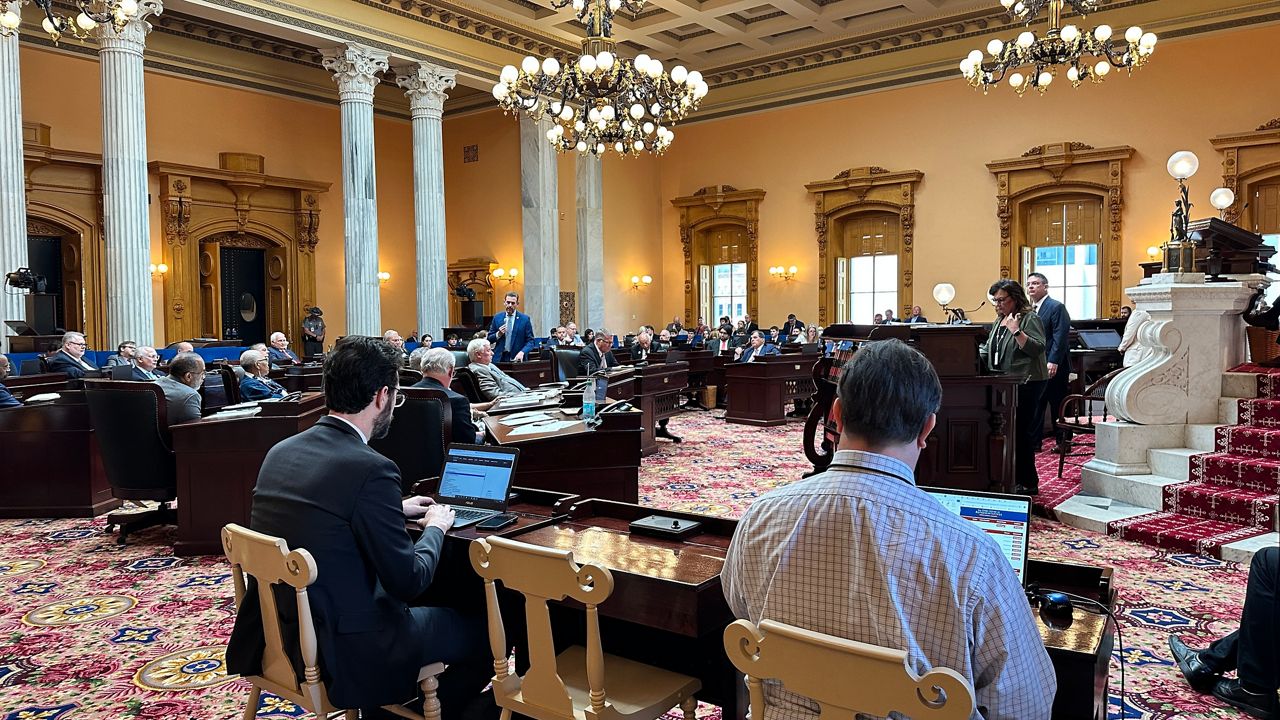
In Ohio, arguments over gun policy often drift toward a familiar dividing line: whether cities should be able to write their own firearm rules, or whether the state should insist on one uniform standard everywhere.
That can sound like a technical turf fight between the statehouse and city halls. It is also a civics question about who gets to define the practical boundaries of an individual right, and how much local democracy can shape rules that are treated as statewide guarantees.
One reason this debate matters beyond theory is that Ohio is home to a program that trains teachers to carry guns, and it now operates in 12 states. Whether you support that approach or oppose it, it is a reminder that legal rules are not abstractions. They are instructions people must follow in specific places, often under pressure.
Join the Discussion
What this covers
This is a general overview of the state versus municipal authority question in firearms regulation, often discussed under the umbrella of firearm preemption. The teacher training program is included as an example of how policy choices can ripple beyond a single community, not as a claim about any particular bill’s status, timing, or outcome.
What preemption means
When state lawmakers and municipal leaders clash over guns, the dispute often centers on firearm preemption. Preemption is the state’s way of saying that certain subjects are reserved to state law, even if a city council believes local conditions call for something different.
Supporters of statewide uniformity typically describe this approach as a way to prevent a patchwork of municipal restrictions that change from one city limit sign to the next. Under that view, if lawful conduct in one jurisdiction becomes legally risky in the next, the right starts to look less like a right and more like a permission slip that must be constantly re-checked.
Local leaders often see the same issue differently. They argue that dense cities can face different crime patterns and different policing realities, and should have room to tailor policies accordingly.
Why schools come up

Firearms policy rarely stays inside neat boundaries. People commute. Families move. Schools hire staff from multiple jurisdictions. Training programs draw participants from different communities, and a practical question follows: what rules apply when someone crosses a municipal line for work, training, or a school event?
That is where the teacher training program is relevant as more than a headline. Training to carry is not just a political concept. It is an operational reality for school staff and districts that choose to pursue armed protection under whatever authorizations and policies apply in their setting.
More broadly, training programs like these often aim to cover fundamentals such as safety, judgment, and a legal overview. Even so, the on-the-ground permissions may still depend on the applicable authorities where someone works, and on how state law, district policy, and any other rules interact in that location.
The point is not that everyone should carry. The point is that the law should be legible before a crisis forces someone to discover the boundaries in the worst possible moment.
The core tension
America is not one simple pyramid of power. It is a layered system. Cities answer to states. States answer to the federal Constitution. And citizens live inside all of it at once.
So the question is not whether local officials care about safety. Many do. The question is whether a city can redefine the terms of gun possession and carry in ways that, in practice, narrow a right the state has chosen to protect broadly.
Preemption is often framed by statewide uniformity advocates as the state’s answer: no. If the state treats the right to keep and bear arms as something that should operate uniformly across Ohio, then local experiments can be experienced as exceptions that reshape the right depending on where a person happens to stand.
Where the Constitution fits
Second Amendment limits
The Second Amendment, as interpreted by modern Supreme Court decisions, is not a blank check for any policy anyone prefers. But it does impose meaningful limits on how far governments can go when regulating ordinary possession and public carry by ordinary citizens.
States still have room to regulate. In many recurring debates, the friction arises when a city tries to go further than the state, or when it tries to accomplish through local ordinances what it cannot do directly.
Home rule limits
Ohio’s Constitution grants municipalities authority over local self-government, but it also allows the state to enact general laws that apply statewide. Preemption battles live in that overlap. Cities argue they are protecting residents under local authority. The state argues that firearms policy is a matter of statewide concern requiring uniform rules.
However courts parse the lines in any given case, the political argument from statewide uniformity advocates is straightforward: they do not want gun rights to vary by zip code.
The patchwork concern
Self-defense is the lived reality behind much of the legal theory. People do not schedule violence. They respond to it. That is why consistency is often treated as especially important in this area of law.
When rules differ city by city, the burden of compliance can fall on the person most likely to be scrutinized after the fact: the citizen who used or displayed a firearm during a crisis. Depending on how an ordinance is written and enforced, a government may argue someone violated a local rule, creating legal exposure even when the person believes they acted responsibly.
From a rights perspective, that is the preemption argument at its strongest: a right that depends on a traveler’s knowledge of dozens of local codes is a right that is easier to lose by accident.
In a school context, the cost of confusion can also be high. If staff are trained and authorized under one set of rules, but additional restrictions or overlapping policies add new conditions in particular places, it can create uncertainty about what is permitted. That uncertainty may matter most when seconds matter and clarity matters.
The local control case

Critics of strict statewide preemption often respond with a blunt claim: state lawmakers are forcing one-size-fits-all standards onto places with different risks and different realities.
Supporters of uniform rules counter that, even if the concern is serious, it leaves a separate tradeoff on the table. If a city can restrict carry, possession, transport, or storage beyond state law, the city is not merely tailoring policy. It is setting the practical scope of a constitutional right for everyone inside its boundaries, including people passing through for work, family, worship, or school activities.
The hard question is this: when the thing being regulated is an enumerated right, how much local tailoring is compatible with equal citizenship across the state?
What to watch
In many states, this debate is not just about policy preferences. It is about authority. In debates like these, when proposals to strengthen preemption appear, supporters often argue it protects uniform rights. Opponents often argue it limits local safety strategies.
If a policy cycle in a given state results in tighter statewide limits on local ordinances, the next phase can shift to disputes over enforcement, definitions, and remedies. Not because litigation is guaranteed, but because preemption fights frequently turn on how boundaries are policed in practice.
Three common pressure points include:
- Enforcement: Whether the state includes practical ways to deter cities from testing the limits.
- Definitions: How broadly firearm regulation is defined, and whether cities try to re-label restrictions as zoning, nuisance, or administrative rules.
- Remedies: Whether individuals or state officials can challenge local ordinances quickly, before someone becomes the test case.
Schools and local governments can run into versions of the same question. When the state sets a rule meant to be uniform, can another layer of government effectively narrow it through adjacent regulations or policies? The answer can vary depending on the specific authority at issue, but the operational challenge is consistent: people want to know what the rules mean where they are standing.
It is also why a program that operates across state lines can sharpen the practical stakes. Even with the same training model, participants can return to different legal environments, and districts can face different layers of policy. The baseline lesson is simple: portability of instruction does not always mean uniformity of rules.
The civics takeaway
We like to talk about government closest to the people. But we also like to talk about rights that do not depend on who happens to control city hall.
In Ohio and elsewhere, the preemption argument is often framed as a statewide answer to a statewide question: can a fundamental right be treated as negotiable at the municipal level?
If your instinct is yes, you are prioritizing local control even when it can narrow liberty. If your instinct is no, you are prioritizing uniform rights even when local leaders argue they need flexibility to respond to local conditions.
That tradeoff is why the state versus city question tends to resurface in recurring gun-policy debates.