
When Americans say they have “lost trust” in the Supreme Court, they rarely mean they no longer trust the Court to decide. Of course it decides. Nine justices vote, opinions get published, and the country moves on, sometimes grudgingly.
What people mean is something more constitutional and more fragile: they no longer trust the Court to be worthy of its role.
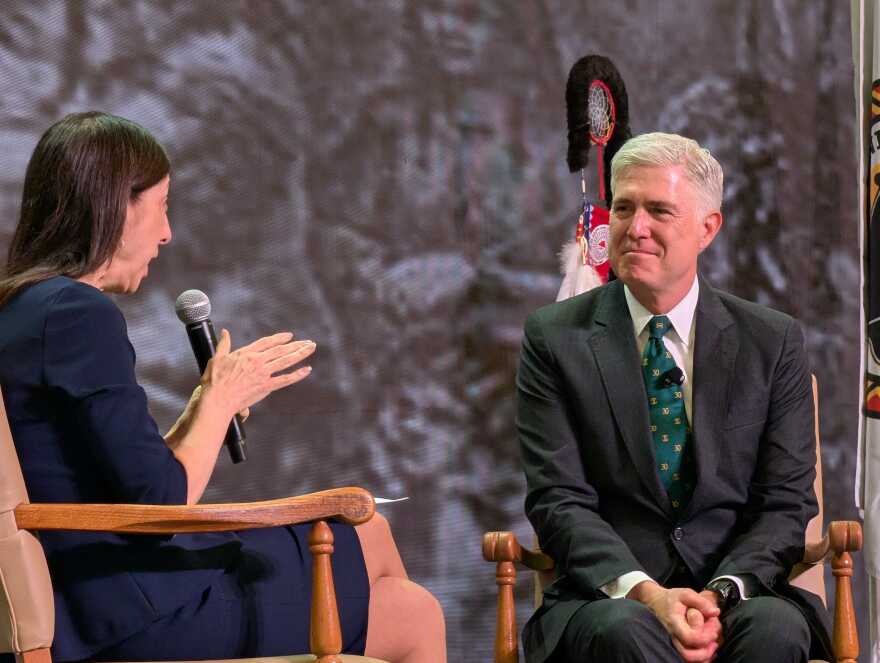
Justice Neil Gorsuch recently offered a compact defense of the institution on exactly that point. The Court, he argued, is doing what it is supposed to do, even in an era when public approval has sagged. He framed the Court as a place where disagreement is real but not reducible to political teams.
Join the Discussion
What he means by hard cases
Start with his core claim: the Supreme Court is not a general error-correcting court. It is, by design, a court of selection. The justices pick a tiny number of disputes out of a vast legal universe, and those disputes are usually the ones where lower courts disagree, constitutional principles collide, or statutes produce real-world chaos.
Gorsuch put a number on that job. The Court takes on “the 70 hardest cases in the country,” he said, and in that set, “we’re unanimous, the nine of us, about 40 percent of the time.”
Those figures matter because they challenge a common public impression: that the Court is basically a permanent 5 to 4 machine where predictable blocs issue predictable results. In Gorsuch’s account, unanimity is not an exception. It is a recurring feature of the docket.
Unanimity vs legitimacy
It is tempting to hear “40 percent unanimous” and conclude: see, the Court is fine.
But constitutional trust does not work like a batting average.
Here is my read of the gap: the cases that shape the Court’s public reputation are not the unanimous ones, even if they are numerous. They are the small cluster of disputes that collide with politics, identity, and the basic terms of civic life. Those are the decisions that reset the daily relationship between citizen and state, and they are also the ones most likely to split the Court.
That is why Gorsuch added an important qualifier. Of the divided decisions, he said only about half are the clean “five-fours or six-threes you’re thinking about.” The rest, in his words, are “scrambled every which way.”
What scrambled shows
Here is the constitutional point hidden inside that phrase: not every disagreement is ideological, and not every alliance is permanent.
In some categories, the familiar left-right map does a decent job predicting outcomes. In others, it fails. Criminal procedure is a good example of the failure. Textual commitments to jury trial, confrontation, due process, and protection from unreasonable searches can produce surprising coalitions, because a justice’s interpretive method can matter more than the justice’s perceived politics.
Gorsuch himself is often an illustration. On criminal justice matters, he is often “scrambled” in alliance with Justice Sonia Sotomayor while he regularly butts heads with Justice Samuel Alito. That kind of cross-cutting pattern is what he is pointing to when he says the Court is “scrambled.”
For public trust, that matters because legitimacy depends on the sense that law is doing real work. If citizens believe results are simply preassigned by partisan identity, the Court looks less like a court and more like a super-legislature with life tenure.
Civility is not enough
Gorsuch also defended the Court as a model of respectful and principled adjudication. Tone matters. A judiciary that treats litigants, colleagues, and the public with visible seriousness can reinforce the idea that legal reasoning is more than a pretext.
But civility is not the same as legitimacy. A well-mannered institution can still be distrusted if the public believes it is inconsistent, unaccountable, or untethered from neutral principles.
Bill of Rights and what follows
In discussing rights, Gorsuch described the Bill of Rights as “your starting place” when asking what government cannot touch. “That’s absolutely your starting place,” he said, emphasizing how much the First Amendment and other provisions already cover.
That is true, and it is also incomplete in a way that exposes a central trust problem in modern constitutional law.
The Constitution contains an explicit warning against reading rights narrowly. The Ninth Amendment states that “the enumeration in the Constitution of certain rights shall not be construed to deny or disparage others retained by the people.” In other words, the text itself anticipates that some rights will exist beyond the list.
Yet the moment you admit that some rights are unenumerated, you run into a legitimacy dilemma. Who identifies those rights, and by what method?
Throughout its history, the Supreme Court has sometimes recognized and protected unwritten rights. For example, in Pierce v. Society of Sisters (1925), the Supreme Court struck down Oregon’s Compulsory Education Act, which outlawed private schools and forced all children to attend only public schools. The Court grounded its decision in an unenumerated liberty interest: the “liberty of parents and guardians to direct the upbringing and education of children under their control.”
Most Americans recognize that as a real freedom. But it is not written out in constitutional text the way speech or jury trial is. The Court had to reason its way there.
And this is where Gorsuch’s defense leaves a key question unresolved: his comments do not clarify how, in practice, he would factor unenumerated rights into the constitutional equation.

Why trust stays hard
Now connect the dots.
Gorsuch says the Court is doing well because it resolves the toughest disputes and often does so unanimously.
He says even when it divides, many splits are not simple ideological blocs.
He also points toward the Bill of Rights as the baseline for what government must respect.
All of that is a case for institutional seriousness. But the disputes that most inflame distrust are often the ones that live in the space between enumerated text and implied doctrine, or between old words and new realities.
Those are hard cases precisely because reasonable people disagree not only about the result, but about the method. Is the Court applying the Constitution’s original public meaning? Is it implementing precedent? Is it balancing interests? Is it protecting unenumerated liberties? Is it narrowing them? In each approach, “principled” means something different.
If Americans cannot agree on what counts as legitimate constitutional interpretation, no amount of unanimity statistics will settle the dispute. The conflict just moves one level up, from cases to the meaning of judging itself.
What healthier trust is
There is a version of “trust in the Court” that is unrealistic: trusting that the Court will usually reach your preferred outcomes.
But there is a version that is both possible and worth fighting for: trusting that the Court is applying a recognizable legal method, that it is willing to constrain government even when that constraint is unpopular, and that it treats both enumerated and unenumerated rights with intellectual honesty rather than convenience.
Gorsuch’s defense is, at bottom, an invitation to see the institution as more complex than cable-news caricatures. The Court is not always two teams in robes. Sometimes it is scrambled. Sometimes it is unanimous. Sometimes it surprises everyone.
The open question is whether that complexity will rebuild public confidence, or whether the country is now so polarized that even good-faith legal disagreement reads as bad faith.
The question to keep
The Constitution does not give the Supreme Court an approval rating to hit. It gives it a job: to say what the law is, to decide cases, and to do so in a way that sustains a system where losing today does not mean abandoning the system tomorrow.
So here is the question Gorsuch’s remarks raise, whether you agree with him or not:
If the Court really is handling “the 70 hardest cases in the country,” what would it take for Americans to accept that hard outcomes can be legitimate outcomes, even when they sting?