
Public schools often say they want “student voice,” but the promise gets complicated fast when a student picks a topic adults would rather avoid. That tension sits at the center of a dispute out of Jefferson County, Colorado, where a 13-year-old student at Drake Middle School says she was prevented from reading a pro-life slam poem for a class assignment because it was “too political.”
If you want the hard civics question, it is this: when a teacher invites students to speak about conflict in the world, who decides which conflicts are acceptable?
Join the Discussion
What the student says happened
The student says her teacher assigned a slam-poem project focused on “conflict in the world” that students felt passionate about. In a video shared online, she described her understanding of the assignment like this: “My teacher assigned an assignment in class to write a slam poem about conflict in the world that we are passionate about.” She then added, “I chose life.”
She says she gathered “reputable resources” and met the stated criteria, but when she asked to present the poem, she was told she could not because the topic was “too political.” Her mother, who appears alongside her in the video, says she contacted the teacher and was later told the poem included “offensive material” and would not be allowed.
The student also claims the teacher initially told her she would not be allowed to remain in the classroom during classmates’ presentations, but later allowed her to stay and listen.
What the poem says
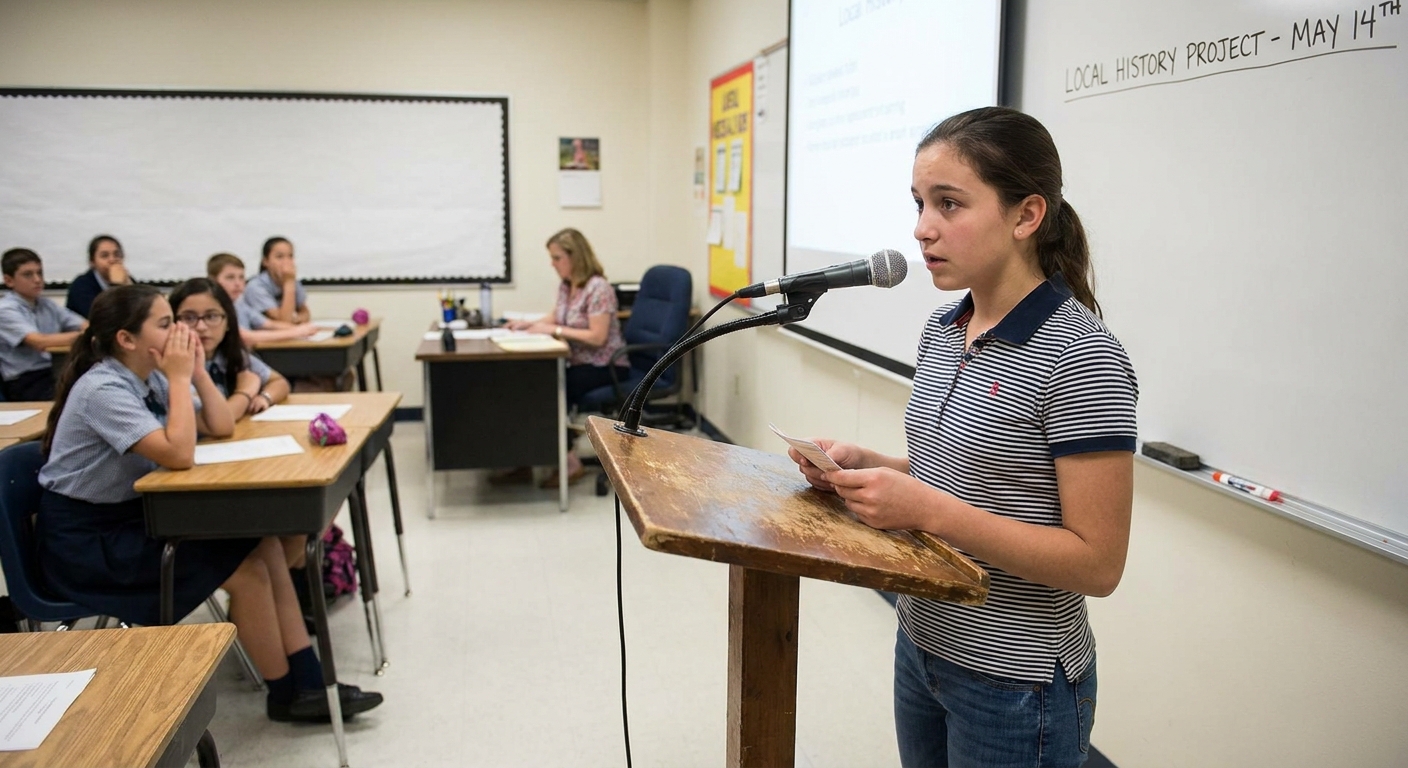
In another video, the student reads her poem aloud. One passage reads: “They never get to see the light of day before they are cast away. They did nothing wrong except exist and were dismissed. People say women need healthcare but never think how unfair — they kill babies for simply being there.”
The poem concludes: “A life is a life, no matter how small.”
Why it mattered to her family
The mother offered her own reason for taking the issue personally. In the video, she said her mother got pregnant with her at 14 and chose to keep her.
“I wouldn't be here today if she lived in the climate that we live in now, because mostly people would say that she should have aborted me,” she said. She added, “This shows why this topic is so very important to us,” saying, “there is hope in hard situations. There is purpose in pain. Good things come out of situations that seem bleak, and my family is proof of that.”
What this raises legally
You do not have to agree with the message to see the constitutional tension that can arise if a school blocks it for the wrong reason.
In plain English, the First Amendment question is not “Can schools avoid controversy?” Schools can and do. The question is whether the rules are being applied evenly, or whether one side of a contested moral debate is being singled out.
This is analysis, not a verdict. Student-speech disputes can turn on small details, and the public account here is still incomplete.
What schools can control
Let’s be honest about the playing field. A public-school classroom is not a public park. It is a structured environment where educators set learning goals, choose materials, enforce time limits, and maintain order. The Supreme Court has long recognized that schools can regulate speech in ways that would be unacceptable on a street corner.
That means a teacher can require a topic to fit an assignment, can enforce standards of civility, and can intervene if a presentation disrupts instruction. A school can also limit speech that crosses into harassment or targeted bullying, and it can impose reasonable boundaries on what is age-appropriate in a middle-school setting.
But the Constitution does not disappear when a student walks through the front doors.
The risk: viewpoint bias
Here is the constitutional tripwire: viewpoint discrimination. That is the legal term for a simple sin, letting one perspective speak while silencing the opposing perspective because of what it believes.
Based on the student and mother’s account, the teacher allegedly allowed other politically charged subjects to be presented in class. The mother said the class raised topics involving “racial issues,” “LGBTQ rights,” and “immigration,” and she objected because “they were presenting a lot of political material themselves” and presenting it “as truth,” while her daughter’s poem was labeled “too political.”
If that description is accurate, it raises the kind of question courts often ask in school-speech cases: was the restriction really about maintaining an educational environment, or was it about excluding a disfavored viewpoint?
A school can restrict an entire category of content if it does so neutrally and for legitimate educational reasons. What it cannot do, at least not easily, is invite student expression on contentious issues and then close the door when a student shows up with the “wrong” opinion.
The classroom dilemma
Every teacher knows the temptation. You want students engaged. You want them to write about what matters. You want energy and moral seriousness. But you also want to avoid the email avalanche from parents, the complaints to administrators, and the spiral into culture-war trench lines.
So the real question is not whether abortion is “political.” Of course it is. The real question is whether the assignment was designed to invite political and moral conflict, and if it was, whether the school can then declare a particular conflict off-limits because it makes adults uneasy.
When schools teach students that speech is welcomed only when it is fashionable, they are not teaching civic engagement. They are teaching self-censorship.
What we still do not know
At this stage, the public account is incomplete. We do not have the written assignment prompt, the grading rubric, any school policy cited to justify the restriction, or the school’s explanation in its own words. Details matter in student-speech disputes. A case can turn on whether the assignment was part of a graded curriculum exercise, whether the teacher had pre-announced constraints, and whether similar constraints were enforced consistently across the classroom.
One more fact matters too: the justification. “Too political” is not a legal standard. It is a label. And labels can become a shortcut when adults are trying to manage controversy.
Requests for comment were sent to Drake Middle School and Jeffco Public Schools, and no responses were immediately received.
What fair rules look like
If a school wants to avoid turning a slam-poem unit into a referendum on America, it can. But it has to do it clearly and evenly. A fair approach usually looks like one of these:
- Topic-neutral boundaries: define the scope in advance (for example, conflicts between nations, or conflicts in literature) and apply it to everyone.
- Process rules, not viewpoint rules: require sources, require respectful language, require a connection to learning standards.
- Consistent enforcement: if abortion is barred as a topic because it is “too political,” then other hot-button political subjects should be treated the same way.
In a constitutional democracy, consistency is not a minor virtue. It is the difference between rules and favoritism.
The lesson students take home
Middle school is where many Americans first learn the practical meaning of power: who gets to speak, who gets interrupted, whose discomfort counts, and whose does not.
If this student’s account is accurate, the lesson she absorbed was not about poetry. It was about permission. About how quickly “speak your truth” can become “not that truth.”
That is why these conflicts matter. Not because a single classroom presentation will change anyone’s mind about abortion, but because the habits of free speech are built in moments like this, when a student tests the boundary and the adults decide whether the boundary is principled or political.