
The phrase “invoke the 25th” has become modern political shorthand for a very old anxiety: what happens if the President cannot do the job, and nobody can agree on it?
That question flares up whenever a major public figure claims a President is cognitively unfit, medically impaired, or simply not in command of their own administration. Governors and commentators may demand action. Members of Congress may make speeches and statements. But the Constitution has a very specific mechanism for presidential disability, and the first move in that process is mostly controlled by the executive branch. Congress’s main upfront leverage is indirect: it can create the alternative “other body” mentioned in Section 4 by statute.
Join the Discussion
Why the 25th Amendment exists
Before 1967, the Constitution had a succession rule, but it had a disability problem.
The original text addressed inability in Article II, Section 1, Clause 6, but it did not clearly define what counts as “inability,” who decides, or how long it lasts. That ambiguity mattered in real life: presidents suffered strokes, underwent surgery, and experienced periods of incapacitation with no clean constitutional process to handle it.
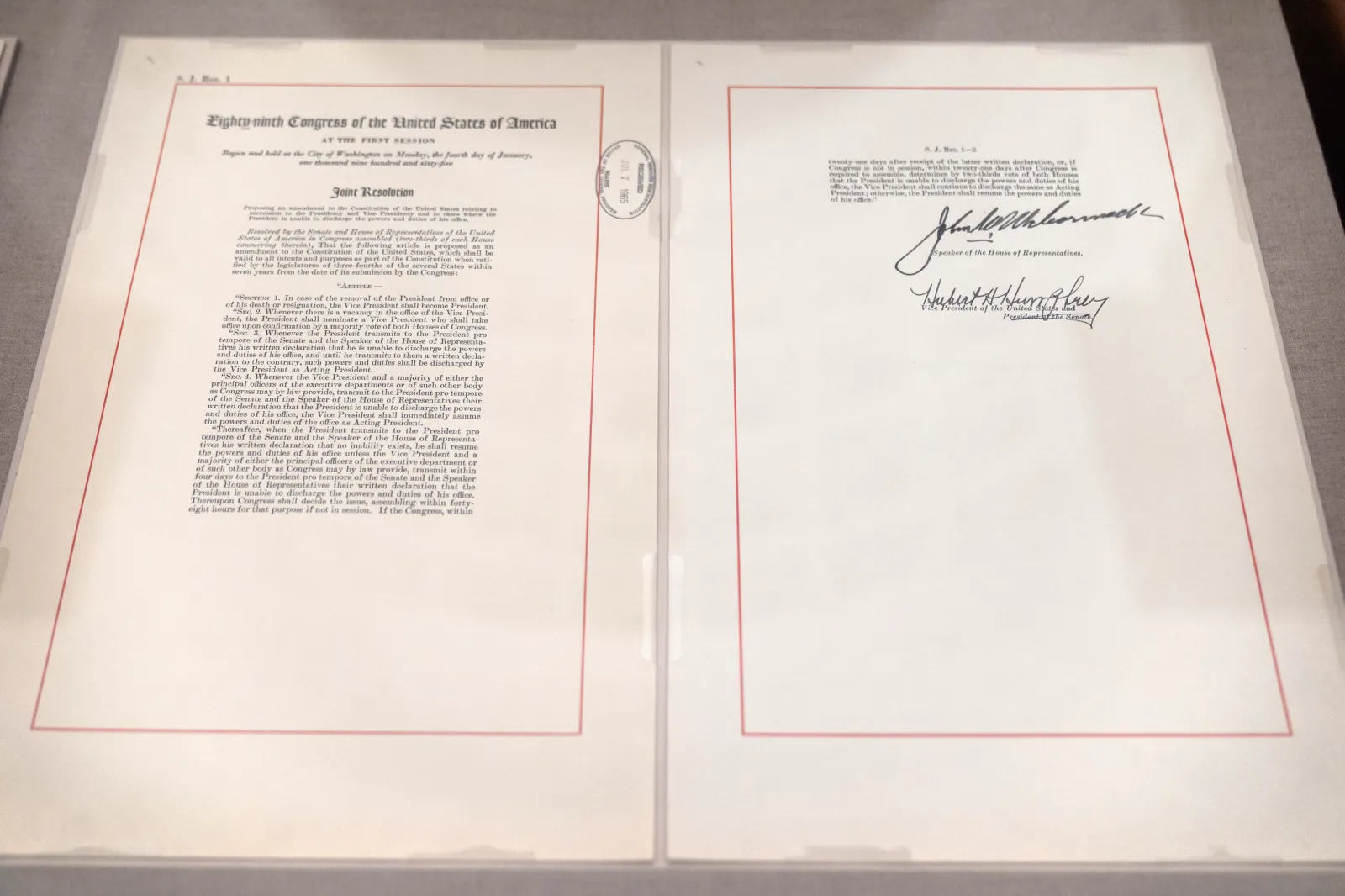
The Twenty-Fifth Amendment, ratified in 1967, was designed to answer four practical questions:
- What if a President dies or resigns?
- What if the Vice Presidency becomes vacant?
- What if a President is temporarily unable and admits it?
- What if a President is unable and does not admit it?
Quick map
Section 1 (succession)
If the President dies, resigns, or is removed, the Vice President becomes President. Section 1 also put John Tyler’s earlier succession precedent beyond doubt. (Tyler’s approach had been treated as controlling in practice long before 1967, but the amendment made it unmistakable.)
Section 2 (vacant Vice Presidency)
If the Vice Presidency becomes vacant, the President nominates a new Vice President, who takes office after confirmation by a majority vote of both the House and Senate.
Section 3 (voluntary temporary transfer)
The President can declare themselves unable, transferring power to the Vice President as Acting President until the President declares ability has returned.
Section 4 (involuntary contested transfer)
The Vice President and a majority of the “principal officers of the executive departments” can declare the President unable even if the President refuses. If the President contests it, Congress decides on a supermajority timetable.
Section 3 in practice
Section 3 is the cleanest version of the idea. It works like this:
- The President sends a written declaration to the President pro tempore of the Senate and the Speaker of the House stating that the President is unable to discharge the powers and duties of the office.
- The Vice President immediately becomes Acting President.
- When the President is ready, the President sends another written declaration stating that the inability has ended.
- The President then resumes the powers and duties of the office.
In practice, this is most associated with planned medical procedures. For example, President George W. Bush invoked Section 3 during colonoscopy procedures in 2002 and 2007. It is procedural by design: a temporary, consensual handoff, with a clear paper trail.
Two key points that get lost in the “25th” chatter:
- Section 3 is voluntary. Nobody can force a President to sign the letter.
- The Vice President becomes Acting President, not President. It is a temporary role unless something else happens (like resignation, death, or removal through impeachment).
Section 4 step by step
Section 4 is the dramatic one, and it is designed for the hardest scenario: a President who is unable but will not, or cannot, admit it. It has never been successfully invoked to keep a President displaced over that President’s objection, which is part of the point. The thresholds are intentionally steep.
Here is the constitutional sequence, step by step.
Step 1: Who starts it
The Vice President must act, and must be joined by either:
- a majority of the “principal officers of the executive departments” (generally understood as the Cabinet secretaries), or
- “such other body as Congress may by law provide.”
They send a written declaration to the Speaker of the House and the President pro tempore of the Senate stating that the President is unable to discharge the powers and duties of the office. At that moment, the Vice President becomes Acting President.

Step 2: The President can contest it
The President can respond with their own written declaration that no inability exists. At that point, the President retakes the powers and duties of the office unless Step 3 occurs within four days.
Step 3: The Vice President and Cabinet can renew the declaration
If the Vice President and the same majority send a second declaration within four days, the dispute becomes a congressional question.
Step 4: Congress decides, under a high threshold
Congress must assemble within 48 hours if not already in session, and then must decide the issue within 21 days.
To keep the Vice President as Acting President over the President’s objection, Congress must vote that the President is unable by a two-thirds vote in both the House and the Senate.
If Congress fails to reach that two-thirds threshold in either chamber, the President resumes the powers and duties of the office.
What counts as “unable”?
The Twenty-Fifth Amendment does not define “unable.” That was intentional. The drafters of the amendment were trying to cover a range of emergencies that do not fit neatly into a statute.
Still, that flexibility has a tradeoff: Section 4 is not a medical exam administered by neutral experts. It is a constitutional process run by political actors with careers, loyalties, and risks.
Most scholars agree “inability” was primarily aimed at serious physical or mental incapacity, not mere unpopularity or ordinary disagreement about judgment. But the text itself is broad, and it is enforced through the incentives of the Vice President, the Cabinet, and Congress.
A hard practical question
One unresolved issue that matters in a real crisis is who counts as the “principal officers of the executive departments.” Most commentary treats this as the Senate-confirmed Cabinet secretaries, but complications can arise when positions are vacant or being filled by acting officials. Those edge cases have not been fully tested under Section 4, which adds another layer of uncertainty to a process that is already difficult to run quickly.
Can a governor invoke it?
No. Governors have no formal role in invoking the Twenty-Fifth Amendment.
A governor can call for its use, urge federal officials to act, or attempt to shape public pressure. But Section 4 starts with the Vice President and the Cabinet (or another body Congress creates by law). Section 3 starts with the President alone.
This is one of the amendment’s clearest design choices: presidential disability is treated as a continuity-of-government problem inside the federal executive, not a state-driven process.
Is the 25th “removal”?
Not in the impeachment sense.
- Impeachment is about misconduct. The House impeaches by majority vote, the Senate convicts by two-thirds, and removal follows conviction.
- The Twenty-Fifth Amendment is about inability. It transfers power to an Acting President and can be temporary. It does not declare a President guilty of anything.
Section 4 can function like removal in practice if Congress sustains the declaration and the condition persists, but constitutionally it is framed as incapacity, not punishment.
Why Section 4 is so hard
Section 4 looks simple until you notice where the friction is built in.
- The Vice President is the gatekeeper. If the Vice President will not initiate, there is no Section 4 process to join.
- The Cabinet must risk their jobs. Most Cabinet secretaries serve at the President’s pleasure. Acting against the President can be career-ending unless the move succeeds.
- Congress must reach two-thirds in both chambers. That is an intentionally steep threshold.
- Time matters. The 4-day window, the 48-hour assembly rule, and the 21-day decision window all assume crisis conditions, not leisurely debate.
The result is that Section 4 is best understood as a constitutional emergency tool: available for genuine incapacity, but difficult to use for anything short of an obvious, urgent breakdown.
The Vice President’s role
When the Vice President becomes Acting President under Sections 3 or 4, they receive the executive power that matters most in the moment: command authority, executive branch control, and the ability to sign or veto legislation.
But “Acting President” is also a legally cautious title. It signals continuity while keeping the office of the Presidency intact unless Section 1 is triggered by death, resignation, or removal through impeachment.

Common misconceptions
- Myth: Congress can invoke the 25th on its own. Reality: Not under the text as written. Congress’s main role is deciding a contested Section 4 dispute after the Vice President and Cabinet act. Congress can also create the alternative “other body” mentioned in Section 4 by law, but it still would not replace the Vice President’s required role.
- Myth: A governor can start the process. Reality: No formal authority.
- Myth: The 25th is for “bad decisions.” Reality: It is framed around inability, not policy disagreement.
- Myth: Section 4 instantly removes the President permanently. Reality: It transfers power immediately, but permanence requires a sustained inability and a two-thirds vote in both chambers if the President contests.
What to watch for
When public officials cite the Twenty-Fifth Amendment during a fitness dispute, the most useful question is not whether the criticism is fair. It is whether the constitutional preconditions are even present.
- Is the Vice President indicating concern, or only outside figures?
- Are Cabinet-level officials publicly signaling willingness to act?
- Is there any suggestion of a written declaration to congressional leaders, which is required?
- If contested, is there any plausible path to two-thirds in both chambers?
Most of the time, “use the 25th” is political language wearing constitutional clothing. The actual amendment is narrower, more procedural, and more executive-branch-centered than the slogan suggests.
Bottom line
The Twenty-Fifth Amendment is not a substitute for elections, and it is not an all-purpose tool for ending a presidency people dislike.
It is a continuity mechanism. Section 3 is for temporary, admitted incapacity. Section 4 is for the rare case where incapacity is serious and disputed, and where the Vice President, the Cabinet, and then Congress are willing to take responsibility for a decision the Constitution intentionally makes difficult.
That difficulty is not a flaw. It is the point. A republic does not casually transfer executive power based on impressions. It requires signatures, majorities, and in the hardest cases, a supermajority that signals something close to national consensus.
Text: Twenty-Fifth Amendment
Section 3: “Whenever the President transmits to the President pro tempore of the Senate and the Speaker of the House of Representatives his written declaration that he is unable to discharge the powers and duties of his office, and until he transmits to them a written declaration to the contrary, such powers and duties shall be discharged by the Vice President as Acting President.”
Section 4 (excerpt): “Whenever the Vice President and a majority of either the principal officers of the executive departments or of such other body as Congress may by law provide, transmit to the President pro tempore of the Senate and the Speaker of the House of Representatives their written declaration that the President is unable to discharge the powers and duties of his office, the Vice President shall immediately assume the powers and duties of the office as Acting President…”