Congress has always had a strange superpower: it can write a law that moves public money, then live in the world that money reshapes.
That is not automatically corrupt. It is also not automatically clean.
When today’s headlines talk about a congressional “get rich” loophole, they are usually pointing at a familiar tension in American government: Article I gives Congress the power of the purse, but the Constitution mostly leaves Congress to police itself when that power creates personal conflicts.
Join the Discussion
The constitutional core: Congress controls spending
The Constitution makes Congress the nation’s spender on purpose. Article I, Section 8 includes the Taxing and Spending Clause, authorizing Congress to lay and collect taxes to “provide for the … general Welfare.” Article I, Section 9 adds the Appropriations Clause: “No Money shall be drawn from the Treasury, but in Consequence of Appropriations made by Law.”
That structure does two things at once.
It empowers Congress. As a rule, agencies cannot spend federal funds without statutory authority, and presidents cannot unilaterally open the Treasury.
It constrains everyone else. Because spending must be “by Law,” appropriations are supposed to be public, debatable, and accountable.
But the Constitution does not include a modern ethics code. It assumes elections, transparency, and internal congressional rules will deter self-dealing. Earmark controversies test that assumption.
What is an earmark, really?
An earmark is a provision in an appropriations bill (or related spending legislation) that directs funds to a specific project, recipient, or location. Think: money for a particular bridge, a specific research lab, a city water project, a university program, or a local transit upgrade.
Supporters argue earmarks are democratic: elected representatives, not distant agencies, decide where some discretionary funds go. Critics argue earmarks can become a back door for favoritism, pay-to-play politics, or private enrichment.
It also helps to distinguish earmarks from other common spending pipelines. Formula programs (and many entitlements) send money based on statutory criteria, not individual member requests. Competitive grants usually have agencies select winners through an application process. Earmarks are different because Congress names the destination in the legislation itself.
Legally speaking, an earmark is not magic money. It is Congress doing what the Constitution explicitly authorizes: appropriating federal funds.
Where the “get rich” worry comes from
Earmarks are not the same as a member of Congress taking a bag of cash. The more common fear is indirect benefit: a lawmaker steers federal dollars to a project that increases the value of a business the lawmaker owns, or benefits a spouse, child, parent, close business partner, or a nonprofit where the family sits on the board.
This is the ethical gray zone people mean when they say “loophole.” It is not always illegal bribery. It can be legal influence plus private advantage, especially when the benefit is filtered through contracts, grants, land values, or institutional prestige.
Three patterns show up again and again:
Family-adjacent recipients. A grant goes to an organization tied to a member’s family or a family-run firm is positioned to win downstream contracts.
Asset value boosts. A transportation or development project increases nearby property values, including property a lawmaker or close relative owns.
Career and network building. Funding flows to institutions that later employ the member, the member’s staff, or close associates, blurring into the revolving door problem.
Are earmarks constitutional?
The Constitution does not prohibit earmarks. In fact, earmarks are a straightforward expression of Congress’s spending authority. The constitutional question is not “Can Congress do this?” The question is “Can Congress do this without turning public money into private leverage?”
That question lives in the space between structure and enforcement:
Structure: Congress writes appropriations.
Reality: Members have personal, financial, and political incentives.
Guardrails: Disclosure rules, conflict-of-interest rules, criminal laws against bribery, and internal discipline.
If you are looking for a single constitutional clause that says “members of Congress may not enrich themselves,” you will not find one. The system relies heavily on rules, norms, and the willingness of Congress to bind itself.
So what rules apply?
There are three main buckets of constraints: internal ethics rules, financial disclosure, and criminal law. Each catches different behavior, and each has gaps.
1) House and Senate ethics rules
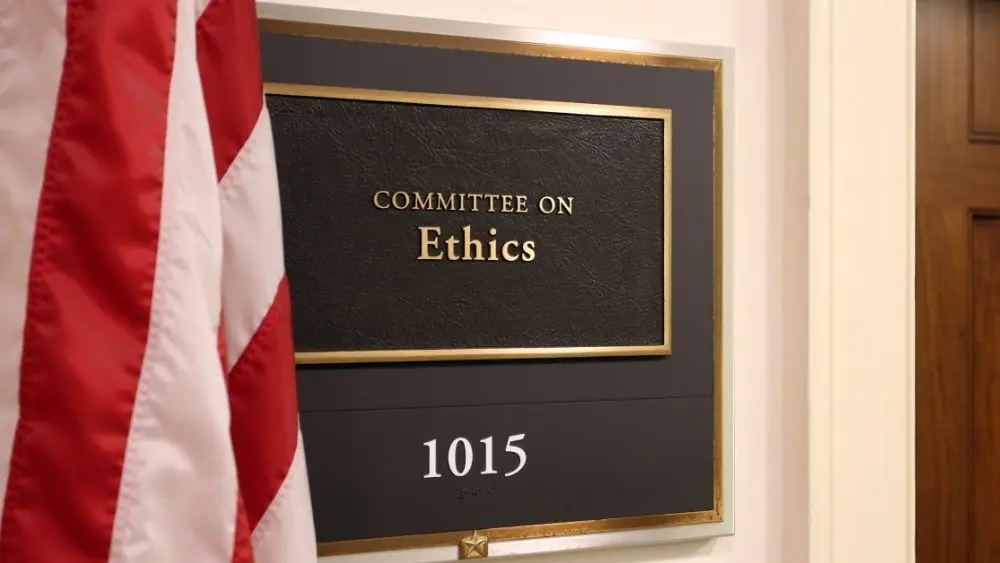
The House and Senate each have ethics committees and their own codes of conduct. They can investigate, reprimand, censure, fine, strip seniority, or recommend expulsion.
But Congress is not like an executive agency. Ethics enforcement is inherently political because members are judging members. That does not mean it never works. It means incentives are different from an outside prosecutor.
2) Financial disclosures
Members must file periodic financial disclosures. The basic idea is sunlight: voters, journalists, watchdog groups, and opposing candidates can see potential conflicts and call them out.
Disclosure is powerful, but it is not the same as prohibition. A system can be transparent and still permit conflicts.
3) Criminal anti-corruption law
When a public official takes something of value in exchange for an “official act,” you enter the territory of federal bribery and honest-services fraud. Those are serious felonies.
The catch is that criminal law generally targets quid pro quo corruption. And honest-services fraud is narrower than people assume post-Skilling, typically tied to bribery or kickback schemes. Earmark conflicts are often structured to avoid obvious explicit trades. The benefit can be indirect, delayed, or routed through intermediaries, making criminal proof harder even when the public’s trust is still damaged.
How earmark disclosures work
Modern earmark systems generally rely on a disclosure-and-certification model. When a member requests community project funding, House and Senate rules have typically required some form of public request materials and a written certification, often along the lines of:
the member (and, in many systems, immediate family) has no financial interest in the recipient
the project serves a public purpose
the request complies with chamber rules
On paper, this is designed to separate legitimate district advocacy from self-dealing.
In practice, the fight is over definitions and enforcement: What counts as a “financial interest”? How close must a relationship be to trigger a conflict? Does the rule cover downstream contractors, affiliated nonprofits, or a spouse’s employer? Does anyone audit the certifications?
Why earmarks can be a loophole
Stock trading restrictions focus on one kind of conflict: lawmakers using nonpublic information or legislative power to trade securities for personal gain.
Earmark conflicts are different. They are about where money goes, not what information you know.
Even if Congress imposed a strict stock-trading ban, a member could still benefit from federal spending decisions in ways that never involve a brokerage account, such as:
a spouse’s firm winning contracts tied to a funded project
a family property appreciating because of infrastructure spending
a favored nonprofit receiving funds that expand a family member’s paid role
That is why “ban stock trading” and “reform earmarks” are often discussed together. They are different pipes in the same plumbing: incentives plus public power.
Context: the ban and the return
Earmarks also carry recent history. After years of scandal-driven backlash, Congress effectively put earmarks under a moratorium starting in 2011.
They returned in the early 2020s under new labels and tighter rule sets, often framed as “community project funding,” with more structured disclosures and certification requirements than the old era. The argument was not that earmarks are suddenly risk-free, but that a transparent process could be better than pretending Congress is not making location-specific spending choices anyway.
What would close the loophole?
Reform proposals tend to fall into a few practical categories. The constitutional reality is that Congress can adopt most of these by rule or statute, but Congress must choose to bind itself.
Stronger conflict definitions
Rules can define “financial interest” to include not just direct ownership, but also spouse and dependent interests, closely held businesses, and certain affiliated entities. The tighter the definition, the fewer easy workarounds remain.
Mandatory recusals for defined conflicts
Congress can require members to abstain from requesting, sponsoring, or voting on certain spending items that present a direct conflict. The hard question is enforcement: who decides a conflict exists, and what penalty follows?
Independent review or auditing
One of the strongest anti-corruption tools is an audit trail. Congress can require documentation and empower internal officers, inspectors general, or an outside review body to verify certifications and flag anomalies.
More transparency, faster
Disclosure works best when it is timely and searchable. Posting earmark requests, recipients, certifications, and justifications in a standardized format makes patterns easier to spot.
Cooling-off rules for revolving door concerns
Earmark conflicts are not only about today’s money. They are also about tomorrow’s job. Tighter post-service lobbying and contracting restrictions can reduce incentives to steer funds toward future employers.
The ethics paradox
The Framers feared corruption. They also feared concentrated power. So they built a system that disperses authority and relies on ambition to check ambition.
That design works best when each branch has an institutional incentive to expose the others. Congressional self-dealing is different. Congress is both the actor and the referee.
That does not make reform impossible. It makes reform a test of institutional maturity. When Congress insists that transparency is enough, it invites the public to treat politics like a marketplace. When Congress treats conflicts of interest as a governance problem, it protects its own legitimacy.
FAQ
Can members of Congress legally profit from earmarks?
They can legally benefit from government spending in indirect ways unless a rule or law specifically prohibits the conflict, or unless the situation crosses into criminal corruption (like bribery). Many earmark systems require members to certify they have no disqualifying financial interest, but what counts as an interest and how it is enforced is where controversy lives.
Is an earmark the same thing as corruption?
No. An earmark is a spending directive passed through the normal legislative process. Corruption involves misuse of office for private gain, often with a quid pro quo. Earmarks can be legitimate, but they create obvious risk if they steer benefits to a member’s financial circle.
Who investigates Congress for ethics violations?
Primarily the House Committee on Ethics and the Senate Select Committee on Ethics, along with the nonpartisan Office of Congressional Ethics in the House (which can review and refer matters). Criminal conduct can also be investigated by the Department of Justice.
Why does the Constitution not just ban this?
The Constitution sets the structure of government and leaves most operational ethics rules to each chamber (Article I, Section 5 lets each house determine its rules). That choice assumes political accountability will do much of the policing. In the modern era, many Americans doubt that assumption, which is why statutory and rule-based reforms keep returning.