
Here is the gut check I wish we did at the start of every election season: Can you name the three branches of the federal government and tell me, in plain English, what each one is supposed to stop the others from doing?
Because a recent national survey suggests a lot of us cannot clear even the first hurdle. The University of Pennsylvania’s Annenberg Public Policy Center found that only 65% of U.S. adults could correctly name the executive, legislative, and judicial branches. That means 35% could not name all three. The survey was conducted Aug. 6–9 with 1,034 adults and a margin of sampling error of ±3.5 percentage points.

Join the Discussion
The question behind the question
Some people treat this as trivia. It is not trivia. It is a diagnostic test for whether the public can perform its most underrated constitutional role: noticing when power is sliding out of its lane.
The Framers did not design a government that runs on good intentions. They designed one that runs on friction. Ambition counteracting ambition. Competing institutions. Rival incentives. But none of that works if the public cannot even identify the institutions doing the competing.
When citizens cannot name the branches, they tend to default to a single mental model: the government as one big “they.” And when the government becomes “they,” accountability becomes fog.
What checks and balances actually requires from the public
Let’s say the President issues an order that stretches a statute. Or Congress tries to pressure an agency to punish opponents. Or a court hands down a ruling that effectively rewrites policy for a whole region. You do not need a law degree to react responsibly to any of that. You just need one civic reflex:
- Who acted? (Which branch, which actor?)
- What power are they claiming? (Constitutional, statutory, or invented?)
- Who is supposed to check them? (A court? Congress? The voters? Federalism?)
Without that reflex, politics becomes pure personality. If you like the person, you forgive the power grab. If you dislike the person, you call it tyranny. Either way, the Constitution becomes a prop instead of a limit.
The First Amendment numbers should unsettle you too
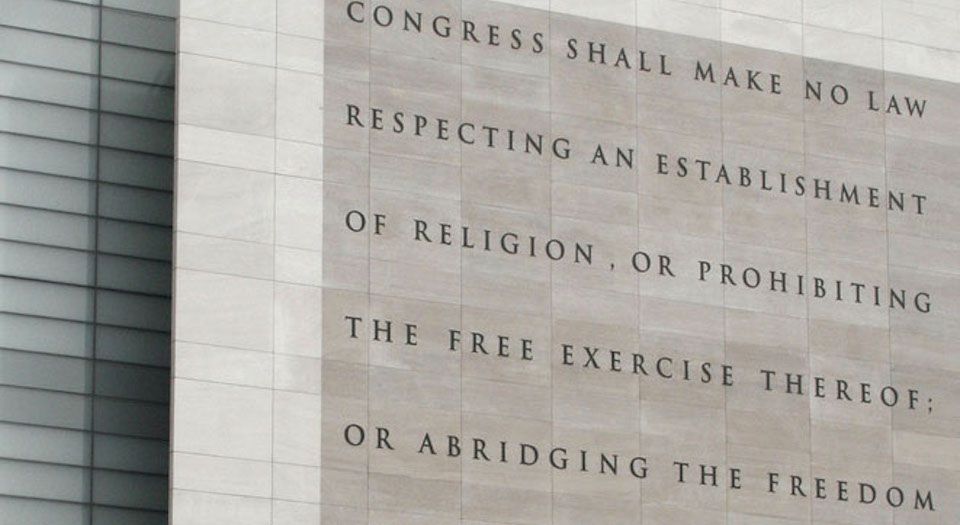
The same survey tested basic knowledge of First Amendment protections, and the results tell a consistent story: Americans tend to recognize the loudest right and forget the rest.
- 73% named freedom of speech.
- 43% named freedom of religion.
- 31% named freedom of assembly.
- 29% named freedom of the press.
- 12% named the right to petition the government.
Only 9% could name all five protections. And 24% could not name a single one.
Even more revealing: 25% mistakenly said the right to bear arms is protected by the First Amendment. That is not just a factual error. It is a warning sign that many Americans sort rights by cultural association instead of constitutional text.
Kathleen Hall Jamieson, director emerita of the Annenberg Public Policy Center, put it plainly: Ignorance is costly. You can’t protect and cherish rights that you don’t know you have.

Why ignorance makes checks and balances easier to bypass
Power does not always arrive wearing a villain costume. In the real world, constitutional shortcuts are usually sold as convenience, emergency, efficiency, or moral necessity.
Here is what low civic knowledge does to the system. It changes the political cost of misbehavior.
1) It turns separation of powers into background noise
If people cannot tell the difference between what Congress does and what the President does, it becomes easier for both to claim credit for the good stuff and blame the other for the bad stuff. That is not just annoying. It is the fuel for unchecked authority.
2) It rewards “strongman” shortcuts
Checks and balances are supposed to feel slow. They are designed to be slow. When citizens are not taught why slowness is a feature, they start demanding that someone “just fix it.” The branch best positioned to “just fix it” is usually the executive, often through agencies and enforcement. That is how temporary urgency turns into permanent expansion.
3) It weakens the simplest check: public outrage with a target
Public pressure works when it is specific. Call your representative. Petition an agency. Support litigation. Show up at hearings. But if the public cannot identify the proper branch or mechanism, outrage becomes general, performative, and easy to ignore.
States are trying to patch the civics hole, but the details matter
Some states have begun treating civics knowledge as something more than a graduation afterthought.
Iowa, for example, now requires students to pass a civics test based on the U.S. Citizenship and Immigration Services naturalization civics test as a condition of graduating high school. Iowa also created a voluntary Seal of Civics Excellence for students who demonstrate civics proficiency and participate in civic and community activities.
I am sympathetic to anything that signals civic literacy is not optional. But I will add a teacher’s caution: a test can measure recall without building judgment. Naming the branches is the beginning, not the end. The real goal is teaching students to recognize a constitutional conflict when it is happening in front of them.

A quick self-audit for adults
If you want a practical way to strengthen your own civic reflex, try these five prompts the next time a political controversy hits your feed:
- Name the branch involved before you name your opinion.
- Identify the tool being used: a law, an executive order, a regulation, a court ruling.
- Ask what the other branches can do in response, and whether they are doing it.
- Separate legality from wisdom. Something can be constitutional and still be a bad idea. Something can be popular and still be unlawful.
- Locate yourself in the system: vote, petition, speak, assemble, serve on a jury, show up locally.
Checks and balances is not just a diagram in a textbook. It is a habit of mind. Lose the habit, and the diagram becomes decorative.
The bottom line
When 35% of Americans cannot name the three branches, that is not an indictment of individual intelligence. It is a sign that we have treated civic literacy like enrichment instead of infrastructure.
The Constitution can survive bad leaders. It can even survive bad moments. What it cannot survive is a public that no longer recognizes what each part of the machine is for. Because the easiest way to bypass checks and balances is to convince people they do not exist, or that they are someone else’s job.