
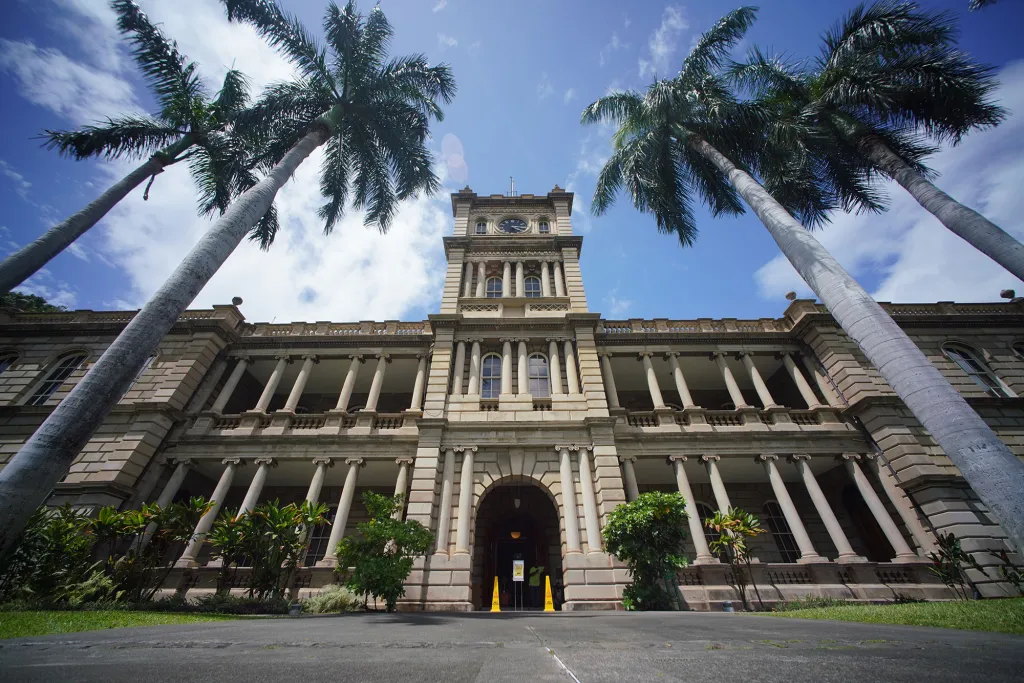
When people hear that a state supreme court might “defy” the U.S. Supreme Court, it can sound like a constitutional cliffhanger. In practice, these moments usually revolve around something more specific: a state court signaling it will read the federal Constitution through a distinct local tradition, even after the U.S. Supreme Court has said the federal rule must be the same nationwide.
Hawaii’s Supreme Court has used language like that in recent Second Amendment litigation, describing an “Aloha Spirit” approach to constitutional interpretation. That raises two separate questions that are easy to mix up:
- Can a state court disagree with the U.S. Supreme Court about what the federal Constitution means?
- If it does, does that implicate the Constitution’s promise that every state will have a “republican form of government”?
To keep this straight, it helps to start with what the dispute is actually about: history, tradition, and whether a state can treat its own past as a reason to narrow a national right.
Join the Discussion
The history fight in the gun cases
A major thread in the Second Amendment litigation is an argument about Hawaii’s historical experience with weapons. In Justice Ketanji Brown Jackson’s dissent in Wolford, she recounts a history in which Hawaii never permitted widespread public carrying of firearms.
One specific example she cites is that in 1833, King Kamehameha III prohibited the possession of “dangerous weapon[s],” including “knife, sword-cane, or any other dangerous weapon.” The history described also emphasizes that Hawaii maintained a tradition of strictly regulating weapons both before and after it was annexed as a U.S. territory in 1898.
That historical framing has been controversial in more than one direction. There was an extended discussion in the broader litigation about whether it is appropriate to rely on racist Jim Crow laws as historical analogues. But there is also a separate critique aimed at the Hawaii-specific material: why should a monarch’s weapons prohibition be treated as a helpful guide to the meaning of a constitutional right that was forged in resistance to arms confiscations by royal authorities?
To put the analogy bluntly, King George III and General Thomas Gage imposed prohibitions on arms in the Massachusetts Bay colony. That kind of violation helped trigger the Revolutionary War and inspired the Second Amendment. So citing King Kamehameha’s laws as a lens for interpreting the Second Amendment raises a sharp question: are monarchical restrictions the kind of “history” that should define an American constitutional guarantee?
The basic rule: one federal Constitution
The U.S. Constitution is not a menu where each state picks its own interpretation of federal rights. The Supremacy Clause (Article VI) makes federal law “the supreme Law of the Land,” and it binds state judges in particular.
That does not mean state courts never interpret the federal Constitution. They do, every day. But when the U.S. Supreme Court has spoken clearly on a federal constitutional question, state courts are expected to follow that precedent.
This is why recent U.S. Supreme Court Second Amendment decisions have emphasized uniformity. The Court has said the Second Amendment has the same meaning in all parts of the United States. In that framing, merely local attitudes cannot shrink or inflate the meaning of a fundamental Bill of Rights guarantee applied to the states through the Fourteenth Amendment. The Court has made the point using comparisons that are hard to miss: the right cannot give way to “the spirit of Aloha” any more than it can yield to the spirit of the Big Apple or the Windy City.
The Court also underscored that this national baseline applies in the same way to the 50th state, where about 8% of adults possess guns, and the 49th state, where the figure is roughly 59%.
What “Aloha Spirit” is doing here
In a concurrence in State v. Wilson, Hawaii Supreme Court Justice Todd Eddins wrote: “In Hawai‘i, the Aloha Spirit inspires constitutional interpretation.” He tied that idea to public safety, adding that “the spirit of Aloha clashes with a federally-mandated lifestyle that lets citizens walk around with deadly weapons during day-to-day activities.” He also pointed to Hawaii’s Constitution, which describes “the law of the splintered paddle” as “a unique and living symbol of the State’s concern for public safety.”
Hawaii also has a statute that defines “Aloha Spirit” in aspirational terms, describing it as “the coordination of mind and heart within each person,” listing virtues such as kindness, unity, humility, and patience. The statute adds that state officials, including judges, “may contemplate and reside with the life force and give consideration to the ‘Aloha Spirit.’”
As a matter of civic life, statements like that can be meaningful. As a matter of federal constitutional law, there is a hard boundary: a state can celebrate its values, and it can provide greater protections under its own constitution, but it cannot use a state-specific spirit to narrow a federally protected right after the U.S. Supreme Court has defined that right’s scope.
And the clash is not subtle. Justice Eddins’s formulation is not just “Hawaii cares about safety.” It is a claim about how the federal Constitution should be read in Hawaii, rooted in a local tradition that developed from a different legal, political, and social set of circumstances than the mainland.
If a state court does not comply
There is no constitutional “time-out corner” where a state court can be sent for misbehaving. The system relies on practical tools:
- Review and reversal. If a state supreme court decides a federal issue in a way that conflicts with U.S. Supreme Court precedent, the losing party can ask the U.S. Supreme Court to review the case. If the Court takes it, it can reverse.
- Remand with instructions. The U.S. Supreme Court can send a case back and direct the state court to apply the federal rule correctly.
- Federal court enforcement in related contexts. Depending on the issue, federal courts can become involved in enforcing federal rights, though the procedural route varies widely by subject.
This is why “defiance” often looks less like a dramatic declaration and more like something subtler: narrowing a ruling, distinguishing facts, or relying on state-law grounds to reach an outcome that resembles what the state court wanted anyway. That may be frustrating to watch, but it is different from openly announcing that federal law does not apply.
Downes v. Bidwell and the “alien” warning
There is another layer to the “Aloha Spirit” argument that is easy to miss if you focus only on guns. If the premise is that Hawaii’s legal system is fundamentally separate from the system that developed on the mainland, that idea brushes up against an old and ugly strain of constitutional reasoning about territories and “difference.”
In Downes v. Bidwell (1901), one of the Insular Cases, the U.S. Supreme Court included this passage:
“If those possessions are inhabited by alien races, differing from us in religion, customs, laws, methods of taxation, and modes of thought, the administration of government and justice according to Anglo-Saxon principles may for a time be impossible, and the question at once arises whether large concessions ought not to be made for a time, that ultimately our own theories may be carried out and the blessings of a free government under the Constitution extended to them. We decline to hold that there is anything in the Constitution to forbid such action.”
The point of raising that passage is not to endorse it. It is to highlight the implication of saying, in effect, that a state’s legal culture is “alien” to the federal constitutional system and therefore can justify a different interpretive approach. That is a road with a lot of historical baggage.
The Guarantee Clause question
Article IV, Section 4 says: “The United States shall guarantee to every State in this Union a Republican Form of Government.” This is called the Guarantee Clause.
It is tempting to treat the Guarantee Clause as a general-purpose weapon for ordinary constitutional disagreements between state and federal actors. Historically, the U.S. Supreme Court has treated many Guarantee Clause claims as political questions, meaning they are often not the kind of dispute courts want to resolve in a lawsuit. In other words, the clause may be a constitutional backstop, but it is not usually the day-to-day enforcement mechanism.
Still, the clause matters as a constitutional principle. A state judiciary that treats federal rights as optional, or treats the federal Constitution as something to be reshaped by a local “spirit” when the U.S. Supreme Court has already spoken, is in tension with the structure the Constitution presupposes.
This is why the “Aloha Spirit” framing triggers a broader line of questions: can a state supreme court justice, who takes an oath to the federal Constitution, base decisions on a “spirit” that is inconsistent with American history and tradition? If Massachusetts could not cite General Gage’s firearm seizures to justify strict gun laws as a matter of federal constitutional meaning, what would be the limiting principle for Hawaii? Is there a “Red Sox Spirit”?
In that sense, the dispute is not only about guns. It is about whether a state’s identity can operate as an interpretive override to a nationally defined constitutional right. And if states and courts keep pushing in that direction, it is fair to ask whether the Guarantee Clause will remain a mostly theoretical promise, or whether it will get renewed attention in extreme cases. The Supreme Court ducked an “invasion” issue in Barbara, but questions about the justiciability of these structural disputes are not going away.
The takeaway
- Supremacy Clause: the direct rule. State courts must follow the U.S. Supreme Court on the meaning of the federal Constitution.
- Guarantee Clause: the background promise. It reflects the expectation that states remain lawful, representative partners in a single constitutional system, even if it is often a difficult fit for courtroom remedies.
Hawaii can honor its history and culture, and it can adopt state constitutional protections that go beyond the federal floor. But when it comes to the federal Bill of Rights as interpreted by the U.S. Supreme Court, a state’s local “spirit” cannot rewrite the national baseline.
Quick FAQ
Can Hawaii interpret its own constitution differently from the federal Constitution?
Yes. States can provide more protections than the federal Constitution requires. What they generally cannot do is provide less protection where the federal Constitution sets a minimum nationwide rule.
Is invoking “Aloha Spirit” automatically unconstitutional?
Not automatically. It depends on what the court does with it. Using it as a general value statement is one thing. Using it as a reason to narrow a federal right after the U.S. Supreme Court has defined that right is where the constitutional conflict appears.
What is the remedy if a state court refuses to follow the U.S. Supreme Court?
The main remedy is appellate review: the U.S. Supreme Court can reverse a state court on federal questions. In rarer, more systemic conflicts, broader federal enforcement and political responses can come into play, but most disputes are handled through the ordinary judicial process.