
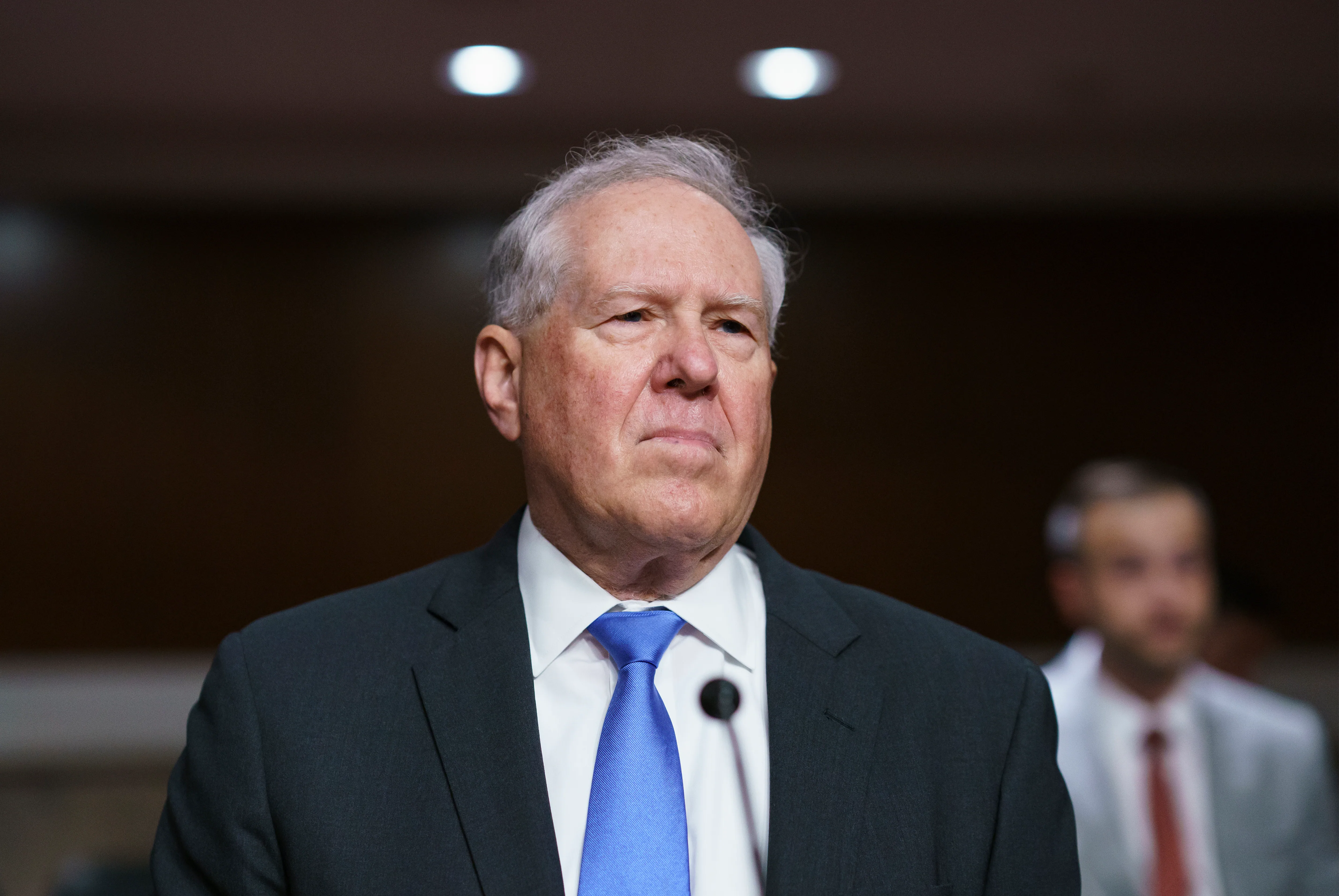
A former Secretary of the Air Force is preparing to take his security-clearance dispute to court, and the legal question underneath it is one the Constitution keeps bringing us back to: who controls access to the nation’s secrets, and how far judges can go when the executive branch says “no.”
Former Secretary of the Air Force Frank Kendall said he plans to sue the Trump administration after his security clearance was revoked. The administration has tied the revocation to claims that Kendall disclosed sensitive information related to the Qatari-gifted jet now serving as Air Force One. Kendall has denied disclosing classified information.
Join the Discussion
What happened
Kendall, a West Point graduate who led the Air Force during the Biden administration, publicly said the government stripped his clearance and that he intends to fight the decision in court. In a televised interview, he framed the dispute as retaliation and said, “As my mother taught me years ago, you stand up to bullies.”
National security attorney Mark S. Zaid confirmed Kendall has retained him, posting “More to come” on X.
Zaid specializes in helping military and civilian clients maintain security clearances in the face of investigations. He has also sued the Trump administration after his own clearance was revoked, and he was later named among 14 other people in an executive order tied to the administration’s clearance actions.
These facts matter for the news. But for constitutional readers, the more durable issue is structural: security clearances sit at the intersection of individual rights, agency process, and presidential power.
Why clearances are treated as executive territory
Security clearances are not just workplace credentials. They are a formal determination that a person may be trusted with classified information. Under our constitutional system, decisions about national defense, diplomacy, and sensitive intelligence are strongly associated with Article II executive power, especially the President’s role as Commander in Chief and the head of the executive branch.
That is why, historically, courts have been cautious. Judges generally do not want to substitute their judgment for an executive determination about who may access secrets, because it pulls the judiciary into questions of national security risk that courts are not institutionally designed to reassess.
In other words: even when a clearance revocation is painful and career-altering, courts often view the underlying access decision as a core executive function.
Can a court force a clearance back?
Usually, courts are far more willing to review the process than to order the outcome.
- What courts may examine: whether the government followed its own procedures, respected statutory limits, or violated constitutional protections (like retaliation for protected speech or denial of basic due process where due process is required).
- What courts hesitate to do: directly order the executive branch to grant or reinstate access to classified information, because that can look like a judge taking over a national-security judgment reserved to the executive.
That does not mean lawsuits are pointless. Litigation can sometimes produce meaningful relief, such as an order requiring the government to provide a lawful process, reconsider a decision under proper standards, or stop using an unlawful policy. But a judge ordering “give this person a clearance” is a tougher ask, constitutionally and practically.
The separation of powers problem
This dispute sits in a classic separation-of-powers pinch point:
- The executive branch claims the authority and responsibility to protect classified information and decide who can access it.
- The judiciary is responsible for saying what the law is, including whether the government complied with statutes and the Constitution.
When a clearance is revoked, the person affected often experiences it as a deprivation of livelihood, reputation, or professional standing. But the executive branch tends to frame it as a forward-looking risk assessment, not a punishment. That framing matters because it influences what courts think they are being asked to do: correct a legal wrong versus second-guess a security judgment.
Why the Air Force One details matter
The administration’s stated rationale ties Kendall’s clearance to alleged disclosures about a very specific national-security topic: the Qatari-provided aircraft that is now serving as Air Force One.
Public controversy around that jet has included reporting on security concerns, including that the aircraft lacks the advanced anti-missile technology of its predecessor. The Justice Department previously issued subpoenas to journalists connected to that reporting and later withdrew them after a federal judge criticized the government’s work in court.
In any clearance lawsuit, the government often argues that details cannot be litigated in open court without risking further disclosure. That can lead to sealed filings, restricted proceedings, or fights over what can be said publicly. The more sensitive the subject matter, the more likely the court will accept that it must tread carefully.
A broader pattern
Kendall is not the only prominent figure to describe clearance revocation as politically motivated. In recent years, the Trump administration has used executive orders and other actions to revoke or threaten clearances for a growing list of current and former officials.
One executive order issued in March 2025 identified a group that included former President Joe Biden and members of his family, as well as former Deputy Attorney General Lisa Monaco and New York Attorney General Letitia James, stating it was “no longer in the national interest” for them to retain clearances. In August 2025, the administration revoked the clearances of 37 additional current and former national security officials, including some connected to disputes that have long angered President Trump, such as assessments related to Russian interference in the 2016 election.
Whether these actions are lawful in a specific instance depends on facts and the legal vehicle used. But constitutionally, the pattern highlights a recurring question: when executive power is used in ways that resemble punishment, what check exists if the usual remedy (a court order restoring access) is considered off-limits?
What to watch in court
If Kendall files suit, here are the questions likely to shape what happens next:
- What legal claim is being made? Retaliation, due process, violation of agency rules, or something else.
- What remedy is requested? A new review, an injunction against enforcement, or a direct reinstatement request.
- How much of the record is classified? That affects what can be litigated publicly and how much deference a court may give the executive branch.
- Was the clearance connected to a job requirement? Courts sometimes treat employment-related consequences differently than disputes over prestige or influence.
However the lawsuit is framed, this is the underlying constitutional reality: courts can police legality, but they are reluctant to run the executive branch’s national-security machinery. That tension is not a bug in the system. It is separation of powers in action, even when it produces unsatisfying answers.
FAQ
Is a security clearance a constitutional right?
No. Access to classified information is typically treated as a discretionary executive determination, not an entitlement guaranteed by the Constitution.
Can someone sue over a revoked clearance?
Yes, people do sue, particularly when they believe a revocation violated a statute, an agency’s own rules, or constitutional protections. The harder part is the remedy.
If courts cannot order reinstatement, what can they do?
Often, the most realistic judicial remedies involve requiring a lawful process, ordering reconsideration under proper standards, or blocking an unlawful policy. Direct orders to grant access are less common because of executive-branch authority over classified information.