
When people think about “gun rights,” they usually picture laws passed by legislatures: bans, permits, waiting periods, and background checks. But sometimes the Constitution shows up in a place that feels more everyday and more personal: a product liability lawsuit, filed by someone who says a firearm went off when it should not have.
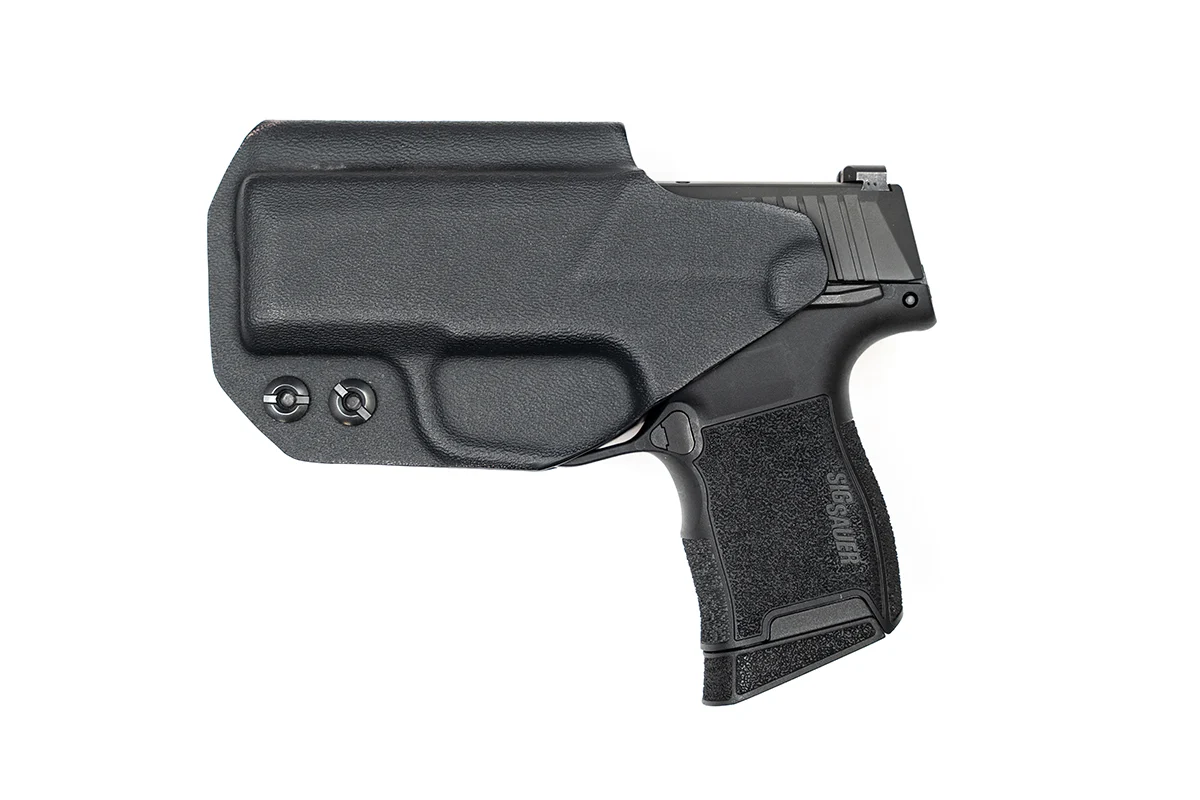
That is the core question in a new federal case out of Georgia involving a Sig Sauer P365X pistol. The lawsuit alleges the gun discharged while still holstered and without any trigger pull. Sig Sauer argued the case should be thrown out, in part because the Second Amendment protects the right to keep and bear arms and, in its view, a design-defect claim could function like a backdoor regulation. The court did not accept that argument at this stage.
Join the Discussion
The situation that led to the lawsuit
The case is Harvard v. Sig Sauer, Inc., filed in federal court in the Northern District of Georgia. (The plaintiff is identified by last name.) According to the complaint, the plaintiff bought a Sig Sauer P365X on November 18, 2023. About a month later, he was at the Rock Bottom Hunting Club in Roberta, Georgia with the pistol in a holster attached to his waistband.
The allegation is strikingly specific: as he removed the holster from his waistband, the gun discharged while still fully seated inside the holster. The complaint also says the casing did not eject and remained in the chamber. The plaintiff claims the discharge severely injured his right index finger.
He sued under familiar state-law theories that come up in many consumer product cases: design defect, failure to warn, and negligence.

So can gun makers be sued for an alleged “no-trigger” discharge?
Yes. A gun is a consumer product, and product liability law generally applies to consumer products, including firearms. That does not mean every case succeeds. It does mean courts can hear claims that a firearm was defectively designed, inadequately warned about, or negligently made or sold.
In this Georgia case, U.S. District Judge Thomas Thrash allowed the lawsuit to move forward past the motion-to-dismiss stage. That is an early checkpoint where the court asks, essentially, whether the plaintiff has pleaded enough to proceed to evidence gathering.
What the plaintiff has to prove (in plain English)
Under Georgia design-defect law, the judge explained that a jury (or other factfinder) weighs the design using a risk-utility approach: whether the dangers of the design outweigh its usefulness, and whether there was a reasonable safer way to design it. The plaintiff also has to connect the alleged defect to the injury. In other words, it is not enough to say “this was dangerous.” The plaintiff must show the design issue actually caused the harm.
Does the Second Amendment block these lawsuits?
Not automatically. The Second Amendment can be raised in many contexts, but it is not a general immunity shield for firearms manufacturers in ordinary civil cases.
Still, Sig Sauer’s argument was not frivolous on its face. Here is the concern in a nutshell: if a court effectively declares that handguns without a manual safety are “defective,” manufacturers might feel forced to stop selling that category of handgun. That could look less like compensating an injured person and more like a court-created restriction on commonly owned firearms.
Judge Thrash acknowledged why the constitutional question comes up. Even though the case is between private parties, courts do more than just referee facts in a design-defect case. The judge noted that Georgia courts have said that when deciding design defects, “the court is called upon to supply the standard for defectiveness.” In other words, the legal system itself is setting a safety baseline.
But at the pleading stage, the judge saw the complaint as primarily alleging internal design problems that caused a spontaneous discharge, not as an attempt to treat “no manual safety” as the defect all by itself. The complaint mentions an external manual safety as something that could reduce risk, but the court read that as part of the required argument that a safer alternative design existed, not necessarily as the central theory of liability.
Why the court let the case proceed, for now
The decision is narrow and procedural: the lawsuit survives for now. The judge did not rule that the gun was defective, or that Sig Sauer is liable, or that the Second Amendment is irrelevant. The ruling simply means the plaintiff alleged enough to move into discovery and later stages.
Importantly, the court left the door open for the Second Amendment argument later. Judge Thrash explained that after discovery, the facts might look different. If evidence shows there were no internal defects and the only remaining “defect” theory is the absence of a manual safety, the constitutional argument could become more serious.
As the court put it, if the plaintiff ultimately prevailed on a theory that effectively imposes liability on all manufacturers making similar guns, a defendant “might plausibly assert” that such claims “infringe on the Second Amendment.” But the judge declined to fully analyze that scenario before the evidence is developed.
How to think about the Second Amendment here
The Second Amendment protects an individual right to keep and bear arms. It does not promise that any particular firearm design is free from ordinary civil accountability. A negligence or defect lawsuit is not the same thing as a statute banning ownership.
That said, this case highlights a real tension courts sometimes have to manage:
- Product safety law asks whether a product was “not as safe as it should be” and whether a reasonable safer design was available.
- Second Amendment doctrine often focuses on whether the government is restricting arms in common use for lawful purposes.
When a civil standard starts functioning like a de facto design mandate for an entire class of firearms, courts may have to decide whether the constitutional right changes the usual tort analysis. Judge Thrash’s approach here was cautious: let the factual record develop first, and then assess whether the case is truly about a dangerous defect or about imposing a broader design requirement through litigation.
What this means for gun owners and manufacturers
For gun owners, the immediate takeaway is simple: courts can hear claims that a gun fired without a trigger pull, and those claims are not automatically barred by the Second Amendment.
For manufacturers, the bigger takeaway is strategic. In cases like this, the details matter. A claim focused on a particular alleged mechanical failure can look like ordinary product liability. A claim that effectively says “this whole category of handgun is defective unless it has feature X” may invite deeper constitutional scrutiny, especially if the feature is tied to common models and common ownership.
Quick FAQ
Is this the same as a government gun regulation?
No. It is a private lawsuit. But courts can still review whether legal rules applied in civil cases create unconstitutional results, because courts are state actors when they enforce legal standards and issue judgments.
Did the judge say the pistol actually fired without a trigger pull?
No. At the motion-to-dismiss stage, the court largely assumes the plaintiff’s factual allegations are true for purposes of deciding whether the case can proceed.
Does this ruling mean Sig Sauer will lose?
No. It means the plaintiff gets to pursue evidence and continue litigating. Many cases settle. Others end at summary judgment. Some go to trial.