
You can feel the post-Dobbs legal map in the latest headlines. One frequently cited estimate, from the Society of Family Planning’s #WeCount project, reports roughly 330,000 medication-abortion regimens were provided via telehealth under protective shield-law regimes to patients living in states with bans or tight restrictions across 2023 and 2024. (For production: cite the specific #WeCount update that reports this figure, including the publication month/year, the precise start and end dates covered, and the definition of “regimen.” Add a direct link in the CMS.) Like most large aggregate numbers, it depends on definitions (for example, counting regimens rather than tablets) and on scope (telehealth provision under shield-law models, not every instance of pills moving across state lines). But as a headline, it captures the basic enforcement puzzle that Dobbs created.
The number functions as a political hook. The constitutional story underneath it is the durable part. Dobbs v. Jackson Women’s Health Organization (2022) did not just change abortion policy. It changed the geometry of abortion regulation by returning primary authority to the states, then forcing states to confront a problem states are not built to solve: how do you enforce a ban when the conduct you want to punish happens partly somewhere else?
This article explains what abortion shield laws are, how cross-state prescribing and mailing works, and which constitutional doctrines will decide whether these laws hold up.
Join the Discussion
What are abortion shield laws?
Shield laws are state statutes designed to reduce the risk that people in one state can use courts or law enforcement in another state to punish abortion-related conduct that is legal where it occurred.
They usually do not “legalize abortion everywhere.” They do something more technical and more federalism-focused. Depending on the state, a shield law may:
- Limit cooperation with out-of-state investigations or subpoenas related to abortions that were lawful in the shield state.
- Block extradition in certain abortion-related cases unless the underlying conduct would also be a crime in the shield state (a “dual criminality” concept).
- Restrict enforcement of out-of-state civil judgments (for example, judgments based on another state’s abortion bounty-style law).
- Protect professional licenses of in-state clinicians from discipline based solely on another state’s abortion restrictions.
- Create a cause of action allowing a provider to sue an out-of-state plaintiff who tries to enforce an out-of-state abortion judgment.
The basic idea is not “ignore the Constitution.” It is “use the state’s own constitutional space.” States control their own courts, their own police powers, their own licensing systems, and much of their own cooperation with other states.
Examples
Shield laws are not theoretical. Massachusetts, New York, and Washington, among other states, have enacted versions that combine non-cooperation rules, limits on enforcing certain out-of-state process, and protections for clinicians. The details vary, but the design tends to rhyme: keep in-state lawful medical care from being re-litigated or enforced through another state’s courts, subpoenas, warrants, civil judgments, or licensing threats.
How can pills cross state lines?
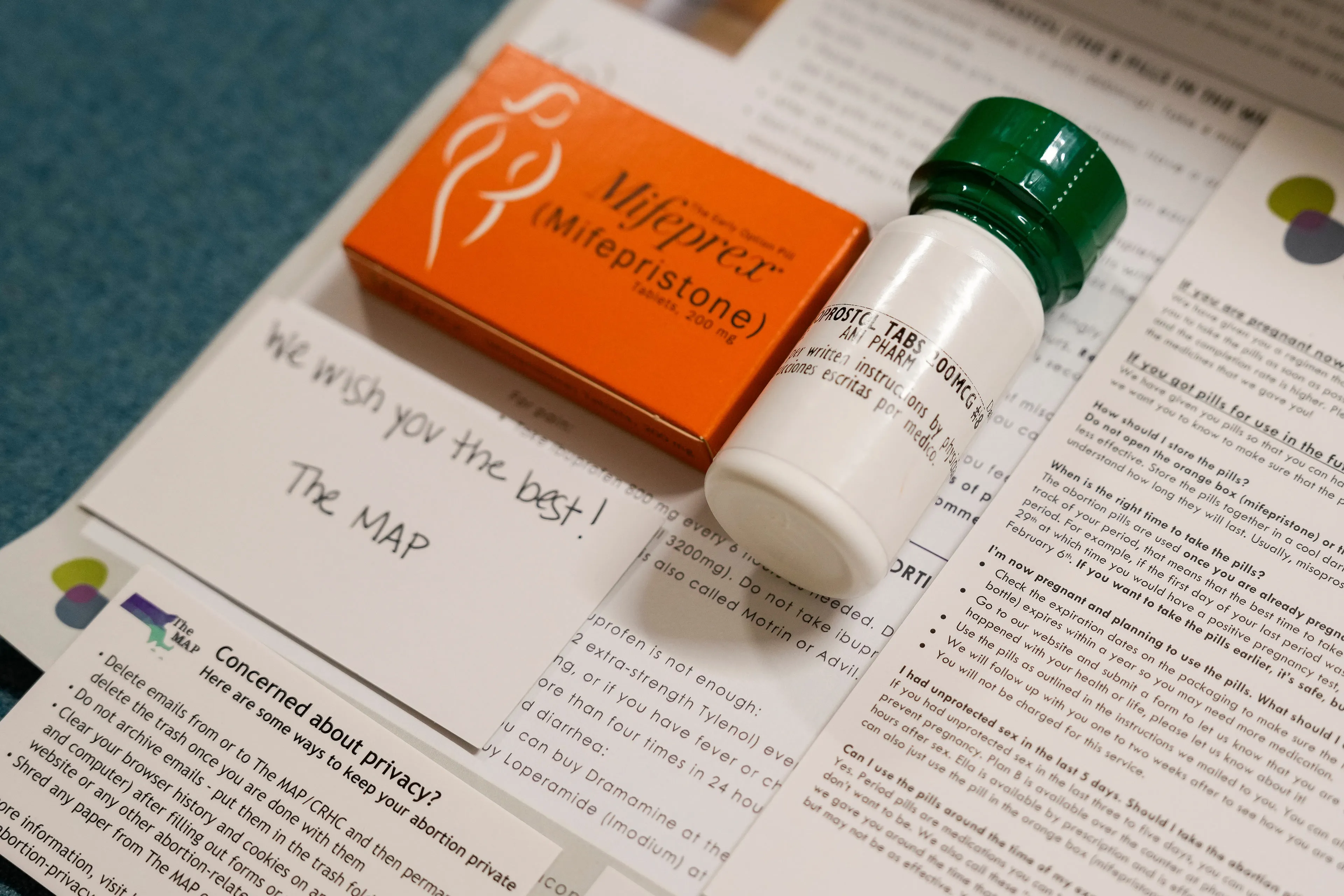
Medication abortion typically involves mifepristone (approved by the FDA) and misoprostol (also used for other medical purposes). After Dobbs, the pressure point is not only whether a state bans abortion. It is whether a state can stop a resident from obtaining a medication-abortion regimen when the prescriber, the pharmacy, and the shipment route may touch multiple jurisdictions.
Common fact pattern
A common scenario looks like this:
- A patient in State A (restrictive) consults via telehealth with a clinician in State B (protective).
- The clinician in State B prescribes under State B law and under whatever federal rules apply.
- A pharmacy in State B (or a mail-order pharmacy operating where it is allowed) dispenses and ships the medication to an address in State A.
From State A’s perspective, the conduct and effects are felt at home. From State B’s perspective, the medical act was lawful where the clinician stood.
Shield laws attempt to keep State A from reaching into State B’s legal system to punish the prescriber, the pharmacy, or anyone else acting lawfully under State B’s rules.
The constitutional questions
Post-Dobbs abortion fights often sound moral. In court, they become structural. Shield laws pull several constitutional levers at once.
1) Criminal jurisdiction
States normally have power to punish crimes committed inside their borders. The cross-state medication scenario complicates that. If the prescribing act occurred in State B, can State A claim it was “committed” in State A because the pills arrived there and were used there?
There is no single constitutional sentence that answers this. The fight turns on a mix of:
- Due process limits on a state asserting jurisdiction over out-of-state defendants.
- Traditional territorial principles in criminal law and conflicts of law.
- How a state writes its statute (for example, whether it criminalizes “aiding or abetting” an in-state abortion, the act of mailing, or the act of prescribing to an in-state resident).
Even if State A writes an aggressive law, enforcing it against a clinician physically located in State B is a separate step. Which leads to the next lever.
2) Extradition
The Constitution’s Extradition Clause (Article IV) and the federal implementing statute (18 U.S.C. § 3182) are generally understood to make extradition largely mandatory once the demanding state has properly charged a person and complied with required procedures. The Supreme Court’s decision in Puerto Rico v. Branstad (1987) is often cited for the proposition that a demanding jurisdiction can seek federal court relief to compel compliance.
That said, extradition is not automatic in practice. It is bounded by procedural requirements and the asylum state’s limited inquiry, and shield-law disputes are likely to be litigated right at those seams:
- The person must generally be charged in the demanding state.
- Governors and courts examine whether the paperwork is proper and whether the person is the one sought.
- Disputes can arise over whether the person is a fugitive, a term many courts treat broadly, including in cases where underlying conduct and alleged “effects” are split across states.
Some shield laws try to narrow when state officials will treat an in-state provider as extraditable for out-of-state abortion charges, especially where the provider never entered the demanding state and acted lawfully at home. That position is legally contested, and in a major clash, the endgame is often federal court.
3) Full Faith and Credit
Article IV also contains the Full Faith and Credit Clause, which requires states to respect the “public Acts, Records, and judicial Proceedings” of other states.
Here is the catch that makes shield laws a live strategy: full faith and credit is strongest for final judgments, and there is not a broad “public policy” veto over enforcing ordinary sister-state money judgments, though enforcement remains subject to familiar limits. In practice, the main defenses tend to be more technical and more durable:
- Lack of personal jurisdiction in the original case.
- Penal judgment doctrine limits (states are not required to enforce another state’s penal laws as such).
- Limits on enforcing certain statutory schemes that function like punitive enforcement mechanisms rather than conventional compensation, depending on how the claim is structured.
Many shield laws are drafted with a defensive posture: they aim to give the shield state’s courts clear grounds to say, “This out-of-state judgment cannot be enforced here,” not because the forum disagrees with the policy, but because jurisdiction or enforceability fails under established doctrine.
4) Dormant Commerce Clause
Dobbs returned abortion regulation to the states, but it did not repeal the Constitution’s rules about interstate commerce.
States can regulate health and safety within their borders. But when State A’s law effectively tries to control transactions occurring in State B, litigants may argue it imposes an unconstitutional burden on interstate commerce. This is a major fault line in medication-abortion litigation because shipping by mail is literally commerce crossing state lines.
Courts, however, have been cautious about sweeping “extraterritoriality” theories in recent cases, including National Pork Producers Council v. Ross (2023). Commerce Clause outcomes here are likely to turn on statutory design, the practical burden imposed, and how courts frame the state’s asserted in-state interest.
5) Federal preemption
The Supreme Court’s abortion decision in Dobbs did not decide who wins if a state ban conflicts with federal law regulating drugs, drug approval conditions, and distribution channels.
Potential preemption arguments include:
- FDA approval and labeling rules for mifepristone, including Risk Evaluation and Mitigation Strategy (REMS) conditions.
- Federal authority over the mail and federal criminal statutes sometimes invoked in this space, including debates about the scope and meaning of the Comstock Act.
- Supremacy Clause principles that invalidate state laws that directly conflict with federal requirements or stand as an obstacle to federal objectives.
These are fact-heavy disputes. Courts will ask what federal law actually requires or authorizes, and what the state law actually prohibits. A state can often regulate medical practice without being “preempted.” But when a state tries to block distribution of an FDA-approved drug in ways that collide with federal rules, the preemption argument gets sharper.
6) Licensure and telemedicine
Even where criminal prosecution stalls, states may try a different route: licensing and professional discipline. Telehealth also raises a basic question that state medical boards often assert: where does the “practice of medicine” occur, where the clinician is located, where the patient sits, or both?
Shield laws often respond by protecting in-state licenses from being penalized based solely on out-of-state abortion rules. But that does not automatically solve cross-border licensure questions, and it does not prevent a banning state from threatening penalties against anyone it claims is practicing medicine “in” the banning state without a license.
What this looks like in court
A shield-law case often begins as a procedural move, not a dramatic criminal trial. Consider a simple sequence:
- Step 1: A demand. A prosecutor or private plaintiff in State A issues a subpoena, a records demand, or a civil complaint aimed at a clinician or platform in State B.
- Step 2: A refusal. The target points to State B’s shield law and asks State B’s courts or officials not to cooperate with the out-of-state process because the underlying care was lawful in State B.
- Step 3: A jurisdiction fight. The State A side argues State A has jurisdiction because the patient was in State A and the effects happened there. The State B side argues due process, territorial limits, and defects in personal jurisdiction.
- Step 4: An enforcement fight. If State A obtains a judgment or issues an arrest warrant, the next question becomes whether State B must recognize it, help enforce it, or extradite. That is where full faith and credit, the penal judgment doctrine, and extradition procedure become decisive.
This is why shield laws matter. They are not a slogan. They are a set of rules about who has to do what, and when, once a cross-border dispute enters the machinery of courts and enforcement.
Why the 330,000 headline matters
Numbers do not decide constitutionality. But they change incentives.
A large volume of provision and shipment makes it more likely that:
- States will bring test cases designed to create precedents about jurisdiction, subpoenas, and extradition.
- Legislatures will draft more explicit cross-border language, which gives courts cleaner targets.
- Federal agencies and Congress will face pressure to clarify how federal drug policy interacts with state abortion bans.
In other words, the headline helps explain why these issues are moving from theory to litigation. Shield laws exist because the enforcement problem is not hypothetical anymore.
What courts will focus on
When shield laws land in court, judges tend to ask practical questions disguised as constitutional ones:
- Where did the relevant act occur? Prescribing, dispensing, shipping, using, paying, advising, or “aiding.”
- Who is the defendant? A clinician, a pharmacist, a platform, a friend who helped, or a patient.
- What is the legal tool? Criminal prosecution, civil liability, professional discipline, or an attempt to enforce a judgment.
- Does the demanding state have jurisdiction? If jurisdiction fails, full faith and credit and enforcement mechanisms often fail with it.
- Is there a federal rule that overrides the state rule? If yes, the Supremacy Clause can end the case quickly.
Shield laws are not one law and one lawsuit. They are a category of statutes that will be tested through many procedural pathways, and the forum matters. Interstate clashes often end up in federal court even when they start with a subpoena, a warrant, or a licensing letter.
Common questions
Are shield laws constitutional?
Some parts likely are, some parts may not be. A state generally can choose how much to cooperate with out-of-state investigations, how to structure its licensing decisions, and how its courts handle certain civil enforcement efforts. But a state cannot nullify federal law, and it cannot ignore binding constitutional duties like extradition if a court determines those duties apply on the facts.
Who faces criminal, civil, or licensing risk?
Readers often collapse these into one category, but the legal exposure is usually separated by the tool being used:
- Criminal exposure is typically driven by the banning state’s criminal code and its theory of where the offense occurred, and it often focuses on providers or helpers, though patient liability depends on state law.
- Civil exposure can arise through private lawsuits, including bounty-style schemes, and the key fights often become personal jurisdiction and whether a resulting judgment can be enforced elsewhere.
- Administrative exposure shows up through medical-board investigations, license threats, and telemedicine enforcement, often turning on where a state says medicine was “practiced.”
Do shield laws protect patients too?
Often, shield laws are written primarily to protect providers and helpers located in the shield state, because that is where the shield state has the clearest control over courts, subpoenas, and licensing. Patient exposure is usually driven by the banning state’s own laws and enforcement choices. Some protective states also limit cooperation with investigations that would target patients for conduct that was legal in the protective state, but shield laws cannot erase the banning state’s power over people and acts within its own territory.
Can a banning state prosecute an out-of-state doctor?
It can try. The hard part is personal jurisdiction and enforcement. A state may claim effects in-state, but if the doctor never set foot in the state and the prescribing act occurred entirely elsewhere, the jurisdictional theory becomes the whole case. Even with charges filed, getting the person, evidence, or compliance can require cooperation from other states or federal courts.
Can a banning state stop pills at the border?
States do not operate like separate countries. They cannot set up routine internal customs checkpoints. Enforcement tends to happen through criminal law, civil suits, and licensing, not border inspections.
Is this really about states’ rights?
It is about federalism, which includes states’ rights and also their limits. Dobbs returned abortion policy to state legislatures, but it also reopened an older question: what happens when one state tries to export its policy into another?
The takeaway
Dobbs did not create a single national abortion rule. It created a 50-state enforcement problem. Shield laws are one side of that problem: a protective state using its own legal system to keep its residents and providers from being governed by another state’s ban.
The next chapter will be written in disputes over jurisdiction, extradition, full faith and credit, interstate commerce, and federal preemption. Those doctrines are not side issues. They are the Constitution’s instruction manual for what states can do to each other when they disagree.
If you want the durable way to follow this story, watch for cases that ask a simple question with enormous consequences: who gets to regulate a medical decision when the patient is in one state and the provider is in another?