
The Strait of Hormuz is not just a watery choke point. It is a constitutional one too. When the world’s most sensitive shipping lane becomes the stage for armed enforcement, the question is not only what happened at sea, but who, back home, has the authority to set the rules.
After an incident involving an Iranian-flagged cargo vessel in the strait, Iran’s top joint military command, Khatam al-Anbiya, condemned the United States and accused it of breaking a ceasefire. U.S. officials, for their part, described their actions as enforcement of what they called a blockade in the Strait of Hormuz. That word, blockade, is doing heavy lifting. It is also the word that should make Congress sit up straight.
Join the Discussion
What happened
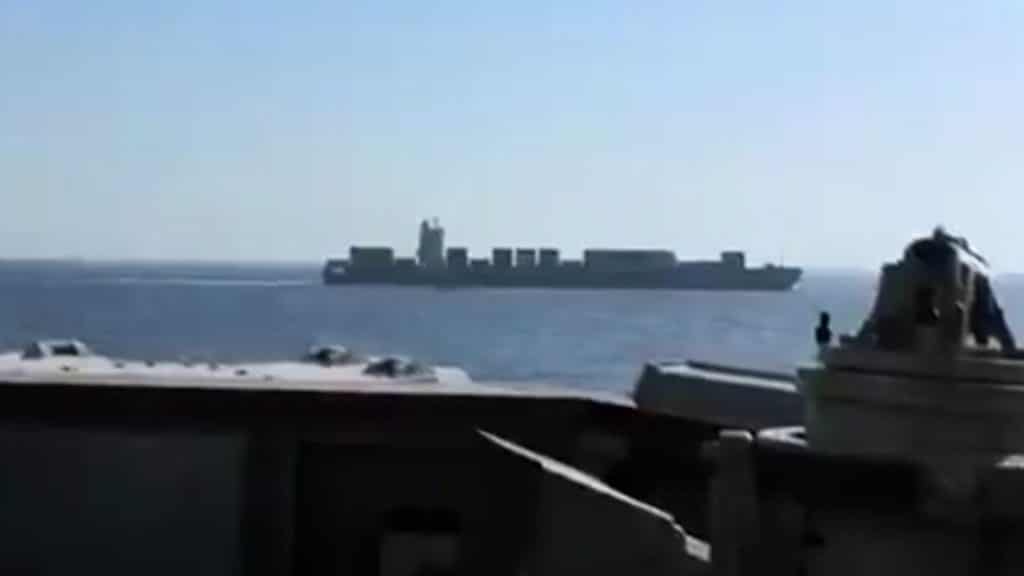
On April 19, 2026, U.S. Central Command released video showing the destroyer USS Spruance firing on an Iranian-flagged cargo vessel identified as Touska after the ship attempted to breach what the United States characterized as a Strait of Hormuz blockade.
Iran’s military leadership framed the incident as an attack that violated a ceasefire. The United States framed it as interdiction, stopping a ship from crossing a line the U.S. says it has the right to enforce.
What is publicly evidenced here is a discrete interdiction captured on video, not a fully described campaign with publicly stated rules, scope, or duration. The public statements available also do not spell out the terms of the ceasefire Iran referenced, which is exactly why the legal and political footing matters. When the underlying agreement is unclear to the public, the definition of “enforcement” can become policy by default.
The key word
Presidents use flexible vocabulary. “Operation.” “Mission.” “Self-defense.” “Maritime security.” But “blockade” has a long history in American law and international practice as something close to a declaration in action.
To be clear, the United States is the one using the term here. Whether this incident satisfies every legal element of a blockade is a separate question from the one it raises: what follows, constitutionally, when U.S. forces act as if that label has real teeth.
In general, a blockade is not merely a warning or a patrol. It typically implies an attempt to shut down an area to traffic, usually by threatening force and, when necessary, using it. If officials say a ship “breached” a blockade and force is used to stop it, that is not clerical enforcement. It is coercive power against foreign commerce at sea.
If U.S. posture were to expand into sustained blockade-like enforcement, it could look and feel like war even when no one wants to say the word out loud.
War powers
Article I gives Congress the power to declare war, to raise and support armies, to provide and maintain a navy, and to make rules for the armed forces. Article II makes the President Commander in Chief. That division was not an accident. The Framers had watched kings slide nations into conflict and wanted the moment of national commitment to be a legislative decision.
Here is the tension that never goes away: a President can move fast, sometimes fast enough to start something that cannot be easily stopped. Congress can authorize, fund, and regulate, but it rarely moves at the speed of a destroyer in the Strait of Hormuz.
Can a President act alone
The honest answer is that a President can attempt it, and history shows presidents often do. The constitutional question is whether they can do it lawfully without Congress’s buy-in, especially if the posture amounts to sustained coercion rather than a narrow, time-limited response.
1) Defense vs pressure
Presidents have a strong claim to act immediately to protect U.S. forces and repel attacks. If an American ship is fired upon, the Commander in Chief does not need a committee meeting to respond.
But if interdictions become a standing effort to control passage in a critical waterway, or if “enforcement” evolves into broader restrictions on transit, that starts to resemble something more than defense. It becomes an attempt to reshape foreign behavior by controlling trade routes. That is the sort of national choice that Article I was built for.
2) Ceasefire disputes
If a ceasefire is in effect and one side claims the other broke it, the situation becomes more combustible and more ambiguous. Ambiguity is where executive power tends to expand. It is also where constitutional legitimacy tends to erode.
3) Hostilities at sea
Even under the modern framework that allows short-term deployments, a blockade-like posture raises the question of whether the United States has introduced its forces into “hostilities” or into a situation where hostilities are clearly imminent. A single interdiction involving live fire is not hypothetical. It is force in action.
If Congress does not authorize, the executive branch typically argues that the operation is limited, defensive, or something short of war. That argument can persist right up until the moment the country wakes up and realizes it is already in one.
Questions for Congress
In my old classroom, I had a rule: if you are using force, you must be able to state the rule you are enforcing and who wrote it. That is the civics version of accountability. Congress should apply the same standard here.
- What is the legal authority for what U.S. officials call a “blockade”? A treaty obligation? A U.N. mandate? A statute? Or a unilateral Article II theory?
- What is the objective? Protecting U.S. vessels is one thing. Interdicting a specific ship is another. If the intent is to restrict wider commercial movement through the strait, that is something else entirely.
- What is the end state? Blockade-like enforcement, if it persists, is not a press release. It is a commitment that can invite escalation.
- What counts as “breaching”? The definition matters because it determines when U.S. forces may fire again.
- Who owns the consequences if this spreads? The President can order action. Only Congress can credibly claim the people consented to the larger war that may follow.
The mirror
America likes clean categories: peace or war, defense or offense, ceasefire or violation. The ocean does not cooperate. Neither do presidents.
If the executive branch can enforce what it describes as a de facto blockade without Congress, then Congress’s war power becomes ceremonial, something we invoke after the fact, once the shooting has already set the policy.
That is the question hiding inside the Strait of Hormuz incident. Not whether a destroyer can stop a ship. It can. The question is whether the Constitution permits one person to turn that stopping power into national strategy under a word like “blockade” while Congress watches from shore.