
John McCain is trending again, and no, it is not because he suddenly reentered American politics from the beyond.
McCain is trending because he has become a prop in a much newer fight: a fresh wave of anger at Senator Lindsey Graham that hit X on July 12, 2026 and used McCain as the moral measuring stick.
This is how political memory works online. People do not just argue about what happened today. They argue about what kind of person today proves you always were. And in the viral story being told right now, John McCain is cast as “honor,” while Lindsey Graham is cast as “ambition.”
Join the Discussion
The trend is really about Lindsey Graham
If you scroll through the most widely shared posts driving the trend, you see the same structure repeating like a chant. The posts are not primarily about McCain’s record, legislation, or biography. They are about Graham’s reputation and what people believe happened to it.
McCain functions as a foil. He is the “before” photo, the earlier Republican style that prized institutional loyalty, public service, and a kind of rhetorical seriousness about America’s role in the world. Graham becomes the “after,” a cautionary tale of what happens when a politician decides that proximity to power is worth any amount of personal humiliation.
That is why so many posts read like moral courtroom statements rather than policy debate. One post circulating widely put it with blunt rage, imagining a final reckoning: “If Lindsey Graham gets one pit stop before his trip to Hell, I hope he got to meet John McCain again tonight and I hope McCain knocked him the fuck out.”
Another, more polished version of the same verdict frames their legacies as opposites, praising McCain as a “true American hero” and condemning Graham as a man who “groveled” for power even after Donald Trump insulted McCain and insulted Graham, too.
What McCain and Graham actually were to each other
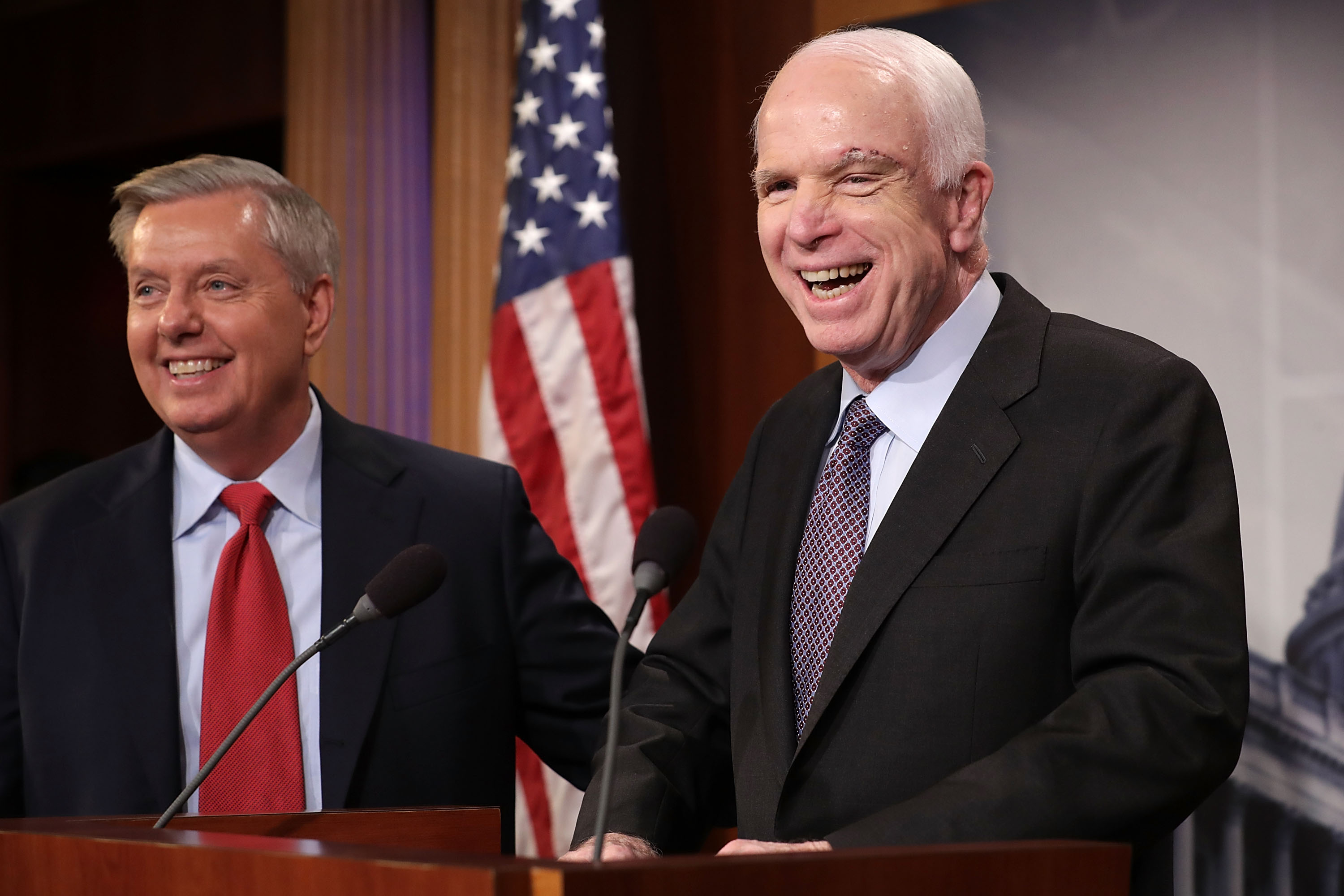
To understand why “betrayal” is the word people reach for, you have to remember that McCain and Graham were not casual colleagues. For years, they were linked as foreign-policy hawks and as partners willing, at least occasionally, to flirt with bipartisan deals.
Graham built part of his national identity as McCain’s dependable ally. That meant showing up for the fights McCain liked: a muscular view of American leadership abroad, a taste for confrontation with adversaries, and a preference for a Senate that still believed in negotiation as a civic virtue rather than a sign of weakness.
Even Graham’s defenders have rarely denied the basic historical outline that makes today’s narrative possible: there was a period when he was seen as an “honorable” figure in McCain’s orbit. A veteran political observer summed up that earlier reputation in a viral post, recalling Graham as McCain’s “sidekick” who tried to forge compromises on climate and immigration and championed campaign finance reform, then calling Graham’s transformation a “tragic” career arc.
That earlier Graham is essential to the online story. Nobody calls it betrayal when you never expected better. The accusation only works because people remember a version of him who seemed to stand for something other than Trump-era performance politics.
The Trump insult problem: why the rupture feels personal
The trend keeps circling one particular emotional trigger: Donald Trump’s public contempt for John McCain.
In the viral retelling, the insult is not merely a campaign-era jab. It is a loyalty test. If you were McCain’s ally, the story goes, you had an obligation to treat that insult as disqualifying. Not because friendship is a constitutional principle, but because character is a political credential. If you say honor matters, you cannot keep your job by laughing at the humiliation of the person who taught you the script.
That is why the backlash does not focus on some single Senate vote. It focuses on a perceived moral concession: a willingness to accept that Trump could degrade McCain publicly and still become the party’s indispensable center of gravity.
To critics, Graham’s later closeness to Trump reads like a declaration that none of the old lines were real. Not the lines about character. Not the lines about America’s alliances. Not the lines about civic restraint.
The December 2016 Ukraine trip that keeps resurfacing
One detail that keeps getting pulled into the viral thread is a December 2016 trip to Ukraine taken by McCain and Graham. In the current wave, people point to the trip as proof that the two men once stood together on the core national-security question of the era: Russia’s role in the 2016 election and the broader challenge Moscow posed to the United States and its allies.
A widely shared post this week resurrected that memory almost like a taunt, recalling that McCain and Graham visited Ukraine in December 2016 and returned warning that Russia interfered with the presidential election, then adding: “Every dog has its day.”
It is less about the trip itself than what the trip symbolizes in today’s argument. The trip represents “the old Graham,” when his public posture aligned more cleanly with McCain’s worldview. Bringing it up now is a way of saying: this was not inevitable. There was a fork in the road, and you chose the road that led to Trump.
Why this narrative keeps going viral
The “Graham betrayed McCain” storyline is durable because it is not really about two men. It is a parable about what party identity means when a party changes quickly.
1) It turns ideology into a story about character
Most voters cannot recite a platform plank from memory. But they can follow a friendship story and understand a “before” and “after.” McCain becomes a shorthand for courage and institutional loyalty. Graham becomes shorthand for adaptation without limits.
2) It gives people a simple moral vocabulary
Terms like “honor,” “courage,” “cowardice,” and “groveling” are not policy analysis. They are moral diagnosis. And social media loves moral diagnosis because it travels faster than nuance.
3) It uses McCain as a kind of civic ghost
McCain’s death intensifies the symbolism. You cannot argue with him. You cannot ask him to clarify. He becomes whatever the speaker needs: a rebuke, a standard, an imagined witness. In the current trend, people talk about him as though he is still present, still judging, still keeping score.
The constitutional subtext: what this fight is really about
On its face, this is a personality drama. Underneath it, the anger is about something more structural: what Americans expect elected officials to do when a political movement pressures them to tolerate conduct they once claimed was disqualifying.
The Constitution does not require senators to be loyal friends. It does not require them to be brave. It does not require them to defend a predecessor’s dignity.
But the Constitution does assume something about the humans who occupy its offices: that ambition will exist, and that it must be checked by other ambitions, other institutions, and public judgment. When people resurrect McCain’s memory to condemn Graham, they are using the only enforcement mechanism ordinary citizens always have: reputation.
They are asking, in the language of the Founders, what kind of virtue a republic needs to survive. And they are answering with a comparison that fits in a single post.
A counter-note in the trend: nostalgia, not just rage
Not every viral McCain mention is a condemnation. A smaller current in the trend is pure nostalgia for the odd-couple chemistry McCain and Graham once had.
One former official shared an anecdote from an Indiana campaign stop: McCain, at lunch with local politicians, got a call from Graham, put him on speaker, and teased him for not showing up. Graham joked back that he was staying away so the candidate could win.
That story is lightweight, but it serves a purpose. It reminds readers that the relationship was real. Which, in turn, makes the “betrayal” version feel more plausible to the people pushing it.
What to take from the trend
- McCain is trending as a symbol, not because of a new development in his life or legacy.
- The flashpoint is Lindsey Graham, with users using McCain’s memory to deliver a moral verdict on Graham’s Trump-era choices.
- The narrative persists because it is simple: a friendship, an insult, a turn, a reckoning.
- It also persists because it is a civic argument, dressed up as personal drama: what do we do when leaders abandon the standards they once demanded?
You do not have to share McCain’s politics to understand why his name keeps being summoned. In American political culture, “McCain” has become less a person than a question: what does courage look like when it costs you something?