
It is hard to think of a more sweeping speech restriction than this: a court order telling a person to stop “publicly writing, printing, or speaking” another person’s name.
That is not a metaphor. It is the kind of command that reaches into ordinary civic life, where we argue about candidates, criticize public officials, and sometimes do it loudly. Even when such an order is later reversed, the pressure can be immediate: people may self-censor, take down lawful posts, avoid public meetings, and learn the wrong lesson about what the First Amendment protects.
Join the Discussion
What happened
The dispute, Coble v. Ballentine, grew out of local politics in Randleman, North Carolina. Two politically active residents who once had a friendly relationship later fell out after the death of the defendant’s father. The defendant had not directly contacted the plaintiff since 2022.
Both were active in local politics and used social media to express political views. While both associated with the Randolph County Republican Party, they had supported opposing candidates in the past.
In March 2024, the plaintiff announced on Facebook that she would run for mayor of Randleman in the 2025 election. Later that year, in response, the defendant created a Facebook page called “Anybody But Coble” and later a website, AnybodyButCoble.org, posting articles opposing her mayoral candidacy.
Around the start of 2025, the plaintiff stated online that she would no longer run for mayor. The filing period, however, remained open until July 2025. The defendant did not remove the content already posted on his platforms.
The plaintiff sought a civil no-contact order. A trial court issued an order requiring the defendant to “refrain from publicly writing, printing, or speaking [the plaintiff’s] name in any manner” and also barred him from coming within fifty yards of her.
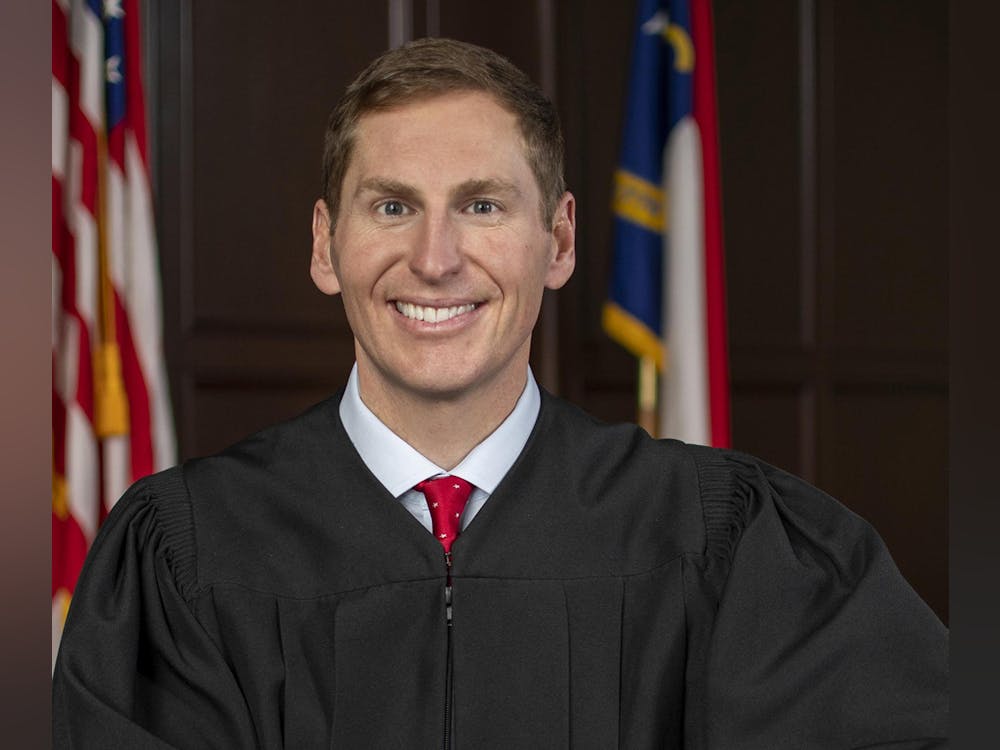
On appeal, the North Carolina Court of Appeals reversed. The opinion was by Judge Jefferson Griffin, joined by Judges John Arrowood and April Wood.
Why a name ban is extreme
Most restrictions on speech that show up in everyday life are not labeled “prior restraints,” but that is what they function like. A prior restraint is a rule that stops speech before it happens, rather than punishing unlawful conduct afterward.
The classic examples are court injunctions that prohibit publishing certain information, or licensing systems that require government permission before speaking. A name-ban order operates in that same space: it blocks future speech across contexts, regardless of tone or truthfulness.
Think through what “do not publicly say her name” could cover:
- Talking about her announced candidacy at a town council meeting
- Sharing a news link that mentions her
- Handing out a flyer about a local election
- Writing a letter to the editor about local government
In other words, it is not just a rule against harassment. It is a rule that can push someone out of public debate.
What the court decided
The appellate court’s reasoning turned on something that often gets lost in online disputes: a post can be about someone without being directed at them.
North Carolina’s civil no-contact process can be used when someone is a victim of unlawful conduct such as stalking. The definitions focus on knowing conduct “directed at a specific person” that “torments, terrorizes, or terrifies” and “serves no legitimate purpose.” In the online context, the statute speaks in terms of communications “directed at a specific person.”
Here, the defendant’s posts were framed as third-person commentary for the community, not messages sent to the plaintiff. Even assuming he knew she used social media, the court concluded that awareness did not necessarily mean he directed his posts to her. The stated purpose of “Anybody But Coble,” to aid voters, also supported the conclusion that the publications were aimed at undecided voters in Randleman, not the plaintiff.
The court also noted the lack of second-person writing in the posts. Writing in the second person can suggest you are speaking directly to someone. The defendant referred to the plaintiff in the third person throughout. While that is not dispositive, the court treated it as further support for the idea that the posts were about her rather than communications to her.
Bottom line: the Court of Appeals found a lack of evidence to support a finding of stalking or harassment under the civil no-contact statute, and reversed on that basis. Because of that, it did not reach the defendant’s First Amendment argument.

What this means for speech
1) Safety tools can become speech controls
No-contact orders exist for serious reasons. People genuinely need protection from stalking and targeted intimidation. But when those tools are stretched to cover public criticism tied to a local election, constitutional values become the guardrail that is supposed to stop the slide.
The problem is not only the outcome. It is the incentive structure. If a person can obtain an order that effectively removes an online critic from the public square, others will try it too.
2) Reversal can come too late
Appellate review takes time. During that time, a speaker may comply under threat of contempt, take down lawful speech, or avoid politics entirely to reduce risk. Even a temporary prohibition can quiet debate when it matters most, including during an election season.
3) Breadth invites arbitrary enforcement
“Do not say her name” leaves enormous discretion in the hands of whoever enforces the order. Does it include quoting someone else? Sharing a screenshot? Saying the name at a public meeting when asked a direct question?
When a rule is this sweeping, people do not just avoid the prohibited conduct. They avoid anything that might be mistaken for it.
If you face an order
I cannot give personal legal advice, but there are practical, civic-minded steps that apply in many situations:
- Read the order closely. Broad, vague language is a red flag, especially when it bans categories of speech rather than specific conduct.
- Preserve records. Keep copies of posts, timestamps, and context. Courts often need to see whether speech was public commentary or targeted contact.
- Separate “contact” from “commentary.” Avoid direct messaging or tagging while a dispute is ongoing. Public debate is often treated differently from repeated direct communication.
- Seek counsel quickly. Gag-like orders can carry contempt consequences. A prompt challenge can limit the time speech is suppressed.
The bigger lesson
In a healthy constitutional culture, political disagreement is not treated as personal danger. You are allowed to oppose a prospective candidate. You are allowed to argue against someone who announced a run for office, even if they later say they are not running. You are allowed to say their name while you do it.
The Court of Appeals ultimately reversed the order here, but the episode is still worth sitting with. Prior-restraint style commands do not just silence one person. They teach everyone watching that speech is conditional, that public debate is risky, and that the safest choice is quiet.
The First Amendment is designed to push back against that impulse. Not because speech is always kind, but because free people need room to talk about power, elections, and public life, out loud, using names.