
People usually notice the U.S. Marshals Service at the loud moments. A high-profile arrest. A fugitive search splashed across headlines. A judge escorted through a garage entrance after threats spike online.
But the Marshals are not a general-purpose federal police force, and they are not a private security detail for the powerful. They sit in a very specific constitutional space: the place where the federal judiciary needs executive muscle to make its orders real.
In plain terms, the Marshals Service is how the federal courts reach out of the courtroom and into the world.

Join the Discussion
Where the Marshals fit
The Constitution creates a federal judiciary in Article III, but it does not create a “U.S. Marshals Service.” It does not list marshals alongside judges or prosecutors. That is because the Marshals are not a constitutional office in the way federal judges are.
Instead, they are a statutory solution to a constitutional problem: courts issue judgments, warrants, and injunctions. Someone has to execute them. The Founders gave the federal government an executive branch in Article II to enforce federal law, but they also built a judiciary that must remain independent. The Marshals Service grew out of that need for an enforcement arm that serves the courts without turning the courts into an armed institution of their own.
The early answer: 1789
Congress created the position of U.S. marshal in the Judiciary Act of 1789, one marshal for each federal judicial district. The Marshals Service often describes itself as one of the oldest federal law enforcement agencies, tracing its roots to the first Congress, built alongside the first federal courts.
The constitutional point is not nostalgia. It is structure. Marshals are executive branch officers, but their mission is deeply intertwined with Article III courts. That relationship is unusual in American government, and it explains why their modern duties still orbit the judiciary.
What powers do they have?
U.S. marshals and deputy marshals are federal law enforcement officers. Their authority is not a free-floating “do whatever is necessary” mandate. It comes from federal statutes, court orders, and Department of Justice missions and directives.
Still, the practical question most citizens have is simpler: Can they arrest people? Yes. But the details matter.
Arrest authority
Deputy U.S. marshals can make arrests under federal authority, including:
- Arrests based on federal warrants issued by federal courts.
- Arrests tied to federal offenses when they have statutory authority or are part of an assigned operation.
- Arrests connected to fugitive investigations, especially for individuals wanted on federal charges or who have fled state charges and are targeted through joint task forces.
Unlike the FBI, the Marshals Service is not primarily an investigative agency building major cases from scratch. Its center of gravity is enforcement: finding people who are already charged, already convicted, already ordered to appear, or already required to comply with a federal court order.
Serving process and court orders
One of the oldest marshal functions is also one of the least understood: service of process and execution of federal court orders.
Historically, marshals served a wide range of civil process. Today, routine civil service is often handled by private process servers. The U.S. Marshals step in when statutes require it or when a court orders it, including common situations like cases involving in forma pauperis plaintiffs or orders where marshal service is necessary to make the court’s process effective.
Executing court orders can include:
- Serving summonses and subpoenas in specific contexts when ordered.
- Executing seizure warrants and restraining orders for property.
- Carrying out writs that require action outside the courthouse, such as producing a prisoner for a hearing, enforcing a turnover order, or executing a court-ordered eviction in a federal matter.
This is where the constitutional role becomes concrete. A federal court’s authority is not self-enforcing. The Marshals turn a judge’s words into action.
Use of force and limits
Like other law enforcement officers, Marshals are bound by the Constitution when they use force, search, or seize.
- Fourth Amendment: arrests and searches must be reasonable. Warrants must be supported by probable cause, unless a recognized exception applies.
- Fifth Amendment: due process constrains federal detention practices and government deprivation of liberty and property.
- Fourteenth Amendment: parallel due process and equal protection limits apply primarily to states, and they matter in joint operations and in the broader ecosystem of state and local partners.
- Eighth Amendment: limits punishments and informs standards governing treatment of people in custody, especially after conviction.
If a marshal violates these constraints, the issue is not merely internal discipline. It can become suppression of evidence, civil liability, or criminal exposure in extreme cases.
Prisoner transport
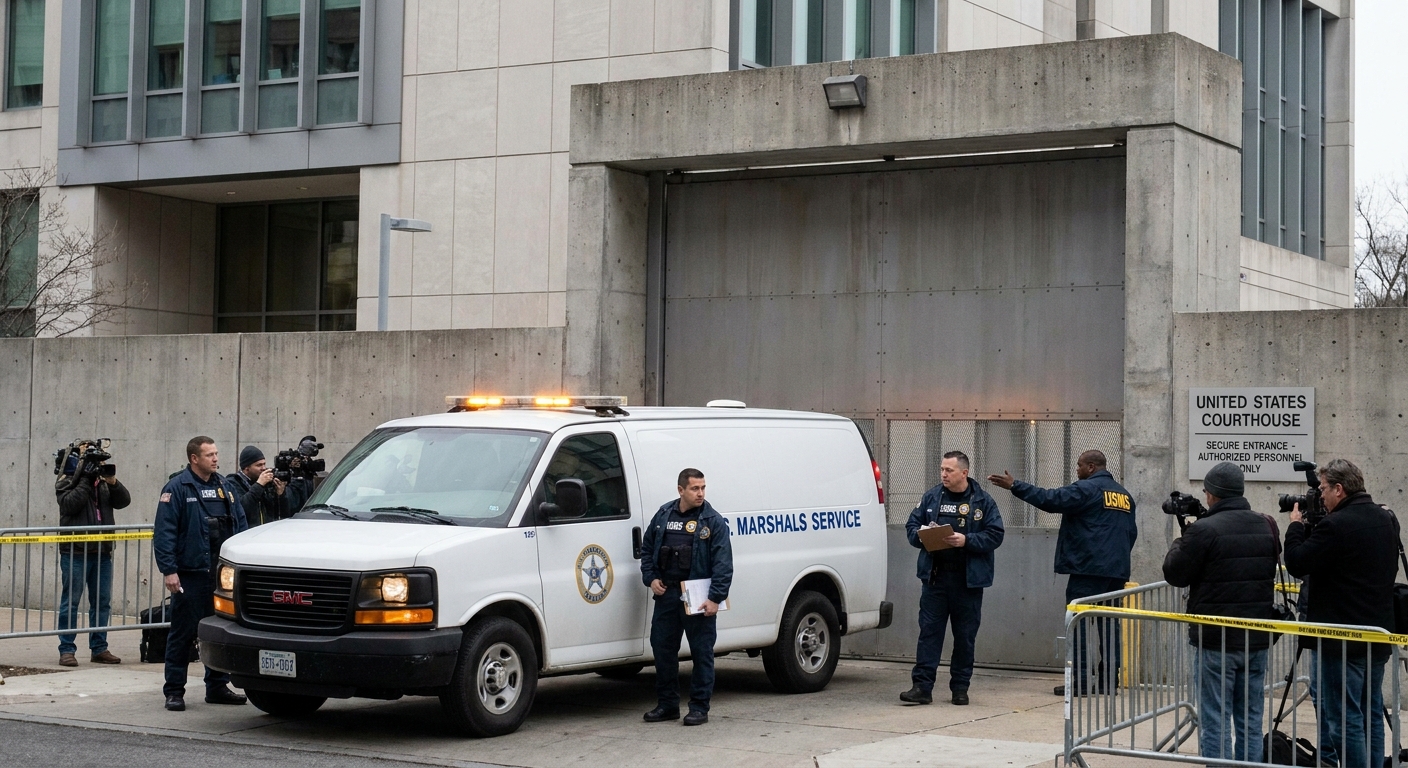
If you have ever watched a federal trial and wondered how defendants, detained witnesses, or people held on warrants actually get to court, the answer is often: U.S. Marshals.
The Marshals Service is a central player in court-related custody and movement, including inter-district movements and air transport through the Justice Prisoner and Alien Transportation System (JPATS), sometimes nicknamed “Con Air.”
In practice, that includes:
- Moving pretrial detainees between local jails, federal holding spaces, and federal courthouses.
- Coordinating movement of individuals to Bureau of Prisons custody after sentencing and to required court appearances.
- Managing long-distance transfers tied to court proceedings, including air transport through JPATS.
The Bureau of Prisons also transports people within its own system, especially for intra-BOP transfers. The constitutional significance on the Marshals side is about keeping the machinery of federal court proceedings working. The Sixth Amendment guarantees criminal defendants the right to be present at trial and to confront the witnesses against them. Those rights become abstract if the government cannot safely and reliably bring defendants into court and run proceedings without breakdown.
Judicial security
The Marshals Service is the primary agency responsible for protecting the federal judiciary. That includes:
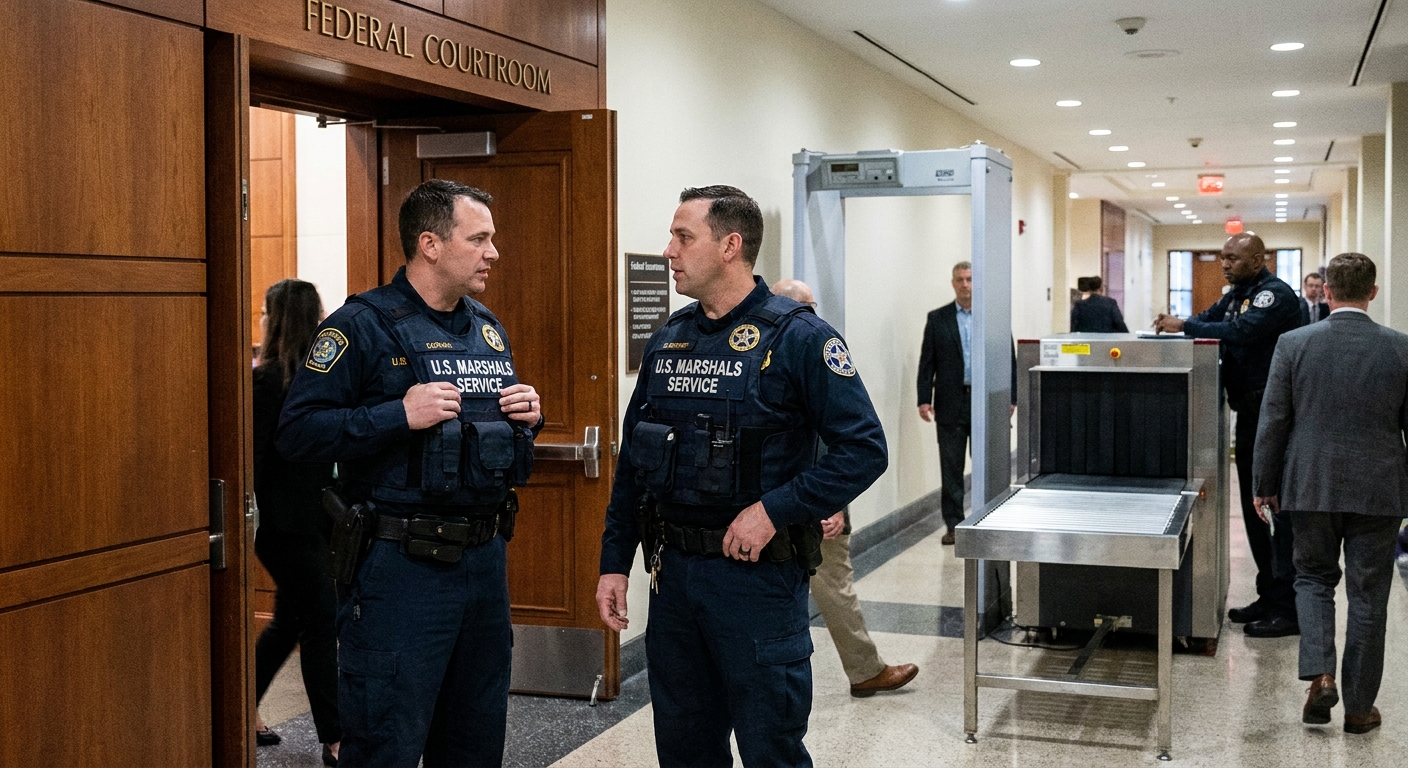
- Security for federal courthouses and courtrooms.
- Protection details for judges and, in certain circumstances, their families.
- Threat assessment and investigations related to judicial threats.
- Coordination with local law enforcement when threats cross jurisdictions.
It is also worth naming the people the public most often sees at checkpoints: many courthouse screening posts are staffed by Court Security Officers (CSOs), who are contract security personnel working under U.S. Marshals Service direction and standards.
Curious citizens often ask: Why are the Marshals doing this, not the Capitol Police or Secret Service?
Because the judiciary is its own branch with its own constitutional independence. The Marshals provide protection that is integrated with court operations, court calendars, prisoner movement, and courtroom security needs. The goal is not to create a fortified judiciary, but to keep courts functional, open, and safe when cases become volatile.
Open versus secure
American courts are supposed to be public institutions. Security must coexist with open proceedings, press access, and the public’s right to observe. That balancing act shows up in the everyday decisions Marshals make: screening checkpoints, courtroom rules, movement of jurors, and responses to protests.
In a democracy, judicial security is not just about preventing violence. It is about preventing intimidation from becoming a veto on the rule of law.
Fugitive task forces
The most visible modern Marshals work often happens through task forces. These are joint operations that can include federal, state, tribal, and local partners focusing on fugitives and violent offenders.
If you have ever heard the phrase “U.S. Marshals task force arrested…” that usually means a coordinated operation where the Marshals provide:
- Federal organization and resources.
- Coordination across jurisdictions.
- Operational expertise in locating and arresting wanted individuals.
Why task forces exist
Fugitives exploit borders. Not national borders, but jurisdictional ones. A person can be wanted in one county, hide in another, and cross state lines to complicate pursuit. Task forces are a practical answer to a structural reality of American federalism: law enforcement power is fragmented.
This is also where citizens’ constitutional questions sharpen. Multi-agency operations raise familiar concerns: Who is accountable? Which agency’s policies apply? What happens if rights are violated during a joint arrest? In practice, constitutional limits follow the officers involved, but the legal aftermath can be complicated when multiple agencies participate.
Who they work for
Here is the relationship in one sentence: the Marshals are part of the Department of Justice, but their core mission is to support and protect the federal judiciary.
That creates a relationship that is both cooperative and carefully bounded.
Judicial independence
Federal judges are not supposed to take orders from prosecutors or the President. Yet they must rely on executive branch personnel for security and enforcement. The Marshals make that dependence workable by operating under statutes, court orders, and established procedures rather than political direction from a particular case.
In the courtroom
If you have watched a federal proceeding and seen deputies near the bench, moving defendants, coordinating jurors, or managing the gallery, you have seen this constitutional choreography. A judge controls the courtroom. The Marshals make courtroom control possible without the judge becoming an armed actor.
USMS versus FBI, DEA, ATF
People often lump federal agencies together. It is understandable. They all carry badges, execute warrants, and show up in the news.
But their institutional purposes differ:
- FBI: broad investigative mandate, national security, and major federal crimes.
- DEA: drug enforcement and drug trafficking investigations.
- ATF: firearms, explosives, arson, and certain regulated industries.
- U.S. Marshals Service: enforcement support for the federal courts, fugitive apprehension, prisoner movement tied to court proceedings, judicial security, administration of the Witness Security Program, and management of certain seized assets.
The Marshals are the agency most directly tied to the day-to-day functioning of Article III courts. That is their niche, and it is why they can feel omnipresent in the justice system while still not being the lead investigator in many major cases.
Seized assets
One quiet but important Marshals function involves asset seizure and forfeiture management in certain contexts, including work connected to the Department of Justice Assets Forfeiture Program. When property is seized pursuant to legal process, someone has to inventory it, store it, maintain it, and sometimes sell it under legal rules.
This work is bureaucratic, but it touches constitutional nerves. Property rights are protected by due process. When the government takes property, the procedures and legal standards matter, and the legitimacy of the system depends on transparency and lawful process.
Common questions
Are U.S. Marshals “above” local police?
No. They are federal officers with federal authority. In practice, they often work with local agencies, but they do not automatically outrank local police in every situation. Each agency operates within its legal scope and command structure.
Can U.S. Marshals enforce state law?
Sometimes they participate in operations involving state warrants or state fugitives through task forces and interagency agreements. But their power is still grounded in federal law and assignments. They are not general state police.
Do Marshals only deal with fugitives?
No. Fugitive work is high-profile, but prisoner movement, courtroom security, and judicial protection are foundational.
Can they arrest you without a warrant?
Sometimes. Like other law enforcement officers, they may make warrantless arrests in legally recognized circumstances, including arrests in public based on probable cause for certain offenses. But entering a home to make an arrest, or conducting certain searches, generally requires a warrant or a clearly established exception (such as consent or exigent circumstances).
Why are they involved in witness protection?
Because keeping witnesses safe is sometimes necessary for federal prosecutions and for the integrity of court proceedings. The Marshals administer the Witness Security Program (WITSEC) in partnership with the Department of Justice. If key witnesses are intimidated or harmed, the promise of a functioning justice system becomes hollow.
Who watches the watchers?
Like other federal law enforcement components, the Marshals operate inside an oversight web: Department of Justice leadership, internal professionalism and discipline systems, the DOJ Office of Inspector General, federal courts that can scrutinize compliance with orders and constitutional rules, and the ordinary mechanisms of litigation when rights are violated.
From 1789 to now
The uniforms changed. The technology changed. The threats changed.
But the core constitutional job description stayed remarkably stable: make the federal courts real in the world outside the courtroom. Arrest the person the court ordered arrested. Secure the courtroom so trials can happen. Move the defendants the Constitution says must be present. Protect judges so decisions can be issued without fear.
That is why the U.S. Marshals Service remains a uniquely revealing institution for civics-minded citizens. It is not just law enforcement. It is federal law enforcement shaped by separation of powers.
The bigger question
Every era has its own version of the same debate: How forceful should the federal government be, and how independent should courts be, when cases become politically charged?
The Marshals Service is where that debate becomes operational. When federal courts issue orders that some citizens or officials resent, enforcement is not theoretical. It is a deputy marshal knocking on a door, a transport detail moving a defendant, a security team protecting a judge.
If you want to understand the Constitution as a living structure, not just a text, watch the places where institutions meet. The U.S. Marshals Service lives at one of the most important intersections: Article III authority backed by Article II enforcement, under laws written by Article I.