
You can study the civics questions for weeks. You can gather tax transcripts, travel records, and a stack of evidence thick enough to make your mailbox nervous.
But U.S. citizenship does not finalize with paperwork. It finalizes with words.
The Naturalization Oath of Allegiance is the moment USCIS stops processing your case and the law starts treating you as a citizen. It is also one of the most misunderstood parts of the process, partly because people mix it up with the civics test and partly because the oath sounds like something written for a different century.
This page is a plain-English walkthrough of what the oath says, what each promise means, what parts can be modified by law, and what typically happens at the ceremony.
Join the Discussion
What the oath is, and what it is not
The oath is the legal moment you become a U.S. citizen
In nearly all cases, you become a U.S. citizen at the moment the oath is administered. Until you take it, even if you have passed the interview and your application is approved, you are still an applicant waiting for the final legal step.
The oath is not the civics test
The civics test is part of the naturalization interview. It is where USCIS checks your knowledge of U.S. government and history, along with English reading and writing (unless you qualify for an exception).
The oath is separate. It happens later, usually at a ceremony, and it is a set of promises about allegiance, law, and civic duty.
The oath is not the whole process
This article focuses on the oath and the ceremony context. Other steps, like eligibility, continuous residence, good moral character, the N-400 application, biometrics, and the interview itself are covered elsewhere on the site.
The text of the Naturalization Oath
USCIS uses a standardized oath set by law. In practice, you may hear slight variations by venue or format, and many printed versions include a blank for your former country (for example, “(name of foreign state)”). If you want the authoritative wording to compare line by line, use the official USCIS version and the statute behind it.
Here is the oath in the form most people encounter it, with the core promises intact:
“I hereby declare, on oath, that I absolutely and entirely renounce and abjure all allegiance and fidelity to any foreign prince, potentate, state, or sovereignty, of whom or which I have heretofore been a subject or citizen;”
“that I will support and defend the Constitution and laws of the United States of America against all enemies, foreign and domestic;”
“that I will bear true faith and allegiance to the same;”
“that I will bear arms on behalf of the United States when required by the law;”
“that I will perform noncombatant service in the Armed Forces of the United States when required by the law;”
“that I will perform work of national importance under civilian direction when required by the law;”
“and that I take this obligation freely without any mental reservation or purpose of evasion;”
“so help me God.”
The sections about bearing arms and military service can be modified for applicants who qualify under the legal standards. The closing phrase “so help me God” can also be omitted, and you can affirm instead of swearing an oath. We will cover both below.
Source note: Always follow the exact wording provided for your ceremony by USCIS or the court.
Line by line: what you are actually promising
“I hereby declare, on oath…”
This is not casual language. You are making a sworn statement. In practice, it signals that this is a serious legal commitment, not a symbolic speech.
“…that I absolutely and entirely renounce and abjure all allegiance and fidelity…”
Plain English: You are ending your political loyalty to other governments.
The word “renounce” means you give up. “Abjure” is older language meaning you reject formally. Together they are meant to leave no wiggle room. You are not promising to stop loving your birthplace or your culture. You are promising that the United States is now your governing home.
“…to any foreign prince, potentate, state, or sovereignty…”
Plain English: This covers any foreign government, whether it is a monarchy, a republic, or something else.
The oath still mentions “prince” and “potentate” because the oath’s structure comes from an older world where loyalty often meant loyalty to a ruler. Today, interpret it as loyalty to a foreign state or governing authority.
“…of whom or which I have heretofore been a subject or citizen;”
Plain English: You are renouncing the allegiance you previously had as a citizen or subject of another country.
This is where many people pause and ask a practical question: does this cancel my original citizenship?
Not automatically. The U.S. oath is about allegiance to governments. Whether you keep or lose your prior citizenship depends on the laws of that other country. Some countries allow dual citizenship easily. Others treat naturalization elsewhere as a loss of citizenship. The oath itself does not rewrite foreign law.
“that I will support and defend the Constitution and laws…against all enemies, foreign and domestic;”
Plain English: You commit to uphold the Constitution and obey U.S. law, and to protect the constitutional order against threats.
Two details matter here.
- Constitution first, laws second. The oath places the Constitution ahead of ordinary statutes. That reflects the basic American idea that the Constitution is the supreme law, and everything else is supposed to fit within it.
- “Foreign and domestic” means threats can come from outside the country or from within it. This is not a call for personal enforcement or vigilantism. It is a pledge of loyalty to constitutional government itself.
“that I will bear true faith and allegiance to the same;”
Plain English: You are pledging real loyalty, not technical compliance.
This line reinforces that citizenship is not just permission to live here. It is membership in a political community built around constitutional rules.
“that I will bear arms…when required by the law;”
Plain English: If the law requires military service in an armed role, you agree to do it.
This line does not mean the government can draft you tomorrow because you became a citizen today. It means you accept the civic obligations that can come with citizenship, including possible military obligations if Congress and the law impose them.
It is also tightly framed: “when required by the law.”
“that I will perform noncombatant service…when required by the law;”
Plain English: If the law requires service but you are not assigned to combat, you agree to serve in a noncombat role.
This is part of how the oath handles conscience, religious conviction, and differing capacities. It signals that even if one form of service is not available to you, citizenship still carries duties.
“that I will perform work of national importance under civilian direction when required by the law;”
Plain English: If the law requires it, you will do essential civilian service in a national emergency.
Think civil defense or emergency response support in extraordinary circumstances, not a routine assignment. The phrase “under civilian direction” matters because it distinguishes civilian national service from military command structures.
“and that I take this obligation freely without any mental reservation or purpose of evasion;”
Plain English: You mean it, and you are not crossing your fingers behind your back.
This is the oath’s credibility clause. It is there because a citizenship oath is not valuable if it is treated as theater. The system is asking for consent, not coercion. If you cannot agree in good faith, it is better to address that before citizenship is granted.
“so help me God.”
Plain English: This is an invocation, not a test of religious belief.
Applicants may request a modification that replaces “on oath” with an affirmation and omits “so help me God.” In American law, an affirmation is a recognized alternative for those whose beliefs do not permit religious oaths.
Optional clauses and lawful modifications
The oath includes promises about military and national service. U.S. law allows certain modifications, but they are not a choose-your-own-adventure. If you need a modification, you request it, USCIS (or the court) reviews it, and the ceremony uses the approved language.
Military clauses: what can change
Some applicants can be excused from the clauses about bearing arms and, in some cases, noncombatant service. USCIS can recognize both religious objections and deeply held moral or ethical objections, as long as they meet the legal standard and are sincerely held.
One important nuance: even when someone is excused from armed service, the “work of national importance under civilian direction” clause is commonly still required. Modifications are specific and tied to what the law allows.
Affirmation and omitting religious language
If you prefer, you can request to affirm rather than swear an oath, and you can omit the final religious phrase. This is a long-standing feature of American legal practice, meant to ensure that citizenship is not conditioned on a religious statement.
How to request a modification
Do not improvise at the microphone. If you need an oath modification, raise it during the naturalization process (often at the interview) and follow the instructions on your ceremony notice. If USCIS asks for a statement or supporting information, provide it as directed. The goal is simple: the ceremony should already know which version you are taking.
What is not optional
The heart of the oath is not negotiable: renouncing prior allegiance and pledging to support and defend the Constitution and laws of the United States. Those are the core commitments of naturalization.
Renunciation and dual citizenship
People often hear “renounce and abjure all allegiance” and assume it is identical to “I give up my other passport.” Sometimes it is. Often, it is not.
What the U.S. is asking for
The United States is asking for a shift in political allegiance. If the U.S. and your former country came into conflict, you are committing that your duty to the United States comes first as a matter of citizenship.
What your former country may do
Whether you keep your prior citizenship is a matter of that other country’s laws and policies. Some countries allow dual citizenship without conditions. Others treat naturalization as automatic loss. Some require formal renunciation paperwork on their end.
What it means in daily life
Most naturalized citizens live an ordinary version of this promise: obeying U.S. law, serving on juries when called, voting, and participating in civic life. The oath’s language is sweeping because it is built for the edge cases, not the routine ones.
The ceremony: what typically happens
Oath ceremonies vary by location and size, but the structure is usually familiar.
- Read your notice (Form N-445): USCIS typically sends Form N-445 (Notice of Naturalization Oath Ceremony). There is a questionnaire on the back that asks whether anything changed since your interview, including arrests or citations, travel, marital status, or other key facts. Complete it and bring it. You usually hand it in at check-in.
- Check-in and verification: You confirm your identity and submit your completed N-445 questionnaire. You will also turn in your Permanent Resident Card (green card) as part of changing status. The exact timing can vary by location.
- Program and remarks: An official may speak about civic responsibility, voting, and the meaning of citizenship.
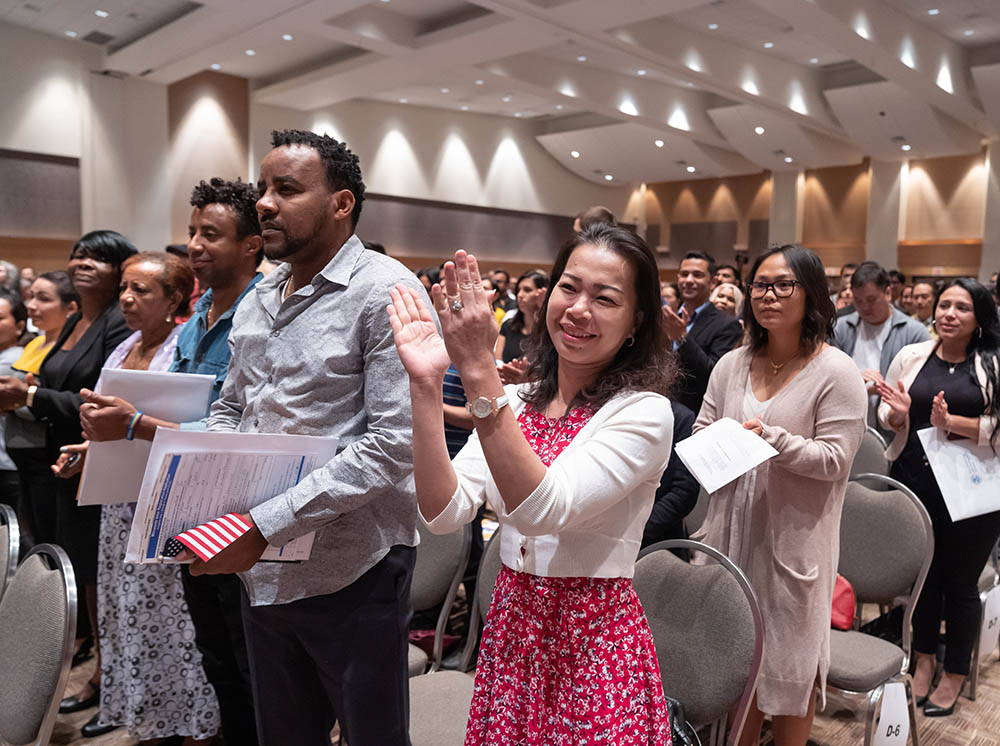
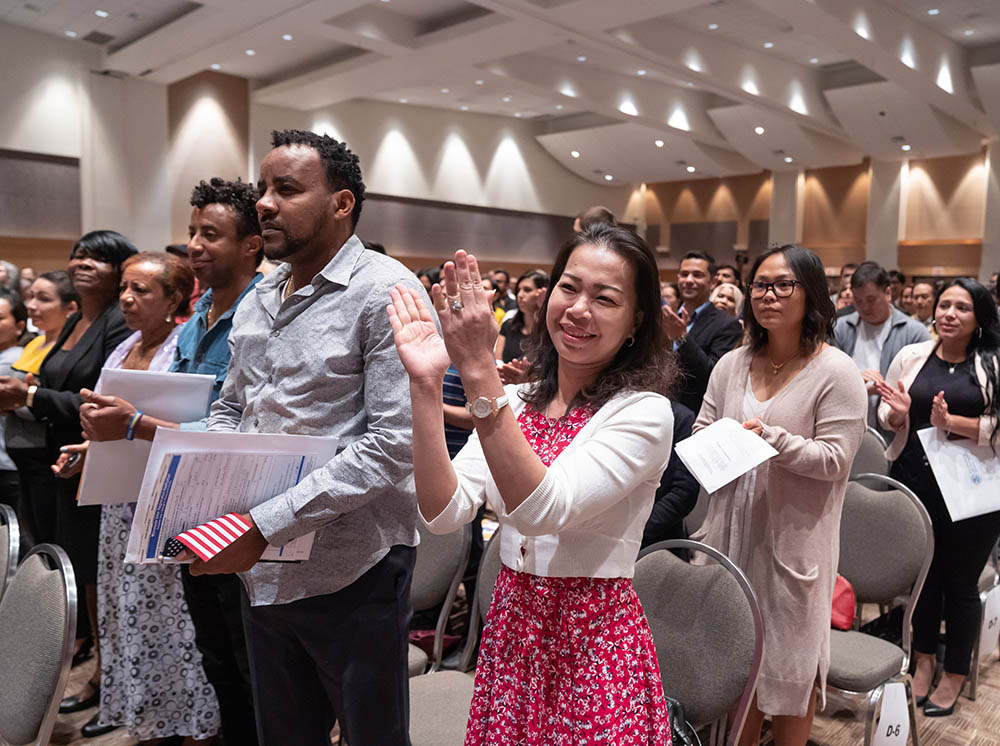
- The oath: Everyone stands and recites the oath together, often with a raised right hand.
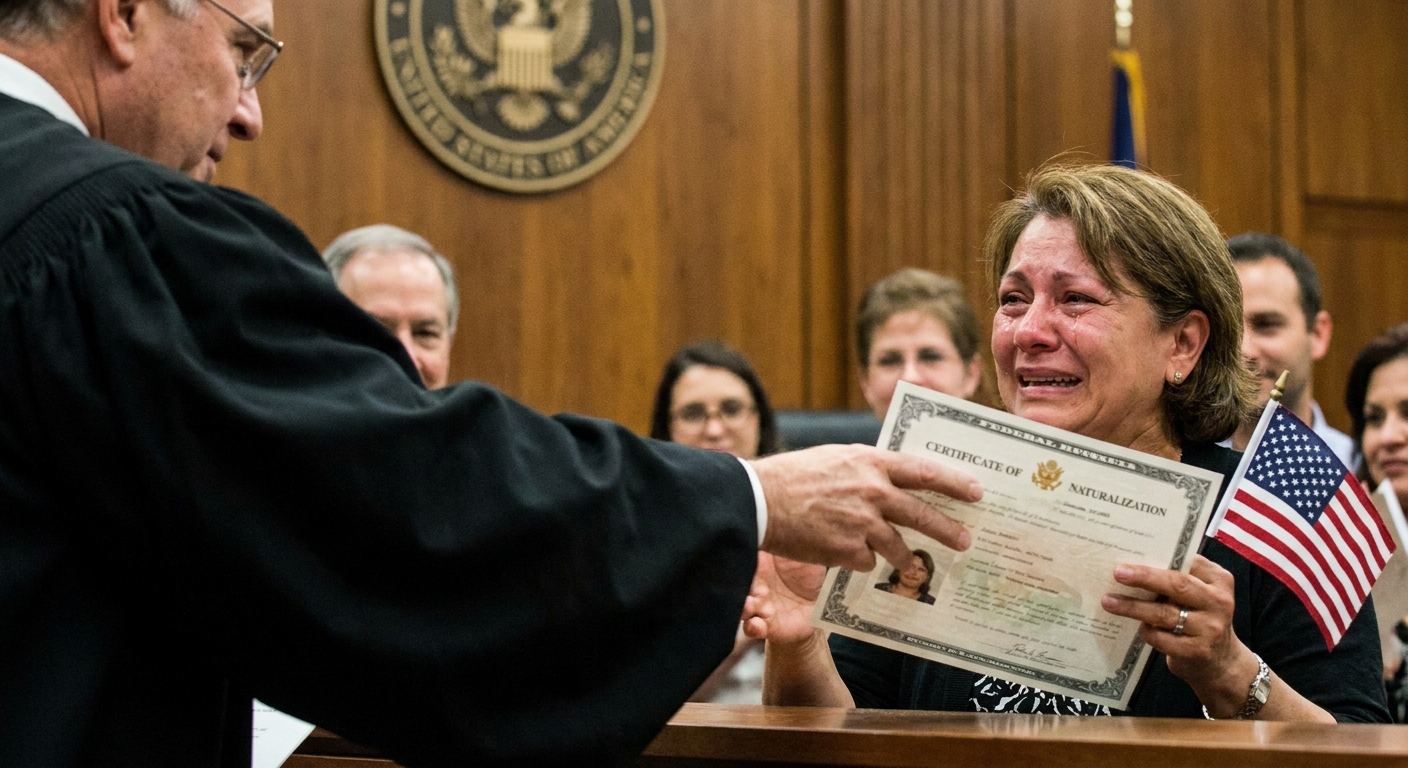
- Certificate of Naturalization: You receive your certificate. Before you leave, check it for errors and ask how to fix any mistakes you spot.
- Optional elements: The National Anthem, the Pledge of Allegiance, voter registration materials, and sometimes messages from elected officials.
Administrative vs judicial ceremonies: Some ceremonies are run by USCIS (administrative). Others are held in federal court (judicial). The legal effect is the same: the oath finalizes naturalization. One practical difference shows up with name changes. If you requested a legal name change through naturalization, you generally must attend a judicial ceremony because only a judge can grant it.
Why the oath focuses on the Constitution
There is a reason the oath does not say “I will support the President” or “I will support a party” or even “I will support the government.” It says the Constitution and laws.
That is the American bet: that loyalty to a set of principles and procedures can outlast individual leaders and political eras.
For naturalized citizens, this is often the most profound shift. You are not joining a tribe. You are joining a framework. The Constitution sets the rules for how power changes hands, how rights are protected, and how disputes are resolved. The oath makes that framework your own.
Common questions
Do I have to say every word exactly?
Ceremonies are often recited as a group. Minor stumbles are common. The important thing is that you take the oath sincerely, and that any requested modifications are handled through the proper process.
Can the oath be modified for religion or conscience?
Yes, in limited and lawful ways, especially regarding bearing arms, military service clauses, and religious phrasing. If you need a modification, raise it through USCIS and follow your ceremony instructions rather than improvising at the ceremony.
Is the oath the same as registering to vote?
No. Voting is a right and a responsibility, but voter registration is a separate step handled by states. Many ceremonies provide registration materials, but the oath itself does not automatically register you.
What if I cannot attend my ceremony date?
Follow the instructions on your notice to request rescheduling as soon as you know you cannot attend. Missing a ceremony without properly responding can delay naturalization and, in some cases, lead USCIS to close the case.
What should I do with my Certificate of Naturalization?
Protect it like a foundational identity document. You will need it for a U.S. passport application and to update records with agencies and institutions.
The point of the oath
The Naturalization Oath is not a loyalty pledge to a person. It is not a demand for cultural erasure. It is a constitutional handshake.
You renounce prior political allegiance, you accept the Constitution as your governing framework, and you agree to the responsibilities that come with membership in a republic that cannot function on rights alone.
In other words: the oath is not the end of your immigration story. It is the beginning of your civic one.