
Here is the civics question nobody in Washington likes to answer out loud: How much is a senator’s “independence” worth when the money shows up right before the budget add does?
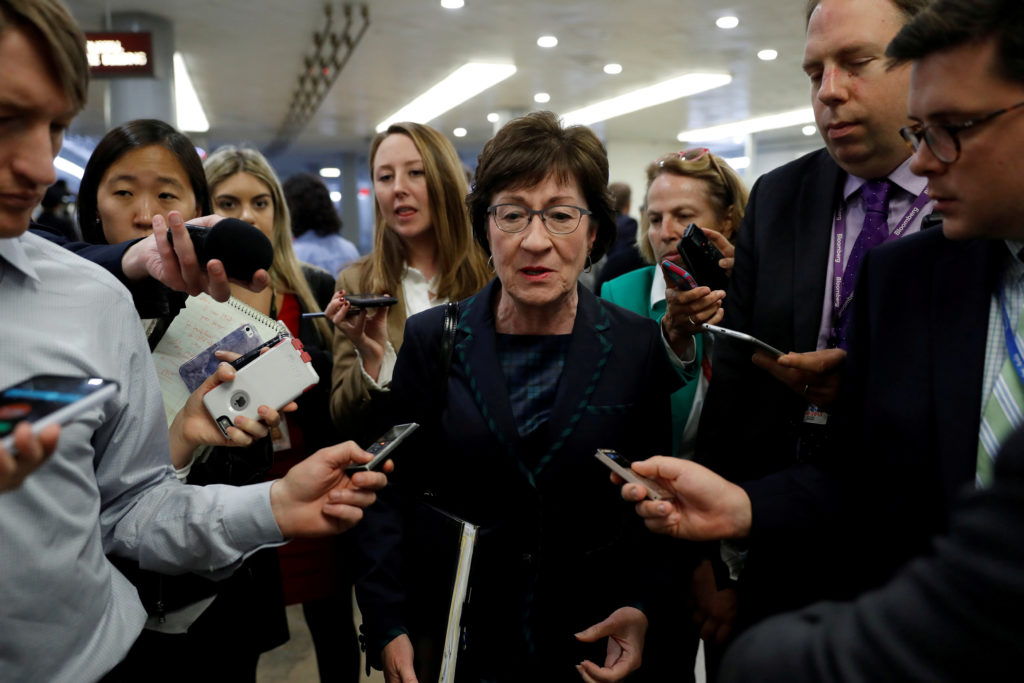
Sen. Susan Collins has built an entire brand on being the grown-up in the room. The reasonable Republican. The one who agonizes. The one who “crosses the aisle.” But the outline federal investigators assembled about a corruption probe touching her campaign donations does not read like independence. It reads, to investigators, like a relationship where access and cash move in the same tight orbit.
We are told, again and again, that our system can tolerate private money because sunlight and enforcement keep the rot in check. This episode tests that comforting story at every joint.
Join the Discussion
Core claims
The pattern investigators focused on is the kind they are trained to spot: a defense contractor gets help accessing federal dollars, and the politician connected to that help receives campaign contributions in close proximity. None of that is a conviction. It is a set of allegations and suspicions mapped onto a timeline.
In this case, the company at the center is Navatek, a Hawaii-based military contractor. Federal investigators examined Collins’s relationship with Navatek and whether she benefited politically after actions that, in investigators’ view, helped the company.
Two concrete actions are repeatedly part of the timeline and should not be blurred together: (1) an $8 million research-funding add that Collins placed into the federal budget and (2) help obtaining a multimillion-dollar contract in Maine.
In a 60-slide presentation agents prepared for prosecutors, they highlighted contributions that Navatek CEO Martin Kao and his wife made to Collins in 2018, right before Collins placed $8 million in research funding into the federal budget.
Separately, the timeline includes a different mechanism: one year before the 2019 fundraising meeting described below, Collins helped Navatek obtain a multimillion-dollar contract in Maine.
Then, in 2019, a federal indictment alleged that Kao sent Collins around $33,000 through illegal straw donors, using relatives as intermediaries.
How it surfaced
This did not start as a random fishing expedition. The broader scrutiny took shape after Kao was arrested in 2020 and federally indicted for allegedly bilking $12.8 million in Covid-19 relief funds.
When agents seized Kao’s computer and emails, they said they found evidence suggesting a “pay-to-play operation” involving members of Congress, including Collins. That phrase is investigators’ framing, and it is also the pivot point. It is what put this relationship under a harsher light and what made the campaign-money details look less like coincidence and more like a system.
Alleged mechanics
Most Americans imagine bribery as a briefcase. Real political bribery, when it happens, is usually bureaucratic and careful. The alleged goal is the same, but the method is designed to look like ordinary politics: donations, access, soft commitments, and paperwork that never uses the forbidden words.
Here, what investigators described matters because it sits at the intersection of criminal law and the everyday loophole culture of campaign finance. The key word is described. This is what agents and charging documents laid out, not something that has been proven in court as to Collins.
In 2019, while Collins was running for another term, Collins, her super PAC chief Scott Reed, and three Navatek executives met at a Corner Bakery in Washington, D.C. During that meeting, Reed asked for a $500,000 donation.
Government contractors face strict prohibitions when it comes to certain political contributions. Investigators scrutinized the allegation that, rather than having Navatek make a direct political contribution, the group agreed to route a contribution through a shell company.
If that was the role the shell company was meant to play, then what investigators were looking at was not just creative fundraising. It was, as they saw it, an attempt to defeat a legal barrier meant to keep the public’s business from becoming a private auction.
Why it matters
Yes, this is about one senator. But constitutionally, it is about something older and more important: whether representative government can survive a world where public power and private money become indistinguishable.
The Framers did not anticipate super PACs, shell entities, or the modern defense-contracting universe. But they absolutely worried about corruption. In plain terms, corruption is what happens when an officeholder starts treating a public position as a private asset.
And that is why this story matters even to people who do not care for Collins, or do not care for her party, or do not care for her record on judges. The constitutional system relies on a simple assumption: elections are how the people correct government. When money turns office into a marketplace, elections become less of a correction and more of an endorsement of whoever can afford the toll.
Collins is famous for insisting she is deliberative and careful with power. But deliberation is not a personality trait. It is a duty. The constitutional question is whether the duty gets compromised when the donor has a contract on the line, and whether the system is even capable of answering that question honestly.
The off switch
Here is where “sellout” stops being just a moral insult and becomes an institutional diagnosis.
Federal investigators continued working the broader matter until at least 2024. Two agents, Michelle Ball and Kevin Gounaud, viewed the evidence as sufficient to explore whether the alleged pay-to-play conduct reached beyond one lawmaker. The record reflects readiness to look wider, not a guarantee that a broader expansion fully launched.
Then the enforcement landscape changed. In 2025, the administration pushed out many of the Justice Department’s anti-corruption lawyers and broke up CR-15, an FBI public-corruption squad focused on congressional misconduct. Ball and Gounaud were later fired after being targeted in a broader retribution campaign inside federal law enforcement. Ball was accused of “weaponizing” the Justice Department for investigating an attempt to overturn the 2020 election.
If you want the constitutional lesson in one sentence, it is this: checks and balances cannot check anything when the checking institutions are dismantled.
People argue endlessly about “weaponization.” Fine. Here is the adult version of that debate: the way you prove enforcement is not political is by protecting its independence, not by firing the people doing the enforcing.
Collins and trust
Collins’s political story is filled with moments when she asks to be trusted on judgment. None looms larger than her role in confirming Justice Brett Kavanaugh in 2018. She presented herself as someone who weighed evidence carefully, insulated from pressure, and guided by principle. Later, after Dobbs ended the constitutional right to abortion, Collins expressed disappointment.
You can have your own views about abortion, judges, and party politics. But credibility is a finite resource. A senator who sells herself as uniquely careful cannot afford a set of allegations and investigative focus points that suggest a simpler explanation for political choices: transactional politics dressed up as civic virtue.
And that is what these details do to the Collins persona. They do not merely accuse. They reframe. They ask the public to reconsider whether “moderation” was ever the point, or whether it was the marketing.
Accountability
In a functioning system, allegations like these trigger three forms of accountability:
- Criminal accountability when money is concealed, laundered through straw donors, or traded for official acts.
- Institutional accountability through ethics inquiries, subpoenas, and oversight that does not care which party benefits.
- Political accountability through voters deciding that “experience” is not a permission slip for conduct that would get an ordinary employee fired.
The problem is that each layer can be neutralized. Prosecutors can be reassigned. Units can be dissolved. Ethics reviews can be slow-walked. And voters are asked to choose between two national parties, even when the local problem is a specific individual.
So yes, call it a sellout if you want. But do not stop there. The deeper issue is that we have built a republic that pretends corruption is an exception, while designing incentives that make it a career strategy.
The question
When Collins next describes herself as an independent voice, here is the question every constituent should press into the conversation:
Independent from whom?
Independent from party leadership is not the gold standard. Independent from donor leverage is. Independent from the subtle, numbing assumption that federal dollars are a reward to be traded is. Independent from the idea that the public interest is just another bargaining chip is.
The Constitution is a mirror. If you do not like what you see in this story, the fix is not just one election. The fix is rebuilding the expectation that public office is not a private revenue stream, and that law enforcement cannot be turned on and off depending on who the investigations might inconvenience.