
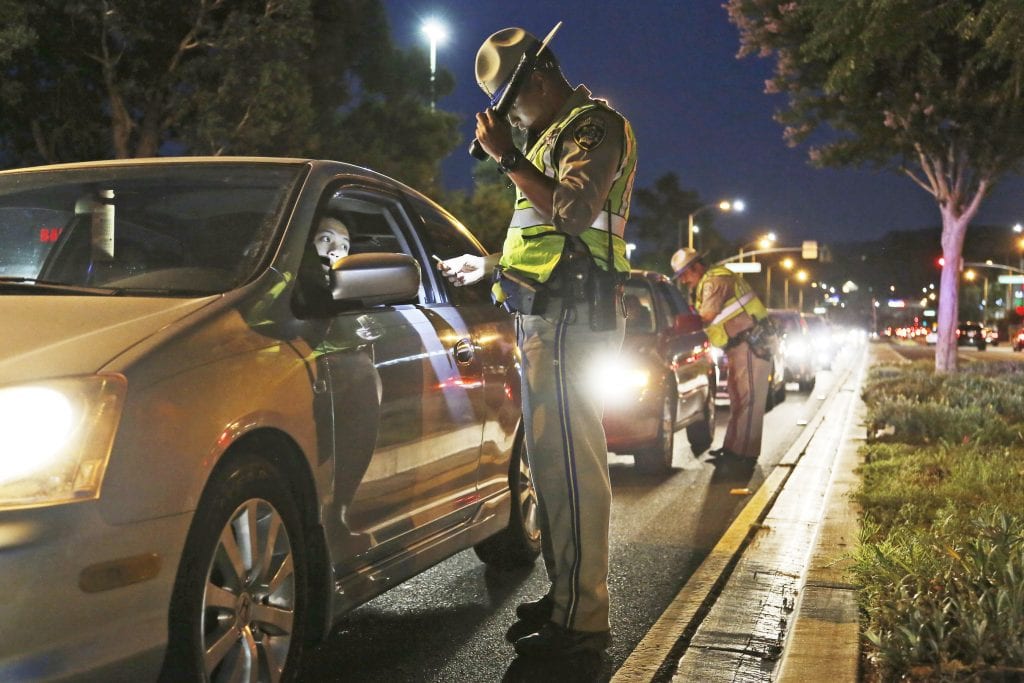
Sobriety checkpoints sit in a narrow, counterintuitive constitutional exception that surprises almost everyone the first time they hit one. You did not do anything wrong, no officer saw you weaving, and yet you are being stopped by the government on a public road.
Under the Fourth Amendment, that is a seizure. The only reason it can be lawful is that the Supreme Court has tolerated certain checkpoint programs, so long as the intrusion on drivers is small, the rules are neutral, and the public safety payoff is real.
Important practical note: Even though sobriety checkpoints are permitted under federal law, they are outright banned or severely restricted in a number of states by state constitutions, state court decisions, or statutes. Examples commonly cited include Texas and Washington, and some states have had major state-law limits even where federal law would allow a checkpoint. Always check your state rules because they can be stricter than the Fourth Amendment floor.
Join the Discussion
The constitutional starting point
The Fourth Amendment prohibits unreasonable searches and seizures. A routine traffic stop is a seizure, and so is a checkpoint stop, even if it lasts only a minute.
Normally, police need individualized suspicion to stop a particular car. Checkpoints flip that presumption. Instead of suspicion aimed at one driver, the government relies on a structured program aimed at a roadway safety problem.
The Supreme Court rule: a balancing test
The modern checkpoint framework comes from Michigan Dept. of State Police v. Sitz (1990), where the Court upheld sobriety checkpoints as reasonable under the Fourth Amendment.
The Court used a balancing approach, weighing:
- The government interest (keeping impaired drivers off the road)
- The degree the program advances that interest (courts do not demand perfection, and Sitz showed substantial deference to reasonable program judgments)
- The level of intrusion on ordinary motorists (time, fear, inconvenience, and discretion)
That last factor is the part most drivers feel, and the part courts often scrutinize closely. When a checkpoint is brief, predictable, and run by neutral rules rather than officer whim, it looks more reasonable. When it becomes discretionary, prolonged, or exploratory, it starts to look like a fishing expedition.
Not every checkpoint is constitutional
Checkpoint legality depends heavily on purpose. The Supreme Court draws a constitutional line between checkpoints aimed at roadway safety and checkpoints aimed at ordinary crime control. In practice, the test is the checkpoint’s primary programmatic purpose.
Programs the Court has allowed
- Impaired driving checkpoints (Sitz)
- Border-related immigration checkpoints near the border (United States v. Martinez-Fuerte, 1976)
- License and registration checkpoints are often upheld by lower courts if run neutrally. The Supreme Court disapproved random spot checks in Delaware v. Prouse (1979), while suggesting that checkpoint-style, neutral criteria can change the analysis.
Programs the Court has rejected
In City of Indianapolis v. Edmond (2000), the Court struck down a checkpoint program whose primary programmatic purpose was general drug interdiction. The message was simple: the Fourth Amendment does not let police stop everyone on the road just because they want to catch ordinary criminals.
Planning and notice
One of the most important themes in checkpoint cases is reducing officer discretion. Courts do not want on-the-spot decisions about who gets stopped, who gets waved through, and who gets pulled aside. The more the checkpoint is governed by pre-set rules, the more defensible it becomes.
Notice
Many states and departments provide public notice, sometimes by announcing the general area or date range. Notice can reduce the fear and surprise element that the Supreme Court has treated as part of the intrusion, and it also signals that the checkpoint is programmatic rather than improvised.
But the federal Constitution does not contain a simple rule that “no notice equals illegal.” Instead, notice is one factor in the overall reasonableness picture, and state constitutions or state statutes may impose stricter requirements.
If you are trying to assess a checkpoint’s legality in a particular state, look for two layers:
- Fourth Amendment floor set by the U.S. Supreme Court
- State-level rules that can provide more protection than the federal minimum, including outright bans in some states
Planning features courts like
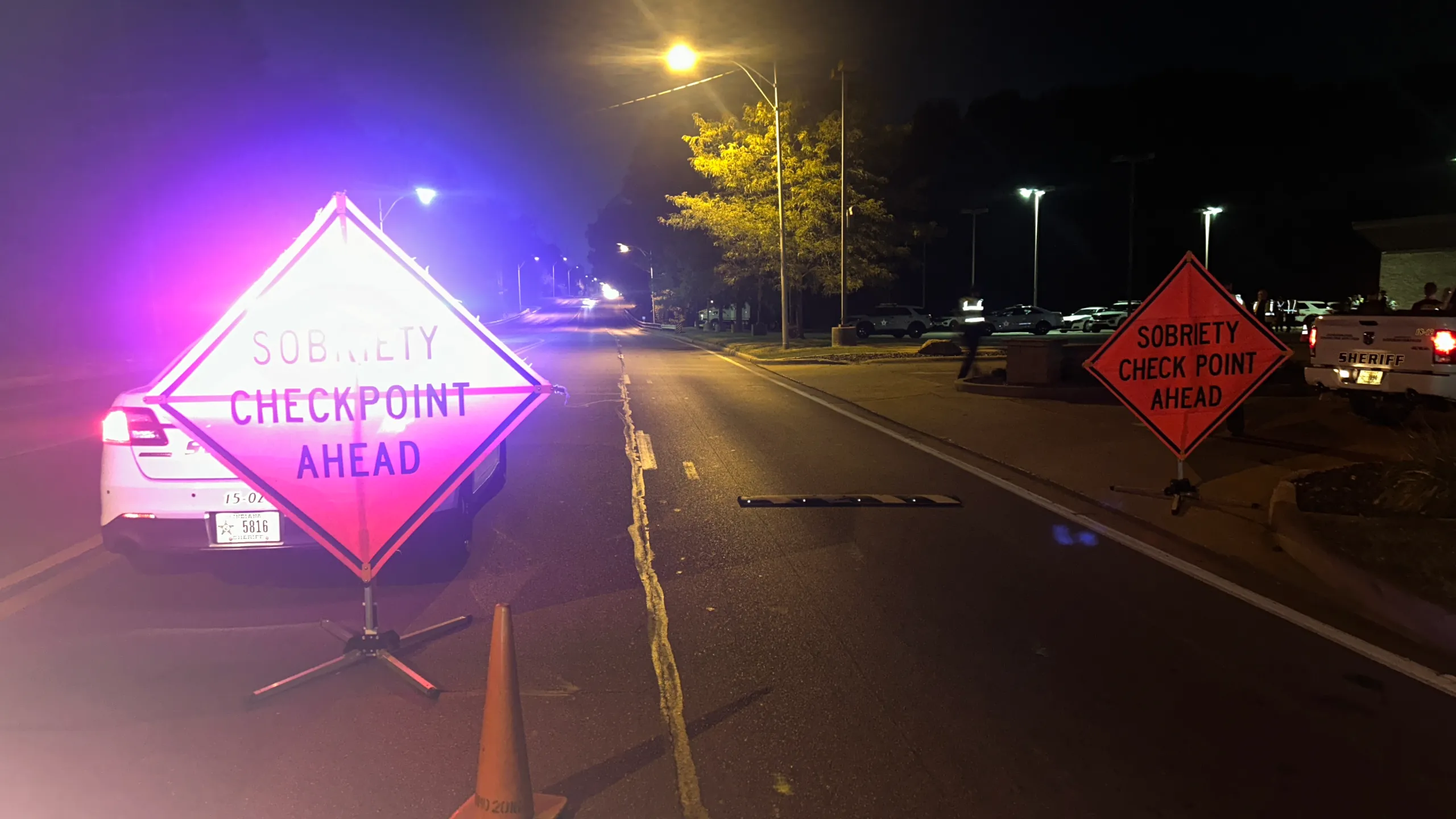
- Supervisor control over the decision to establish the checkpoint, instead of leaving it to officers in the field
- Neutral stopping pattern, such as stopping every car or every third car, rather than picking vehicles based on hunches
- Safety precautions, including visible uniforms, marked patrol cars, lighting, cones, and a clear traffic plan
- Minimal delay for most drivers, with a quick initial screening
- Clear location rationale, such as high DUI crash corridors, rather than arbitrary placement
What police may ask
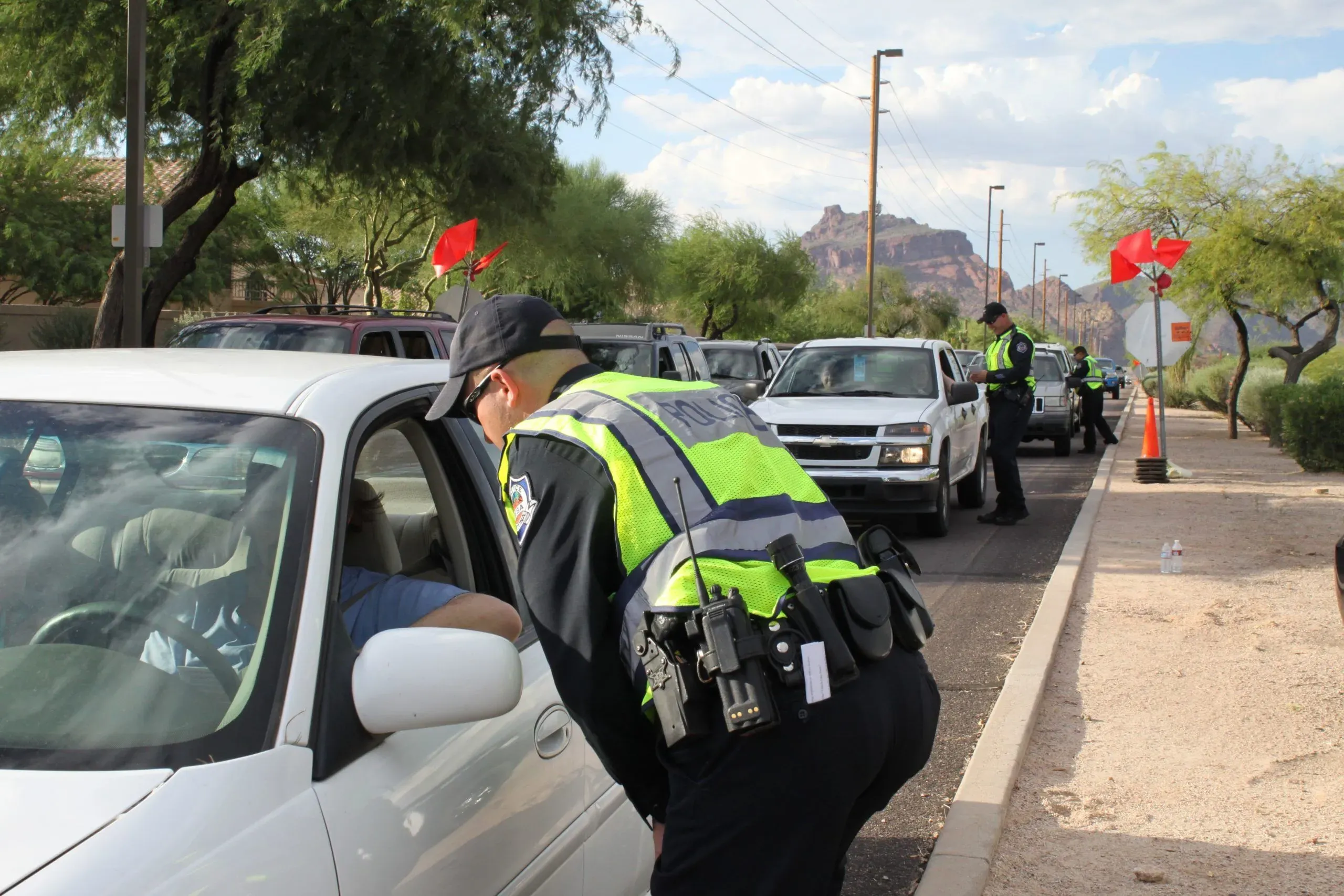
A checkpoint stop typically begins like a rapid, standardized traffic encounter. An officer may ask brief questions and look for observable signs of impairment.
What you generally must provide
- Driver’s license
- Vehicle registration
- Proof of insurance (where state law requires it to be carried or displayed)
What you may be asked to do
- Answer basic identifying questions (for example, confirming your name). You may often decline to answer investigatory questions such as “have you been drinking?” Depending on the state and the situation, silence can lead the officer to continue the screening or direct you to secondary, but criminal penalties for politely declining to answer are uncommon.
- Roll down your window enough for communication. Officers may also use plain senses, including smelling alcohol or observing bloodshot eyes.
- Follow simple safety directions, such as pulling forward, turning off the engine, or moving to a secondary screening area.
Key distinction: a checkpoint is supposed to be brief for drivers who show no signs of impairment. If the officer develops reasonable suspicion of DUI during that brief interaction, the encounter can expand much like an ordinary traffic stop.
Tests: where the law tightens
Checkpoint screening can lead to a request for further testing. What you are required to do depends on the kind of test and your state’s implied consent laws.
Field sobriety tests
Standardized field sobriety tests, such as walk-and-turn or one-leg stand, are usually treated as investigative steps used once police have reason to suspect impairment. In many states, you can refuse FSTs without the same automatic penalties that come with refusing a chemical test, but refusal can still influence what happens next.
Preliminary breath tests
A handheld roadside breath test is often treated as a screening tool. Rules vary widely: in many states, officers generally need reasonable suspicion to request or rely on a PBT, and refusal is often treated differently than refusal of an evidentiary test. The safest way to think about it is that a PBT is commonly less mandatory than an evidentiary breath or blood test, but state law controls the consequences.
Evidentiary breath or blood tests
The Supreme Court has held that breath tests incident to DUI arrest are generally permissible, while blood tests are more intrusive and usually require a warrant absent an exception. The rules here are heavily influenced by Birchfield v. North Dakota (2016) and related cases on warrants and implied consent.
One more nuance matters: even when criminal penalties for refusing certain tests are limited, civil or administrative penalties (like license suspension) can still apply under state implied consent schemes.
Limits on searches
A sobriety checkpoint is not a blank check to search your car. The Fourth Amendment still controls what police can do inside the vehicle and what they can demand from you.
What police can do during a typical stop
- Look through windows from lawful vantage points, using ordinary observation
- Use what they can smell or hear during conversation, including odor of alcohol or marijuana
- Direct you to a safer location, including a secondary screening lane
When a search may become lawful
Police generally need probable cause, a warrant, or a recognized exception. Common exceptions in checkpoint contexts include:
- Consent: If you voluntarily agree to a search, the Fourth Amendment barrier drops. You can refuse consent.
- Probable cause plus the automobile exception: If officers develop probable cause that evidence of a crime is in the car, they may search areas where that evidence could be found.
- Search incident to arrest: After an arrest, a vehicle search is limited and depends on whether evidence relevant to the arrest might be found in the vehicle.
- Plain view: If contraband is clearly visible from outside, that can change the legal posture quickly.
What a checkpoint cannot justify by itself
- Random vehicle searches without individualized justification
- Drug-sniffing as the primary mission of the checkpoint, or using the checkpoint as a pretext for general crime control (Edmond)
- Extending the stop longer than necessary for the checkpoint purpose unless new suspicion arises. This principle also shows up in traffic stop law, including Rodriguez v. United States (2015), which rejected prolonging a stop for a dog sniff without independent justification.
Secondary screening
Many checkpoint setups have two stages: a primary lane for quick contact and a secondary area for closer evaluation. Moving you to secondary does not automatically mean you are under arrest, but it usually reflects that the officer believes more investigation is warranted.
Courts tend to tolerate secondary screening when it is:
- Triggered by objective observations (odor of alcohol, slurred speech, open container, admission of drinking)
- Conducted efficiently and not used as a general investigative dragnet
- Closely tied to the checkpoint mission of roadway safety
Checkpoints vs. traffic stops
Checkpoint stop
- Trigger: Programmatic stop of multiple vehicles under a neutral plan
- Fourth Amendment theory: Reasonableness balancing under cases like Sitz
- Officer discretion: Supposed to be minimized by advance planning
- Length: Should be brief unless new suspicion develops
- Main risk: Sliding from safety screening into general crime control
Ordinary traffic stop
- Trigger: Individualized suspicion, such as a traffic violation or reasonable suspicion of crime
- Fourth Amendment theory: Investigatory stop principles tied to Terry v. Ohio and traffic stop doctrine
- Officer discretion: Higher, because the stop is based on the officer’s observations
- Length: Limited to the mission of the stop unless new facts justify extension
- Main risk: Prolonging the stop or expanding it without adequate justification
Practical takeaways
Checkpoint law is less about clever scripts and more about structure: what the government planned, what the officer observed, and how quickly the stop moved.
- Expect a brief seizure even if you did nothing wrong. That is the checkpoint model.
- Have your documents ready. License and registration usually end the primary screening quickly.
- Keep it calm and safe. Follow safety instructions, keep your hands visible, and focus on getting through the initial screening.
- Know the line between screening and searching. A checkpoint does not automatically authorize a search of your vehicle, and you can refuse consent.
- Watch for mission creep. The more the stop looks like general crime control rather than DUI screening, the shakier the constitutional footing.
If a checkpoint stop turns into a search or arrest, the legal questions become highly fact-specific: the exact instructions given, the timeline, the observations recorded, whether the checkpoint was run under a neutral plan, and whether your state allows checkpoints at all.
Why the details matter
Sobriety checkpoints are a constitutional compromise. The Court tolerated suspicionless stops because the intrusion can be small and the public danger is large, but only if the program is run with discipline. The Fourth Amendment question, in other words, is not whether drunk driving is dangerous. It is whether the government can address that problem without turning every driver into a suspect by default.
That balancing act is the real story of checkpoints. It is also the reason the details matter, because a checkpoint is constitutional only as long as it stays in its lane.