
Gerrymandering is one of those civic words that gets used like a moral verdict. A map “looks wrong,” so it must be unconstitutional.
But the Supreme Court has drawn a sharp line between two accusations that sound similar in everyday speech: partisan gerrymandering (drawing districts to help a political party) and racial gerrymandering (using race as the dominant reason to draw districts).
That line explains a modern frustration that shows up every redistricting cycle: federal courts often can police racial discrimination in mapping, but often will not police partisan advantage as such. Not because the Court thinks partisan gerrymandering is healthy. Because it thinks federal judges are not equipped, under the Constitution, to decide when partisanship has gone “too far.”
Join the Discussion
Two kinds of gerrymandering
Partisan and racial gerrymandering can overlap in the real world, but the legal theories are not interchangeable.
Partisan gerrymandering
Partisan gerrymandering is about political identity: the map is drawn to entrench Democrats or Republicans, usually by packing the other party’s voters into a few districts and spreading the rest thin across many.
It feels like the kind of thing the Constitution should forbid, because it can blunt majority will and lock in power for a decade. The problem is doctrinal: the Constitution does not contain a manageable rule for how much partisanship is “acceptable” in redistricting, and political considerations have always been part of the redistricting process.
Racial gerrymandering
Racial gerrymandering is about race as a controlling factor in drawing lines. This can show up in at least two ways:
- Vote dilution: lines are drawn to weaken the electoral power of racial minority voters, often by cracking a cohesive community across districts or packing it into one district unnecessarily.
- Racial sorting: lines are drawn with race as the predominant reason, even if the state claims it was pursuing political goals.
Unlike partisanship, race triggers explicit constitutional and statutory guardrails. The Equal Protection Clause of the Fourteenth Amendment is the core constitutional tool here. The Fifteenth Amendment, which bars denying or abridging the right to vote on account of race, is part of the broader constitutional backdrop for race and elections. And Congress, using its enforcement power, has added the Voting Rights Act.
Why federal courts often say no
The Court’s modern “no” is not a single case so much as a conclusion reached over decades: partisan gerrymandering claims present a political question that federal courts are not supposed to resolve.
A political question is not simply an issue that feels political. In this context, it means the Court views the claim as nonjusticiable because there is no judicially discoverable and manageable standard for deciding it. In other words, the problem is not a lack of concern. It is the lack of a workable legal rule that judges can apply in a consistent way.
Vieth v. Jubelirer
In Vieth v. Jubelirer (2004), the Court confronted a partisan gerrymandering challenge to Pennsylvania’s congressional map. A plurality concluded that partisan gerrymandering claims were not justiciable in federal court because no manageable standard existed to separate “normal politics” from unconstitutional entrenchment.
Importantly, Vieth did not end the story. Even in 2004, some justices believed a workable test might eventually emerge. For a while, reformers thought they had found one in metrics like partisan symmetry and the efficiency gap.
Rucho v. Common Cause
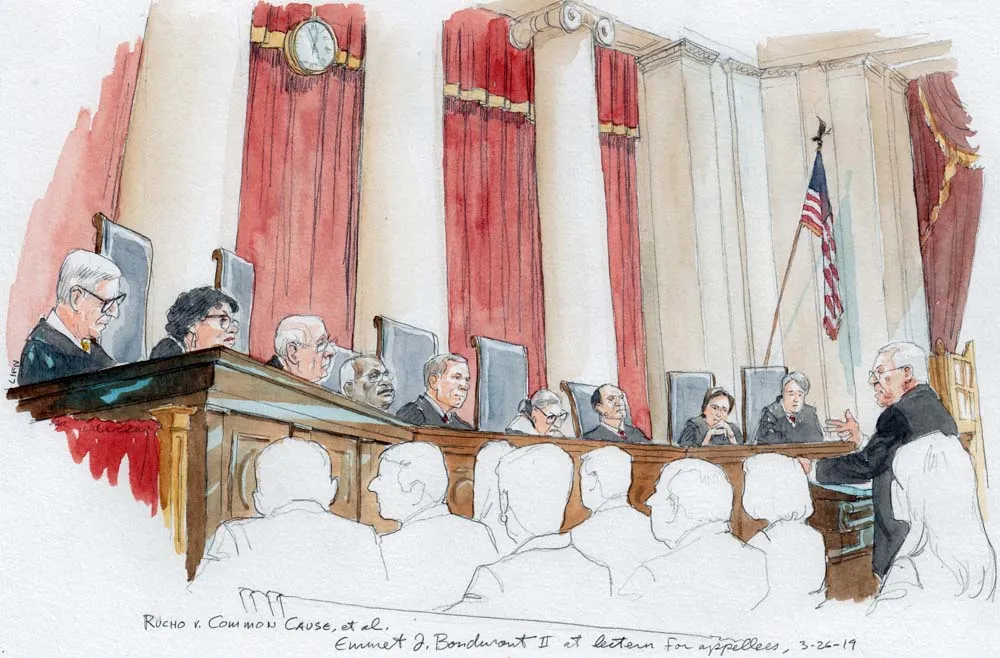
In Rucho v. Common Cause (2019), the Court took the question again and answered it more definitively. The majority held that claims of partisan gerrymandering present political questions beyond the reach of federal courts.
The reasoning had two main parts:
- Partisan considerations are not new. The Court treated politics as an unavoidable feature of districting rather than an aberration that courts can cleanly remove.
- No “how much is too much” rule. Even if extreme gerrymanders are ugly, the Court said the Constitution does not supply a clear judicial standard for determining when partisanship becomes unconstitutional.
Here is the practical effect: after Rucho, if your claim is “this map is unfair because it entrenches a party,” federal court is usually the wrong courthouse door. (But other federal claims, like racial gerrymandering, Voting Rights Act challenges, and one-person-one-vote claims, are a different category and can still be heard.)
What Rucho did not do
It is easy to misread Rucho as a blessing of gerrymandering. It is not. The Court called partisan gerrymandering incompatible with democratic principles, then said federal judges are not the ones who can fix it.
Rucho also did not wipe out other election law claims. It did not say maps are immune from review. It said partisan gerrymandering claims, as such, are not for federal courts.
Where race claims can succeed
If partisan gerrymandering is the claim federal judges tend to decline, racial discrimination is the claim they still actively police. But the path matters. “Race” shows up in redistricting law in more than one way, and those theories can pull in different directions.
1) Equal Protection racial sorting
The Court has held that states cannot use race as the predominant factor in drawing district lines unless the use of race satisfies strict scrutiny.
This is why states often insist their maps are politically motivated, not racially motivated. If a state can persuade a court that it was pursuing partisan advantage, that may be lawful after Rucho. If plaintiffs can show that race, not politics, drove the lines, the case looks very different.
These cases are fact-intensive. Courts look for evidence like:
- Unusually shaped districts that track racial data closely.
- Legislative records showing explicit racial targets.
- Map drawers using racial composition thresholds without a compelling justification.
2) VRA Section 2 vote dilution
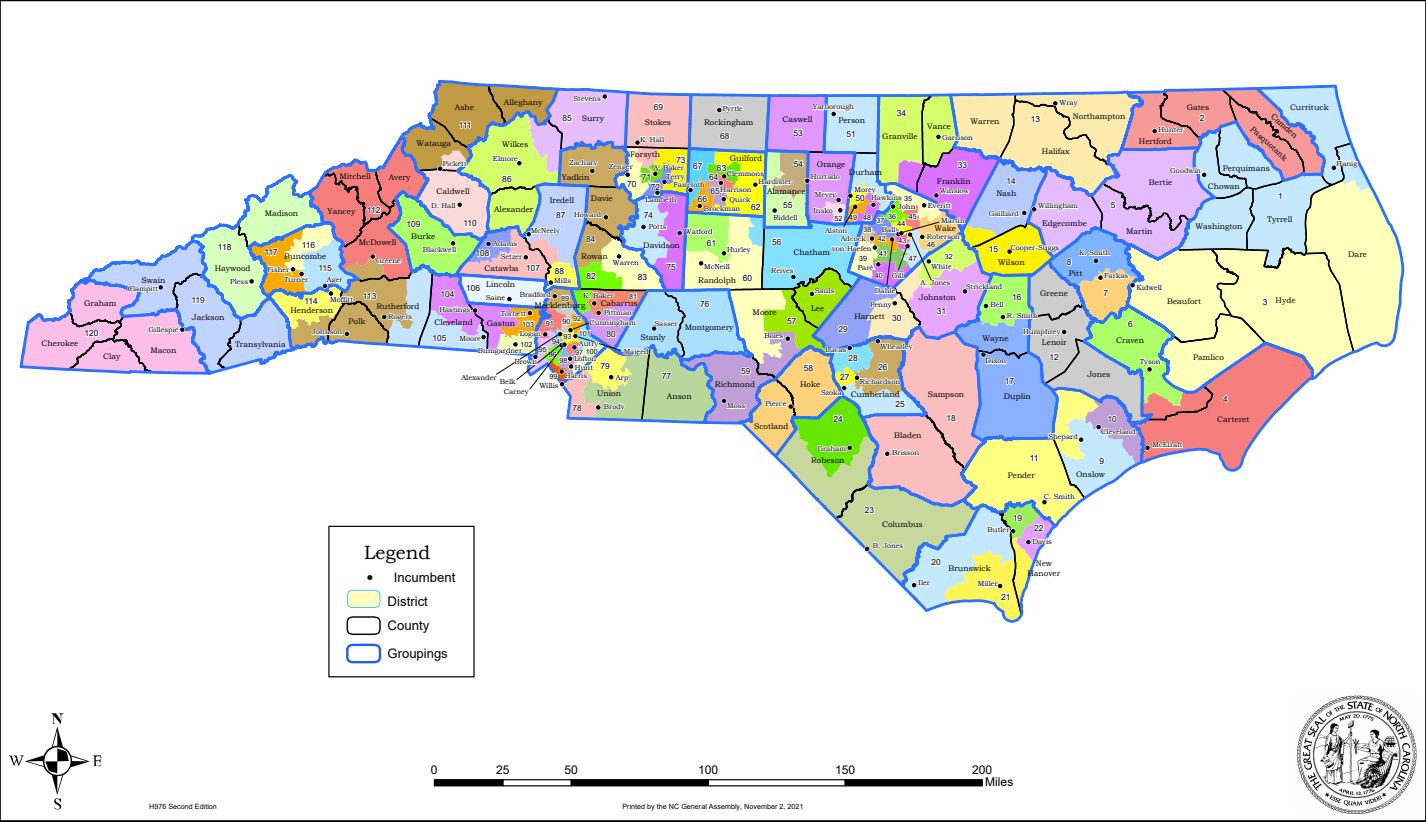
Section 2 of the Voting Rights Act prohibits voting practices that result in minority voters having less opportunity than others to elect representatives of their choice. In districting, this often becomes a vote dilution case: cracking or packing minority communities so they cannot form an effective electoral coalition.
Section 2 cases have their own legal tests, including whether a minority group is sufficiently large and geographically compact to form a majority in a district, whether it is politically cohesive, and whether white bloc voting usually defeats the minority’s preferred candidate. That framework comes from Thornburg v. Gingles (1986), and the Court reaffirmed its basic viability in the redistricting context in Allen v. Milligan (2023).
At the same time, Section 2 doctrine has tightened in some areas. In the vote-denial context (rules about how voting happens, not line drawing), the Court narrowed Section 2’s reach in Brnovich v. Democratic National Committee (2021). That does not replace Gingles for districting, but it signals an overall skepticism toward expansive Section 2 theories and anything that resembles a guarantee of proportional representation.
3) Intentional discrimination
Even when a map is defended as “politics,” plaintiffs sometimes attempt to prove intentional racial discrimination. That is a demanding burden. Yet it remains one of the clearest constitutional red lines: if lawmakers used race to target or punish a group’s political power, the Constitution still has something to say about it.
The tension in modern cases
Modern redistricting fights rarely come with a label that reads “racial gerrymander.” They come with emails about “performance,” spreadsheets about voter history, and testimony about “communities of interest.”
In many states, race correlates strongly with party preference. That creates a recurring legal puzzle: when is the map targeting voters because of their race, and when is it targeting them because of their likely partisan behavior?
There is also a second tension that confuses readers on purpose and sometimes confuses legislatures for real: Equal Protection doctrine can punish race being used too much, while Section 2 can sometimes push states to consider race to avoid diluting minority voting power. Many of today’s hardest disputes live in that narrow space between “race cannot predominate without strong justification” and “race-blindness can still produce unlawful dilution.”
After Rucho, the line between race and party matters more than ever. If a state can successfully characterize its choices as partisan, federal courts may treat a pure partisan-fairness challenge as outside their reach. Plaintiffs, meanwhile, try to show that race was not merely correlated with politics, but used as a direct sorting tool.
Who can act
The Court’s own answer in Rucho was blunt: the remedy is political, not judicial. That points to four arenas where change is still possible.
State courts and state constitutions
Rucho did not restrict state courts interpreting state constitutions. Many state constitutions contain election provisions that are broader than the federal Equal Protection Clause, including explicit promises of free elections or protections against partisan manipulation.
As a result, some of the most important anti-gerrymandering rulings now come from state supreme courts, not federal ones. A concrete example is Pennsylvania’s 2018 congressional redistricting decision under the state constitution (League of Women Voters v. Commonwealth).
Congressional action
Congress has constitutional authority over the “Times, Places and Manner” of congressional elections (Article I, Section 4), subject to constitutional limits. That creates room for federal standards governing congressional redistricting, even if federal courts will not invent those standards on their own.
That Elections Clause power is primarily about congressional maps, not state legislative maps. Federal limits on state legislative redistricting generally arise through other constitutional and statutory routes, like Equal Protection and the Voting Rights Act.
Independent commissions
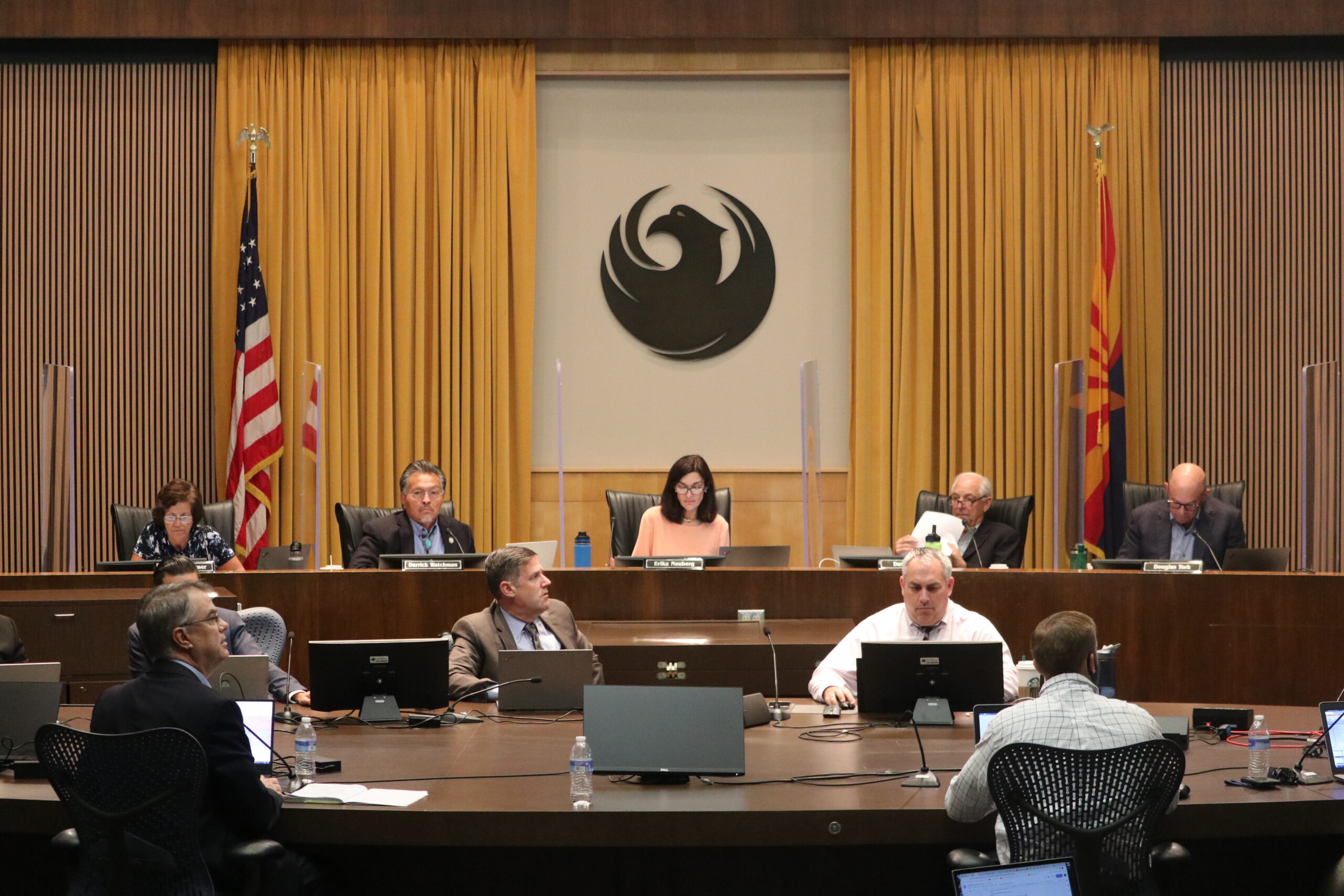
If the problem is that elected officials have an incentive to choose their voters, commissions try to break that incentive loop.
Commissions vary widely, but they typically aim to:
- Move line-drawing away from incumbent legislators.
- Require transparent criteria like compactness and respect for communities of interest.
- Reduce the temptation to maximize partisan advantage.
The Constitution does not require commissions, and commissions do not guarantee fair outcomes. But as a policy alternative, they are one of the few reforms that directly address the structural conflict of interest at the heart of partisan gerrymandering.
Ballot initiatives and state laws
In states that allow direct democracy, voters can sometimes create commissions or tighten mapping rules through ballot initiatives. Elsewhere, state legislatures can adopt criteria that limit partisan map-drawing, including public map submissions, disclosure rules for consultants, and clearer standards for preserving communities.
What to watch next
After Rucho, the most consequential redistricting battles often turn on how a claim is framed and where it is filed.
- Is the claim about party advantage? Expect federal courts to cite nonjusticiability.
- Is the claim about racial discrimination or vote dilution? Federal courts can still hear it, but plaintiffs must meet specific evidentiary burdens.
- Is the claim grounded in a state constitution? State courts may provide the primary venue for partisan fairness claims.
- Is there a commission model on the table? Reform debates increasingly shift from litigation to institutional design.
The civics lesson
The Supreme Court’s partisan gerrymandering doctrine forces a distinction many Americans do not want to make: something can be corrosive to democracy and still be beyond what federal courts think they can fix.
If that feels like a dodge, it is worth sitting with the constitutional logic. Courts are not empowered to solve every democratic failure, especially when the Constitution does not provide a clear rule for what the solution must look like.
So the question that remains is not only whether gerrymandering is wrong. It is where, exactly, a republic chooses to correct itself: in federal court, in state court, in Congress, or in the architecture of redistricting itself.