
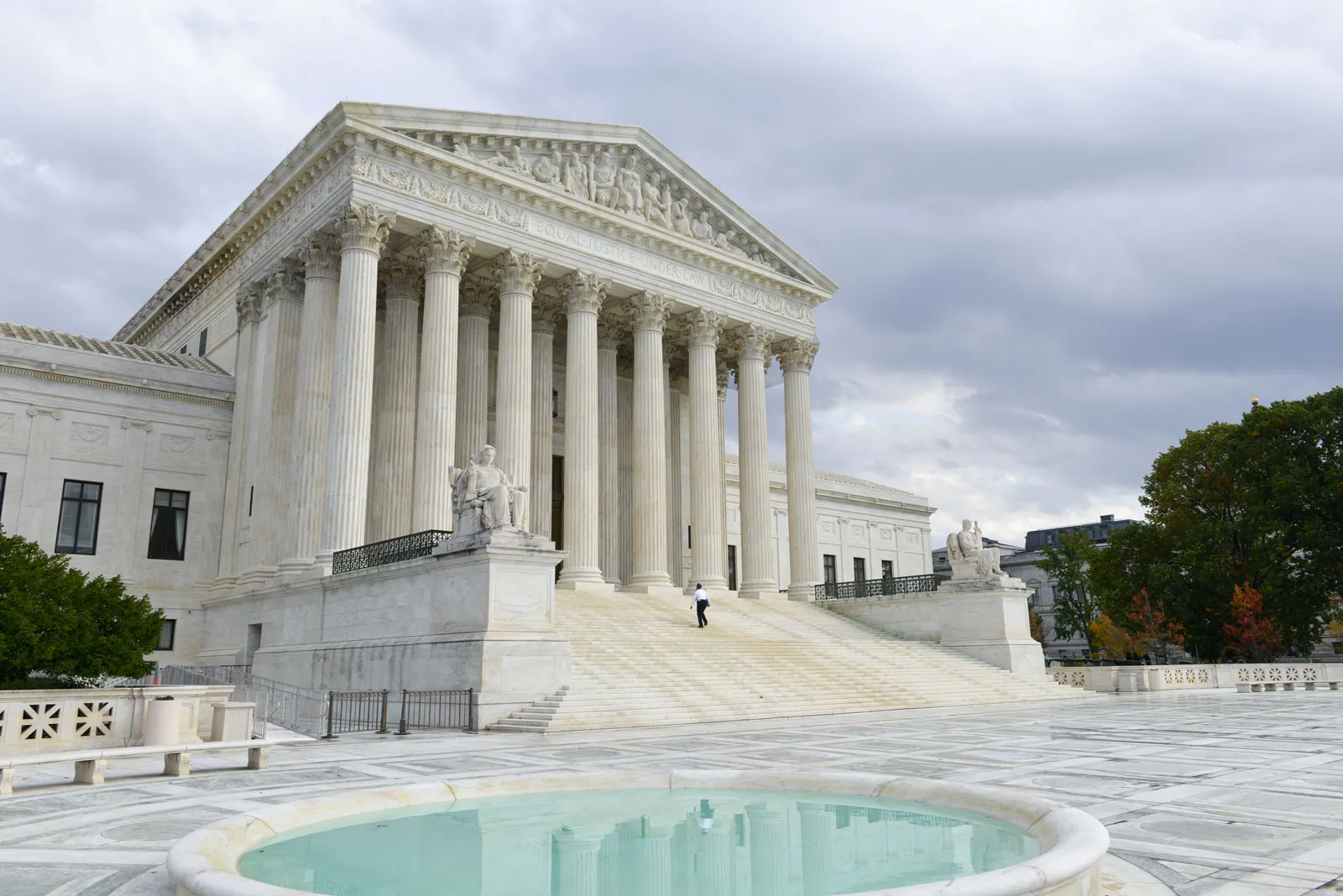
A multistate coalition led by Montana Attorney General Austin Knudsen is asking the U.S. Supreme Court to take up Beckwith v. Frey, a challenge to Maine’s 72-hour waiting period for firearm purchases. The coalition filed an amicus brief urging the justices to grant certiorari.
The filing comes after a three-judge panel of the U.S. Court of Appeals for the First Circuit upheld the waiting period. The amici states say they are stepping in “to safeguard their citizens’ fundamental rights.”
Join the Discussion
The case
The brief urges Supreme Court review of Maine’s law requiring a 72-hour wait before a buyer can take possession of a firearm. With the First Circuit leaving the law in place, Knudsen and other state officials are asking the Court to weigh in on how the Second Amendment applies to waiting periods.
Montana is joined by “States of Montana, Alabama, Alaska, Arkansas, Florida, Georgia, Idaho, Indiana, Iowa, Kansas, Kentucky, Louisiana, Mississippi, Missouri, Nebraska, North Dakota, Ohio, South Carolina, South Dakota, Tennessee, Texas, Utah, West Virginia, Wyoming, and the Arizona Legislature…”
What the states argue
The amici states frame the dispute as a question about the scope of the right to “keep” and “bear” arms. In their view, that right includes the ability to take possession of arms, not just to own them in the abstract.
They put the point in direct terms: “Forcing a person to delay taking possession of a firearm is clearly ‘a[] restriction[]’ on possession.”
Heller and Bruen
The brief points to Heller (2008), emphasizing the Court’s recognition of “‘the right of law-abiding, responsible citizens’ to keep and bear arms.”
It also relies on Bruen (2022), highlighting the Court’s rejection of rules that would treat the Second Amendment as “a second-class right, subject to an entirely different body of rules than the other Bill of Rights guarantees.”
Applying that framework, the amici states argue that “Maine cannot justify its cooling-off law based on the nation’s historical tradition of firearm regulation.”
Reese and purchase rights
The amici states also cite circuit-court decisions they say support treating acquisition as part of the protected conduct. They note the Fifth Circuit’s statement in Reese v. ATF that the Second Amendment “‘covers’ the conduct (commercial purchases) to begin with.”
The brief quotes the Fifth Circuit’s reasoning that “constitutional rights impliedly protect corollary acts necessary to their exercise” and warns of “the baleful implications of limiting the right at the outset by means of narrowing regulations not implied in the text,” adding that “step by step, other limitations on sales could easily displace the right altogether.”
Corfield and acquisition
The brief also points to Corfield v. Coryell (1823), where Justice Bushrod Washington wrote that fundamental rights included “the enjoyment of life and liberty, with the right to acquire and possess property of every kind, and to pursue and obtain happiness and safety.”
The amici states use that passage to reinforce their contention that acquiring property and possessing it are linked concepts in law, including in the Second Amendment context.
What the brief asks
The amici states say the Court should take the case “to provide guidance on two important aspects of Second Amendment doctrine.” First, they argue the plain text of the right to “keep” and “bear” arms includes the right “to take possession of such arms in the first place.” Second, they argue that a mandatory delay on possession is itself a restriction on possession.
The states also note they rely on other Supreme Court decisions and additional circuit-court rulings alongside the cases discussed in the brief.
Signatories include Steve Marshall (Alabama), Cori Mills (Acting Alaska), Steve Montenegro (Speaker of the Arizona House of Representatives), Warren Petersen (President of the Arizona Senate), Tim Griffin (Arkansas), James Uthmeier (Florida), Chris Carr (Georgia), Raul R. Labrador (Idaho), Theodore E. Rokita (Indiana), Brenna Bird (Iowa), Kris Kobach (Kansas), Russell Coleman (Kentucky), Liz Murrill (Louisiana), Lynn Fitch (Mississippi), Catherine L. Hanaway (Missouri), Mike T. Hilgers (Nebraska), Drew Wrigley (North Dakota), Andy Wilson (Ohio), Alan Wilson (South Carolina), Marty J. Jackley (South Dakota), Jonathan Skrmetti (Tennessee), Ken Paxton (Texas), Derek Brown (Utah), John B. McCuskey (West Virginia), and Keith Kautz (Wyoming).